

Table of Contents
In many organizations today, technology stacks grow organically rather than strategically. A CRM is added to manage leads, an accounting tool to handle finances, a project management platform for operations, and multiple spreadsheets to bridge gaps between systems. Initially, this patchwork approach appears efficient. Over time, however, it creates operational fragmentation.
When business data lives in multiple disconnected systems, teams spend more time reconciling information than making decisions. Sales reports do not match finance numbers. Inventory updates lag behind orders. Customer information is duplicated across platforms.
The result is hidden operational loss—missed revenue opportunities, inefficient workflows, and delayed decision-making.
Integrated ERP systems are designed to solve exactly this problem.
The Problem: Fragmented Digital Ecosystems
Modern organizations often operate with 8–15 different software platforms across departments. Each system captures valuable data, but none provides a complete picture of the business.
Operational Fragmentation Snapshot
| Department | Tool Used | Problem Created |
| Sales | CRM platform | Data not synced with accounting |
| Finance | Accounting software | Revenue reporting delays |
| Operations | Project management tool | Workflow disconnected from sales |
| Inventory | Warehouse software | Stock data mismatch |
When these systems operate independently, operational clarity disappears.
The Financial Impact of Disconnected Tools
Disconnected software systems generate several hidden costs.
Business Cost Drivers
| Cost Category | Impact on Business |
| Manual data entry | Increased labor hours |
| Data inconsistency | Incorrect reporting |
| Integration maintenance | Higher IT costs |
| Decision delays | Missed market opportunities |
Studies across technology consulting firms show that companies can lose up to 20–30% productivity due to fragmented systems.
Traditional Software Stack vs Integrated ERP
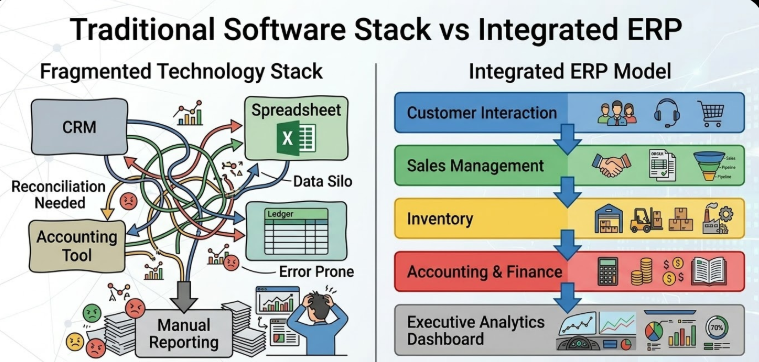
Fragmented Technology Stack
CRM → Spreadsheet → Accounting Tool
↓
Manual Reporting
This approach requires continuous reconciliation between systems.
Integrated ERP Model
Sales
↓
Inventory
↓
Accounting
↓
Customer Data
↓
Unified ERP Platform
Instead of syncing multiple tools, an ERP system centralizes operations in one platform.
How Integrated ERP Solves the Problem
ERP platforms like Odoo integrate business processes across departments.
A single transaction—such as a customer order—automatically updates:
- Sales pipeline
- Inventory levels
- Financial records
- Customer history
- Operational dashboards
This eliminates duplicate data entry and improves reporting accuracy.
Key Features of Integrated ERP
| Feature | Operational Benefit |
| Unified Database | Single source of truth |
| Real-time reporting | Faster decision-making |
| Cross-department automation | Reduced manual work |
| Customer lifecycle tracking | Better customer insights |
| Financial integration | Accurate revenue visibility |
ERP transforms isolated data points into operational intelligence.
Case Study: Mid-Sized Services Company
A consulting firm operating across three countries struggled with fragmented systems:
- CRM for sales
- Separate accounting platform
- Project management software
- Manual Excel reporting
Key issues included delayed revenue reports and inconsistent customer data.
After implementing Odoo ERP:
- Reporting time reduced from weekly to real-time dashboards
- Sales and finance reconciliation errors dropped significantly
- Project billing became automated
- Customer relationship insights improved
The company’s leadership gained immediate visibility into performance metrics across departments.
Performance Improvements After ERP Adoption
| KPI | Before ERP | After ERP |
| Reporting speed | Weekly | Real-time |
| Data accuracy | Moderate | High |
| Operational productivity | 70% | 90% |
| IT integration cost | High | Reduced |
These improvements allowed management teams to focus on strategic growth rather than operational troubleshooting.
ERP Architecture Overview
Customer Interaction
↓
Sales Management
↓
Inventory & Operations
↓
Accounting & Finance
↓
Executive Analytics Dashboard
All business processes feed into one centralized operational system.
Strategic Benefits for Leadership
Integrated ERP systems provide measurable advantages:
- Improved decision-making speed through real-time analytics
- Operational transparency across departments
- Reduced software complexity
- Lower long-term IT maintenance costs
- Stronger customer relationship management
For executives, ERP provides not only operational control but also strategic insight.
The Future of Business Operations
As organizations adopt digital transformation initiatives, integrated platforms are becoming essential. The next generation of enterprise systems will increasingly incorporate artificial intelligence, predictive analytics, and automated workflows.
Companies that continue to rely on disconnected tools will face increasing operational inefficiencies.
Integrated ERP systems provide the infrastructure required for scalable, data-driven organizations.
Executive Perspective
Disconnected tools rarely fail individually; they fail collectively. The problem is not that CRM, accounting, and project systems lack functionality—it is that they operate independently.
Integrated ERP platforms like Odoo eliminate these silos by creating a unified operational environment.
For modern businesses, operational intelligence is the key competitive advantage. Companies that unify their systems gain clarity, efficiency, and agility.
In a world driven by data, integration is not a technical upgrade—it is a strategic necessity.



Post Comment