


Why Operational Bottlenecks Are Often a System Problem — Not a People Problem
Table of Contents
Many organizations assume productivity issues come from employee performance. Managers often push teams to work harder, respond faster, and produce more results. Yet in many cases, the real obstacle is not the team — it is the system they work within.
Disconnected software tools, outdated workflows, and fragmented data structures create invisible friction across departments. Sales teams struggle with incomplete customer data. Operations teams manually reconcile reports. Finance teams spend hours verifying numbers from multiple systems.
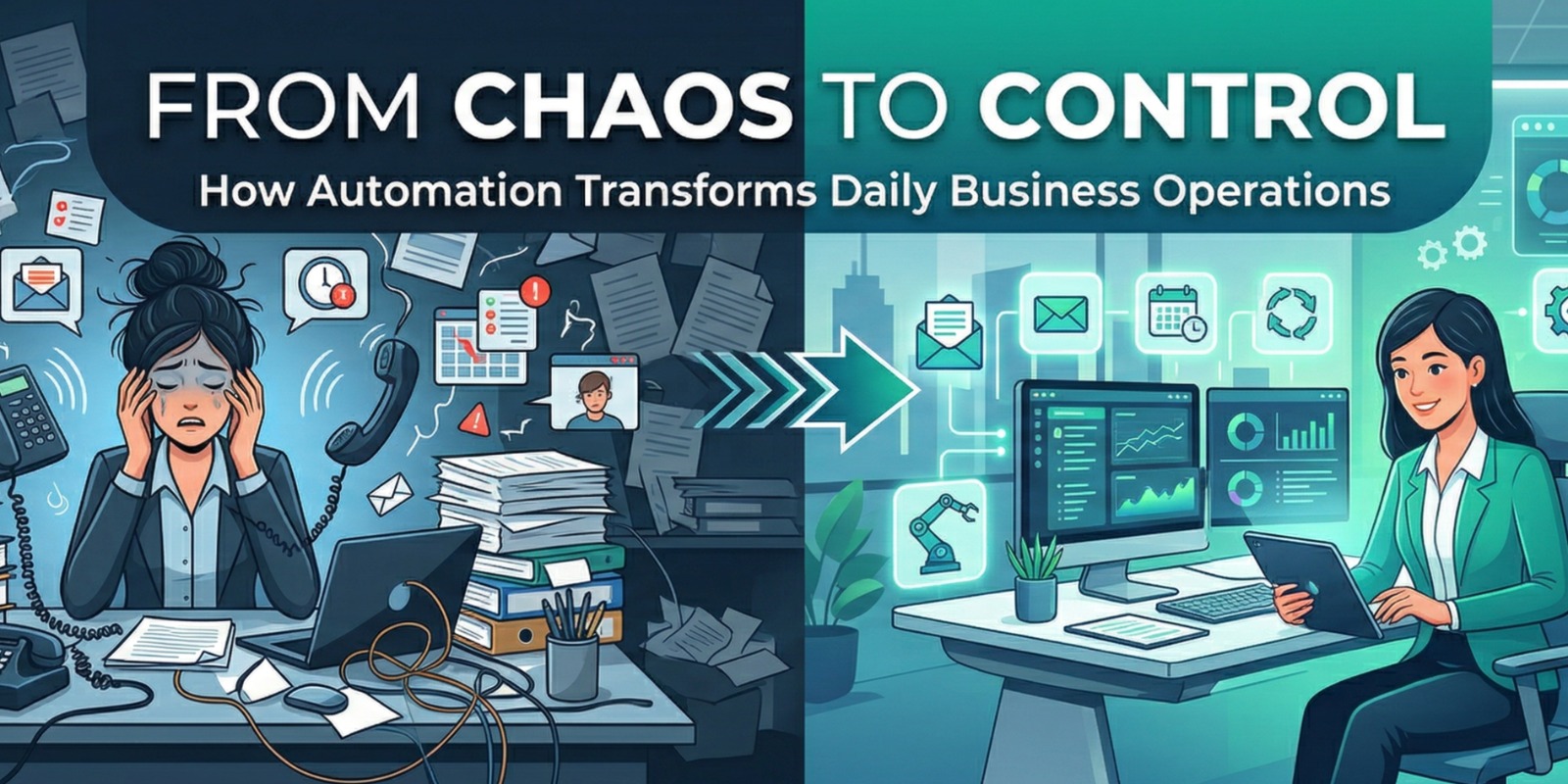
The reality is simple: when systems are inefficient, even the most capable teams cannot perform at their full potential.
Modern organizations are increasingly turning to integrated enterprise systems like Odoo ERP to eliminate operational friction and enable teams to focus on strategic work rather than administrative overhead.
When Hard Work Meets System Friction
In many companies, employees spend a significant portion of their time navigating systems rather than performing value-generating tasks.
Common operational inefficiencies include:
- Switching between multiple software platforms
- Manually transferring data between systems
- Recreating reports from different sources
- Searching for missing customer information
- Repeating tasks that could be automated
Productivity Loss Snapshot
| Operational Issue | Impact on Employees | Impact on Business |
| Multiple systems | Context switching | Reduced productivity |
| Manual data entry | Repetitive work | Increased errors |
| Data inconsistencies | Decision delays | Strategic misalignment |
| Lack of automation | Slow workflows | Lower scalability |
These inefficiencies accumulate across teams and significantly affect overall business performance.
The Fragmented System Model
Most organizations evolve their technology stack gradually. New tools are introduced to solve individual problems, but the overall system architecture becomes increasingly fragmented.
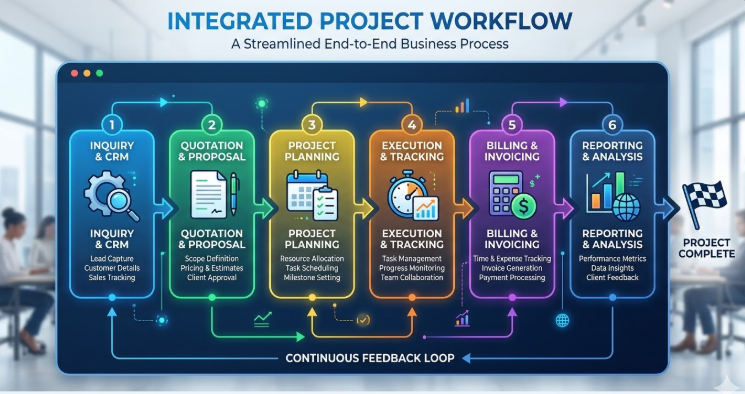
Each department operates efficiently within its own system, but the lack of integration creates operational blind spots.
The Integrated System Model
Integrated ERP platforms unify business processes across departments.
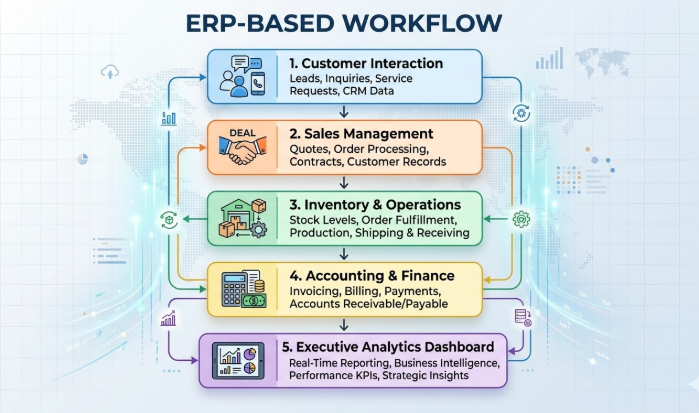
Instead of transferring data manually between tools, information flows automatically across the organization.
How Integrated Systems Improve Team Performance
An integrated ERP system connects departments through a single operational platform.
Key Capabilities
| Feature | Business Advantage |
| Unified database | Single source of truth |
| Automated workflows | Reduced manual work |
| Real-time reporting | Faster decision-making |
| Cross-department integration | Operational transparency |
| Customer lifecycle tracking | Better relationship management |
By eliminating system friction, employees can focus on strategic tasks rather than operational troubleshooting.
Case Study: Professional Services Firm
A consulting firm managing projects across multiple regions experienced persistent operational delays despite having highly skilled teams.
The organization used separate systems for:
- Sales CRM
- Project management
- Financial accounting
- Customer support
As a result:
- Sales forecasts were inaccurate
- Project billing was delayed
- Customer records were inconsistent
After implementing an integrated ERP platform, the firm observed significant operational improvements:
| KPI | Before ERP | After ERP |
| Reporting speed | Weekly reports | Real-time dashboards |
| Data accuracy | Moderate | High |
| Project billing cycle | 10 days | 3 days |
| Operational efficiency | 70% | 90% |
The change did not require employees to work harder — it required systems that supported their work effectively.
The Strategic Role of ERP
Modern ERP platforms are designed to integrate critical business functions:
- Sales and CRM
- Inventory and operations
- Financial accounting
- Project management
- Customer service
By connecting these functions within a single environment, organizations reduce operational complexity and improve visibility.
ERP Integration Architecture
Customer Data
↓
Sales Pipeline
↓
Operations & Inventory
↓
Finance & Accounting
↓
Executive Intelligence Dashboard
This structure ensures that every business activity contributes to a unified data ecosystem.
Why System Design Matters
Employees are often evaluated based on productivity metrics, yet system design heavily influences those metrics.
Organizations with fragmented systems experience:
- Slower decision-making
- Higher administrative workload
- Limited strategic visibility
- Reduced innovation capacity
Integrated platforms eliminate these barriers and create an environment where teams can perform at their highest potential.
Executive Perspective
Leadership teams often focus on hiring stronger talent, improving training programs, and optimizing performance management systems. While these initiatives are valuable, they overlook a fundamental factor: the technology infrastructure that employees depend on daily.
A poorly designed system can undermine even the most talented workforce.
Conversely, a well-integrated ERP platform empowers teams with real-time information, streamlined workflows, and operational clarity.
The question is not whether your employees are capable of delivering better results.
The question is whether your systems allow them to.
In modern organizations, productivity is no longer just a human factor—it is a systems factor.




Post Comment