

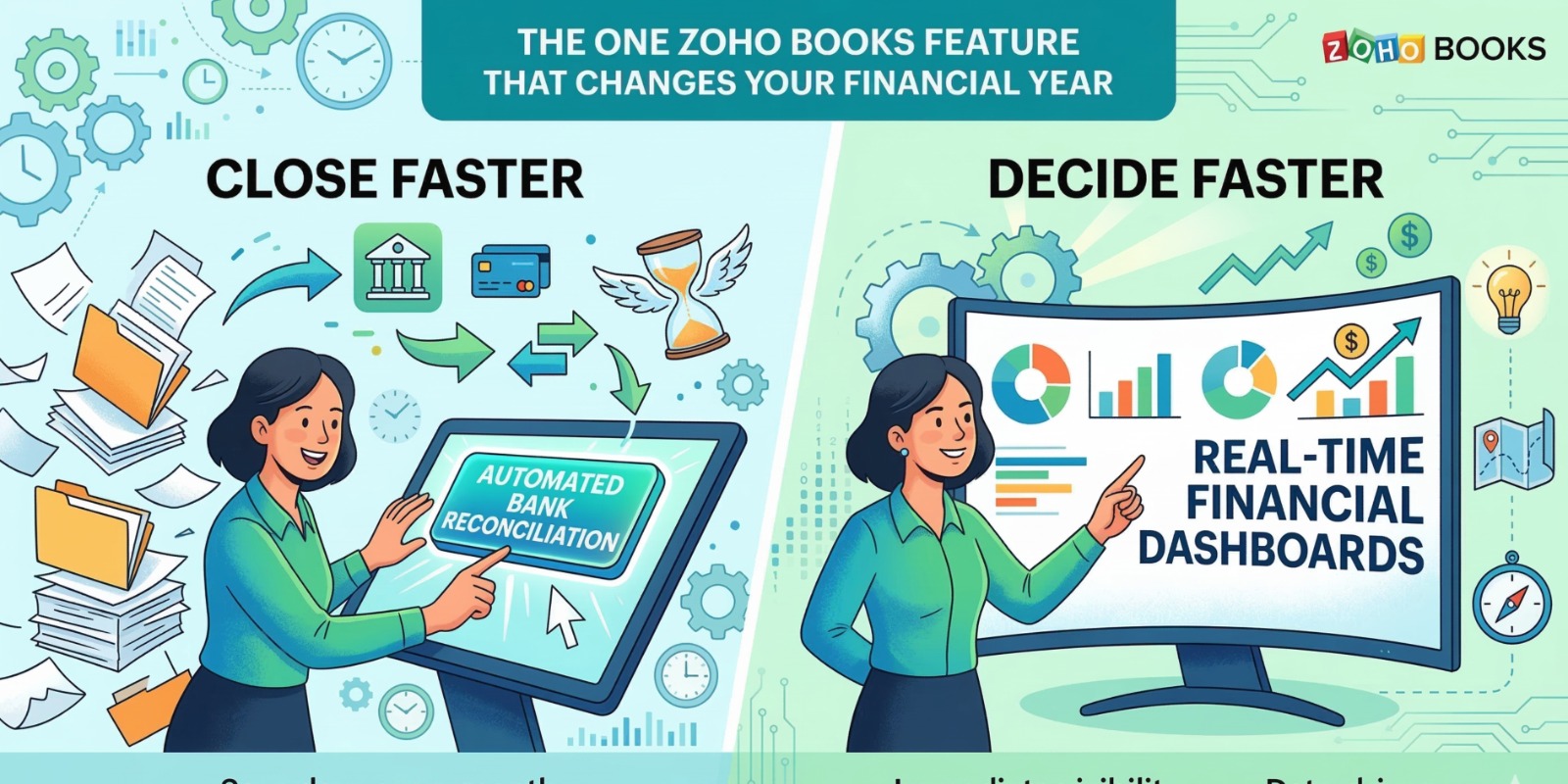
Why “Auto Bank Feeds + Smart Reconciliation” Is the Real MVP for Modern Accounting
Table of Contents
A new fiscal year usually begins with intent: cleaner books, faster reporting, tighter cash control. Yet for many businesses, the same friction returns—month-end rush, reconciliation backlogs, delayed insights, and compliance anxiety. Finance teams work harder, but leadership still waits days for clarity.
The root cause isn’t a lack of effort; it’s the operating model. When accounting relies on manual entries, spreadsheet stitching, and post-facto reconciliation, the function becomes reactive. By the time numbers are “ready,” they’re already stale.
The shift that unlocks performance is simple in principle but powerful in impact: move from manual accounting to continuous, automated reconciliation. In Zoho Books, the feature that most directly enables this is Auto Bank Feeds with Smart Reconciliation.
The Pain Point: Month-End Accounting in a Real-Time Business
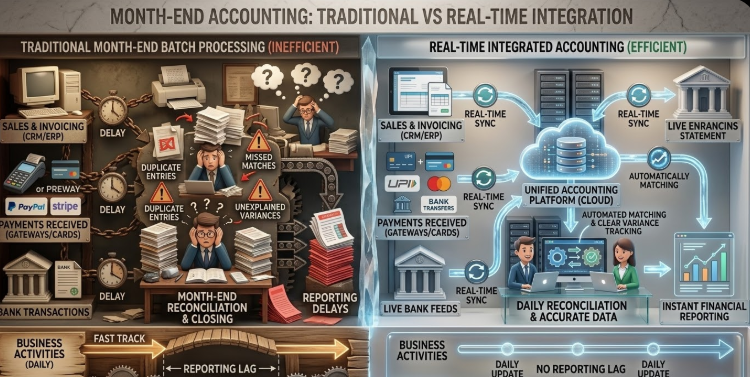
Growing companies process payments across multiple channels—UPI, cards, bank transfers, and gateways. Each stream creates entries that must be recorded, matched, and reconciled. In a traditional setup:
- Invoices are created in one system
- Payments are recorded in another
- Bank statements are imported later
- Reconciliation happens at month-end
This leads to familiar symptoms: duplicate entries, missed matches, unexplained variances, and reporting delays. The business runs daily; accounting catches up weekly or monthly.
The Breakthrough: Continuous Reconciliation, Not Periodic Cleanup
Auto Bank Feeds connect your bank accounts and payment gateways directly to Zoho Books, pulling transactions in near real time. Smart Reconciliation then matches those transactions to invoices, bills, and expenses using rules and pattern recognition.
Instead of a monthly “cleanup exercise,” reconciliation becomes a continuous background process. The ledger stays aligned with reality as transactions occur.
What Changes Operationally
When reconciliation is continuous, several downstream benefits compound:
- Always-current books: P&L and cash position reflect reality, not last week’s close
- Faster close cycles: Month-end becomes validation, not reconstruction
- Lower error rates: Fewer manual touchpoints reduce mismatches
- Better cash control: Outstanding receivables and payables are visible in real time
Traditional vs. Smart Accounting (Zoho Books)
| Dimension | Traditional Approach | Zoho Books (Auto Feeds + Smart Reconciliation) |
|---|---|---|
| Data Capture | Manual entry/imports | Automated bank & gateway sync |
| Reconciliation | End-of-period, manual | Continuous, rule-based matching |
| Close Cycle | Days to weeks | Hours to a day |
| Error Rate | Higher (duplication/misses) | Lower (system-driven matching) |
| Visibility | Delayed snapshots | Live dashboards |
| Cash Control | Reactive | Proactive |
Real-World Case: Services Firm with Multi-Channel Payments
A mid-sized consulting firm handling retainer billing and project-based invoices across India and the UAE struggled with reconciliation. Payments arrived via bank transfers, payment links, and wallets. Their finance team spent 2–3 days each month reconciling statements and chasing mismatches.
After implementing Zoho Books with auto bank feeds:
| Metric | Before | After |
|---|---|---|
| Reconciliation Effort | 2–3 days/month | ~3–4 hours/month |
| Unmatched Transactions | Frequent | Minimal (rule-based matching) |
| Close Time | 5–6 days | 1–2 days |
| Cash Visibility | Lagging | Near real time |
The immediate gain wasn’t just time saved; it was decision velocity. Leadership could see cash inflows and outstanding receivables daily, not after the month-end.
Why This Matters at the Start of a Fiscal Year

The beginning of a financial year is when organizations reset KPIs, budgets, and compliance posture. Continuous reconciliation supports all three:
- Budget adherence: Real-time expense capture prevents surprises
- Revenue tracking: Invoice-to-cash cycles are visible daily
- Compliance readiness: Clean, up-to-date ledgers reduce audit friction
For GST/VAT environments, accurate, timely books simplify return preparation and reduce the risk of penalties.
Beyond the Core: Features That Amplify the Impact
While auto feeds are the linchpin, Zoho Books compounds value with adjacent capabilities:
| Feature | Strategic Benefit |
|---|---|
| Automated Invoicing & Payment Links | Faster collections, lower DSO |
| Expense Capture (Receipts & Rules) | Better cost control, audit trail |
| GST/VAT Handling | Accurate tax computation & reports |
| Multi-Currency Accounting | Clean FX handling for global ops |
| Role-Based Access & Approvals | Governance without bottlenecks |
| Real-Time Dashboards | Instant P&L, cash flow, aging |
Together, these features turn accounting from a record-keeping function into a control system for the business.
Implementation Approach (Practical and Low-Risk)
- Connect banks & gateways: Enable feeds for primary accounts first
- Define matching rules: Map common patterns (e.g., invoice numbers, payee names)
- Standardize invoicing: Consistent references improve match rates
- Clean opening balances: Start the year with reconciled positions
- Train for exception handling: Focus the team on resolving edge cases, not routine entries
Most organizations see meaningful gains within the first month as rules learn and match rates improve.
Common Objections—and the Reality
- “We already reconcile monthly; that’s enough.”
Monthly reconciliation hides intra-month cash issues. Continuous reconciliation surfaces problems early. - “Automation may miss nuances.”
Smart rules handle the majority; exceptions are flagged for review. Net accuracy improves. - “Setup will be complex.”
Initial configuration is straightforward, and benefits accrue immediately. Complexity decreases over time as rules stabilize.
Signals You’re Ready for This Shift
- Reconciliation takes more than a few hours each cycle
- Multiple payment channels create frequent mismatches
- Leadership asks for real-time cash insights you can’t provide
- Month-end close delays affect decision-making
- Teams rely heavily on spreadsheets alongside accounting software
If these resonate, your bottleneck isn’t accounting knowledge—it’s the process.
Final Takeaway
In modern finance, speed and accuracy are not trade-offs—they are outcomes of the right system design. Auto Bank Feeds with Smart Reconciliation in Zoho Books replaces periodic cleanup with continuous alignment, turning accounting into a live, reliable signal for the business.
As you step into a new fiscal year, the goal isn’t just cleaner books—it’s faster, better decisions. And that begins with ensuring your numbers are always current.
Don’t wait for month-end to understand your business.
Run it in real time.



Post Comment