

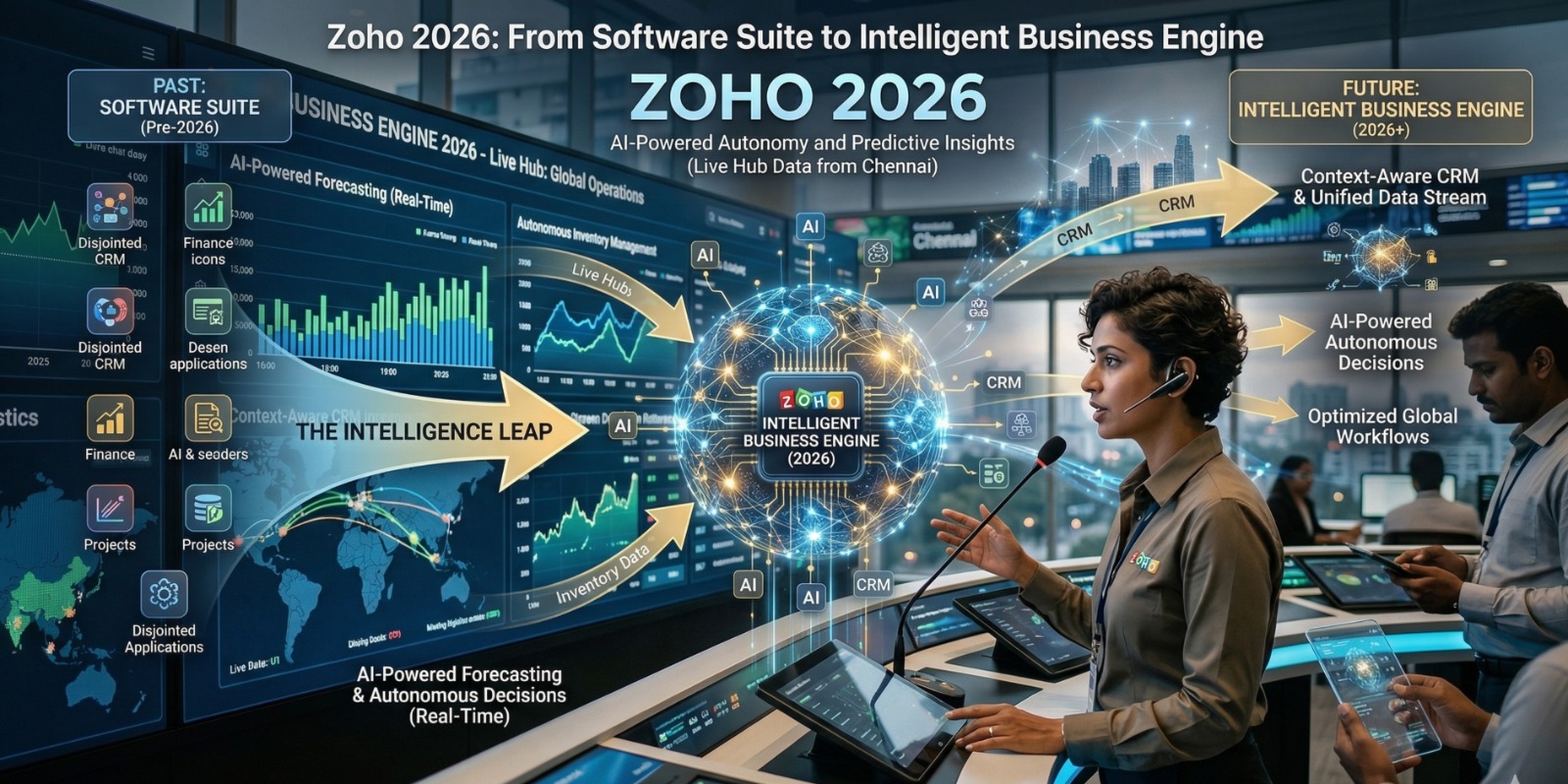
How AI, Automation, and Unified Control Are Redefining Business Operations
Table of Contents
Every year, businesses invest in new tools expecting better efficiency, faster decisions, and smoother operations. Yet despite adopting multiple platforms, many organizations still struggle with the same issues—manual work, disconnected systems, delayed reporting, and lack of visibility.
The problem is no longer access to tools.
The problem is lack of intelligence and integration between them.
Zoho’s 2026 evolution directly addresses this gap. It is no longer just a collection of business applications—it is becoming an AI-powered, fully connected business ecosystem designed to deliver end-to-end operational control.
The Pain Point: Too Many Tools, Not Enough Control
Modern businesses often operate with a stack of software:
- CRM for sales
- Accounting software for finance
- HR tools for employee management
- Marketing platforms for campaigns
While each tool solves a specific problem, together they create a fragmented environment.
The result?
- Data is scattered across systems
- Teams operate in silos
- Reports take time to compile
- Decisions are made on outdated information
Even with advanced tools, businesses lack real-time control over their operations.
What’s New in Zoho 2026
Zoho’s latest advancements focus on three pillars:
1. AI-Driven Intelligence (Zia Evolution)
Zoho’s AI assistant, Zia, has evolved from a support tool into a decision-making engine.
Key capabilities include:
- Predictive analytics for sales and revenue
- Intelligent anomaly detection in finance
- AI-powered customer insights
- Automated recommendations for process optimization
Instead of just reporting data, Zia now helps businesses act on it.
2. Deep Automation Across Workflows
Automation in Zoho 2026 is no longer limited to basic triggers. It now supports end-to-end process orchestration.
Example:
| Process | Before | With Zoho 2026 |
|---|---|---|
| Lead to Order | Manual handoffs | Fully automated pipeline |
| Invoice Processing | Manual entry | Auto-generated + reconciled |
| Customer Support | Ticket-based | AI-assisted resolution |
| HR Onboarding | Multiple tools | Unified automated workflow |
This level of automation eliminates repetitive work and ensures consistency across operations.
3. End-to-End Business Control (Unified Platform)
Zoho is now focusing on creating a single source of truth across all business functions.
All modules—CRM, Books, Inventory, HR, Projects—are tightly integrated.
Unified Business Flow
| Step | Zoho 2026 Flow |
|---|---|
| Lead captured | CRM updated instantly |
| Deal closed | Invoice auto-generated |
| Payment received | Finance updated in real-time |
| Inventory adjusted | Stock synced automatically |
| Dashboard updated | Leadership sees live data |
This integration removes data silos and enables real-time decision-making.
Zoho 2026 vs Traditional Business Systems
| Feature | Traditional Tools | Zoho 2026 |
|---|---|---|
| Data Flow | Disconnected | Fully integrated |
| Decision-Making | Reactive | AI-driven |
| Automation | Limited | End-to-end workflows |
| Reporting | Delayed | Real-time dashboards |
| Scalability | Complex | Seamless |
Zoho is shifting from being a tool provider to becoming a business operating system.
Real Case Study: Service Business Transformation
A mid-sized service company handling sales, billing, and customer support across multiple regions faced operational inefficiencies due to fragmented systems.
Challenges:
- Customer data spread across CRM and spreadsheets
- Delayed invoicing and payment tracking
- Manual reporting taking 2–3 days
- Lack of real-time insights for leadership
After adopting Zoho’s integrated ecosystem:
| Metric | Before | After |
|---|---|---|
| Report Generation Time | 2–3 days | Real-time |
| Invoice Processing | Manual | Automated |
| Customer Visibility | Limited | 360° view |
| Decision Speed | Slow | Instant |
The business didn’t just improve efficiency—it gained complete operational visibility.
The Strategic Shift: From Tools to Intelligence
Zoho 2026 represents a broader shift in how businesses operate.
Earlier, companies asked:
“Which tools do we need?”
Now, the question is:
“How do we connect everything and make it intelligent?”
This shift is critical for scaling businesses.
Where Businesses Will See the Biggest Impact
Zoho’s new capabilities create immediate value across key functions:
| Department | Impact |
|---|---|
| Sales | Predictive forecasting and faster conversions |
| Finance | Real-time accounting and compliance |
| Operations | Automated workflows and tracking |
| HR | Streamlined employee lifecycle management |
| Leadership | Unified dashboards and insights |
This ensures that every department operates with aligned data and shared visibility.
Signs Your Business Needs This Upgrade
If your organization experiences any of the following, Zoho 2026 can deliver immediate value:
- Teams rely on multiple disconnected tools
- Reporting is delayed or inconsistent
- Manual processes dominate operations
- Decision-making lacks real-time data
- Growth is creating operational complexity
These are clear indicators that your current systems are limiting your potential.
Final Thoughts
Zoho 2026 is not just an upgrade—it is a transformation.
By combining AI, automation, and integration, Zoho is enabling businesses to move from fragmented operations to intelligent, unified systems.
The companies that adopt this approach will operate faster, make better decisions, and scale more efficiently.
Those who continue relying on disconnected tools will struggle to keep up.
The future of business is not about using more software.
It is about using smarter systems that work together.
The real question is:
Are you managing tools…
Or are you running a connected business?
👉 Because in 2026, control will belong to those who operate intelligently.



Post Comment