

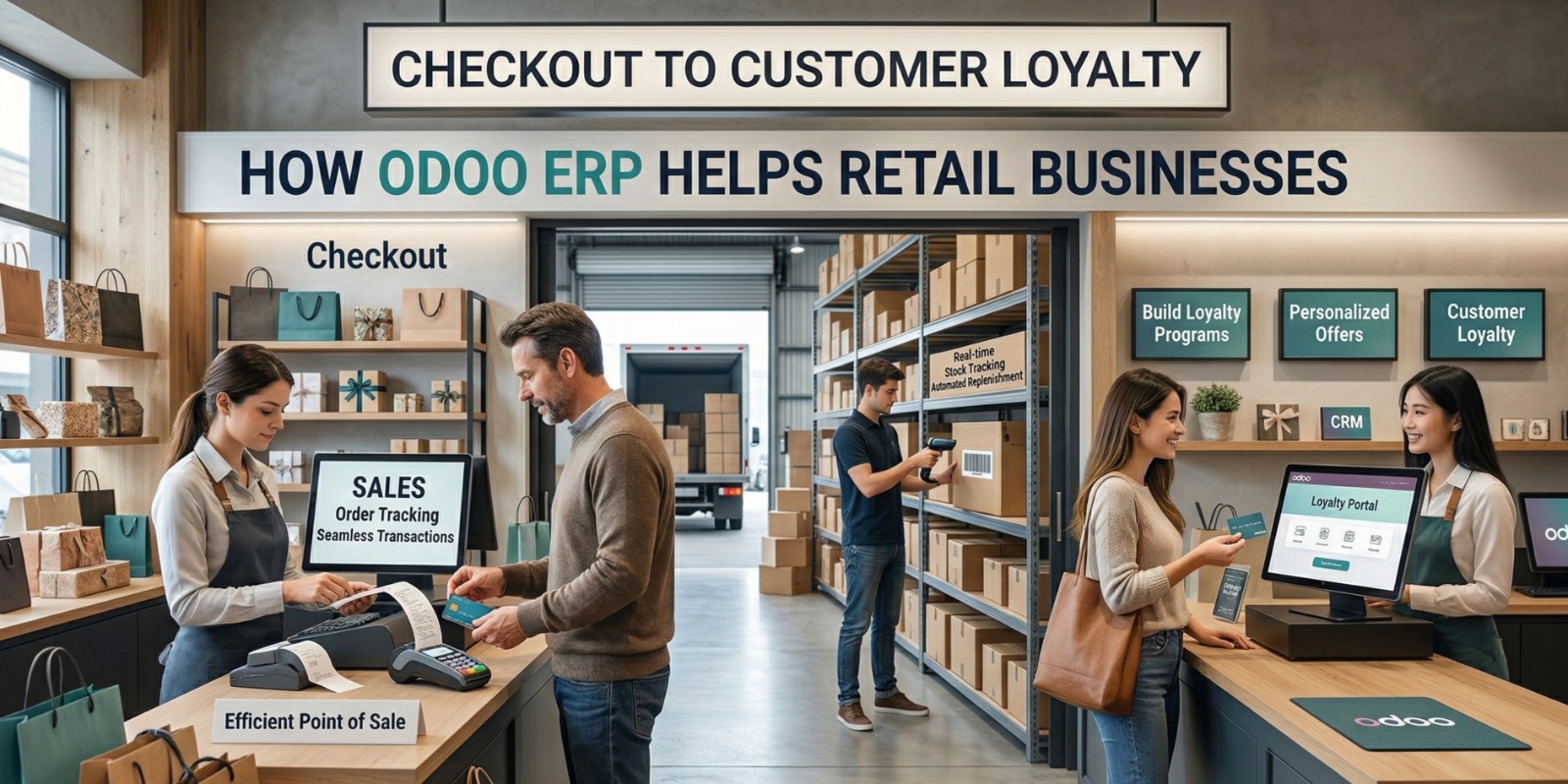
Why Modern Retailers Are Replacing Disconnected Systems With One Unified Platform
Table of Contents
Retail businesses operate in one of the most dynamic environments. Customer expectations change quickly, inventory moves fast, and competition is always one step away. To stay competitive, retailers must manage sales, inventory, and customer relationships seamlessly.
However, many retail businesses still rely on disconnected systems—POS software for billing, spreadsheets for inventory, accounting tools for finance, and manual processes for customer management. While this setup may work initially, it becomes increasingly difficult to manage as the business grows.
The result is a common retail challenge:
Sales are happening, but operations are struggling to keep up.
This is where Odoo ERP is transforming retail operations by bringing everything into one integrated system.
The Real Pain Point: Retail Chaos Behind the Counter
Retailers face operational challenges every day:
- Stock mismatches between stores and the warehouse
- Manual billing and delayed sales tracking
- Lack of customer purchase history
- Difficulty managing multi-location inventory
- Delayed reporting and decision-making
These problems not only slow operations but also impact customer experience.
For example, a customer walks into a store asking for a product. The system shows it is available, but the shelf is empty. This happens because inventory is not updated in real time.
These small issues accumulate and lead to lost sales and dissatisfied customers.
How Odoo ERP Solves Retail Challenges
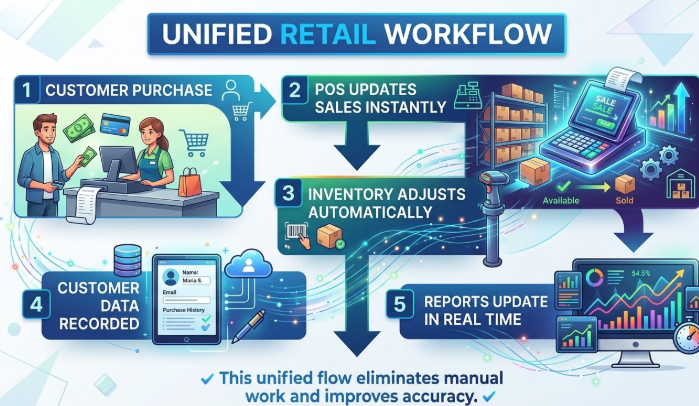
Odoo ERP integrates retail operations into one system, connecting sales, inventory, and customer data.
Instead of using separate tools, everything flows automatically.
Unified Retail Workflow
Customer Purchase
↓
POS updates sales instantly
↓
Inventory adjusts automatically
↓
Customer data recorded
↓
Reports update in real time
This unified flow eliminates manual work and improves accuracy.
Sales Management With Odoo POS
Odoo provides a modern Point of Sale (POS) system that works both online and offline. Retail staff can process orders quickly while the system automatically updates backend data.
Key benefits:
- Fast checkout experience
- Real-time sales tracking
- Multi-store POS integration
- Automatic invoice generation
- Promotions and discount management
Retailers gain complete visibility into daily sales performance.
Inventory Management Without Guesswork
Inventory is one of the biggest challenges for retailers. Overstock leads to capital blockage, while stockouts result in lost sales.
Odoo solves this by providing real-time inventory tracking.
| Inventory Challenge | Without ERP | With Odoo ERP |
|---|---|---|
| Stock visibility | Manual tracking | Real-time tracking |
| Multi-store inventory | Difficult | Centralized control |
| Reordering | Manual | Automated rules |
| Stock accuracy | Low | High |
| Inventory reports | Delayed | Live dashboards |
Retailers can monitor stock levels across locations and automate replenishment.
Customer Management for Better Loyalty
Retail success is not just about selling products—it’s about building relationships. Odoo captures customer purchase history and behavior automatically.
Retailers can:
- Track customer buying patterns
- Offer personalized discounts
- Launch loyalty programs
- Send targeted promotions
- Improve customer experience
This turns one-time buyers into repeat customers.
Real Case Study: Multi-Store Retailer Transformation
A fashion retailer operating three stores struggled with inventory and customer tracking. Each store used a separate POS system, and inventory was managed manually.
Challenges:
- Stock mismatches across locations
- No centralized customer data
- Delayed sales reporting
- Manual reconciliation
After implementing Odoo ERP:
| Metric | Before Odoo | After Odoo |
|---|---|---|
| Inventory Accuracy | 70% | 95% |
| Sales Visibility | End of day | Real-time |
| Customer Data | Separate | Unified |
| Stock Transfers | Manual | Automated |
The retailer improved operations and increased repeat customers.
Multi-Store Retail Management
Odoo is especially powerful for businesses operating multiple outlets. It allows centralized control over all locations.
Retailers can:
- Monitor store performance
- Transfer stock between stores
- Compare sales by location
- Manage centralized pricing
- Control promotions across branches
This helps retailers scale without operational complexity.
Real-Time Retail Analytics
One of the biggest advantages of Odoo is real-time reporting. Retail managers no longer need to wait for end-of-day reports.
Key insights include:
- Best-selling products
- Store-wise sales performance
- Inventory turnover
- Customer purchase trends
- Revenue tracking
These insights help retailers make smarter decisions.
Manual Retail vs Odoo ERP
| Factor | Manual Retail Setup | Odoo ERP |
|---|---|---|
| Sales tracking | Delayed | Real-time |
| Inventory | Manual updates | Automated |
| Customer data | Limited | Complete view |
| Reporting | Time-consuming | Instant |
| Scalability | Difficult | Easy |
Odoo transforms retail operations from reactive to proactive.
Why Retail Businesses Choose Odoo
Retailers adopt Odoo because it provides:
- Integrated POS system
- Real-time inventory tracking
- Customer relationship management
- Multi-store management
- Automated reporting
All in one platform.
This reduces complexity and improves efficiency.
Signs Your Retail Business Needs Odoo
If your retail business is facing these issues, Odoo can help:
- Frequent stock mismatches
- Slow checkout process
- No customer purchase history
- Difficulty managing multiple stores
- Manual reporting
These are indicators that your current systems are limiting growth.
Final Thoughts
Retail success depends on speed, accuracy, and customer experience. Disconnected tools make it difficult to achieve these goals.
Odoo ERP brings sales, inventory, and customer management into one unified system, enabling retailers to operate efficiently and scale confidently.
Businesses that adopt integrated systems gain better control, improve customer satisfaction, and increase profitability.
In retail, every sale matters.
And with the right system, every sale becomes easier to manage.



Post Comment