

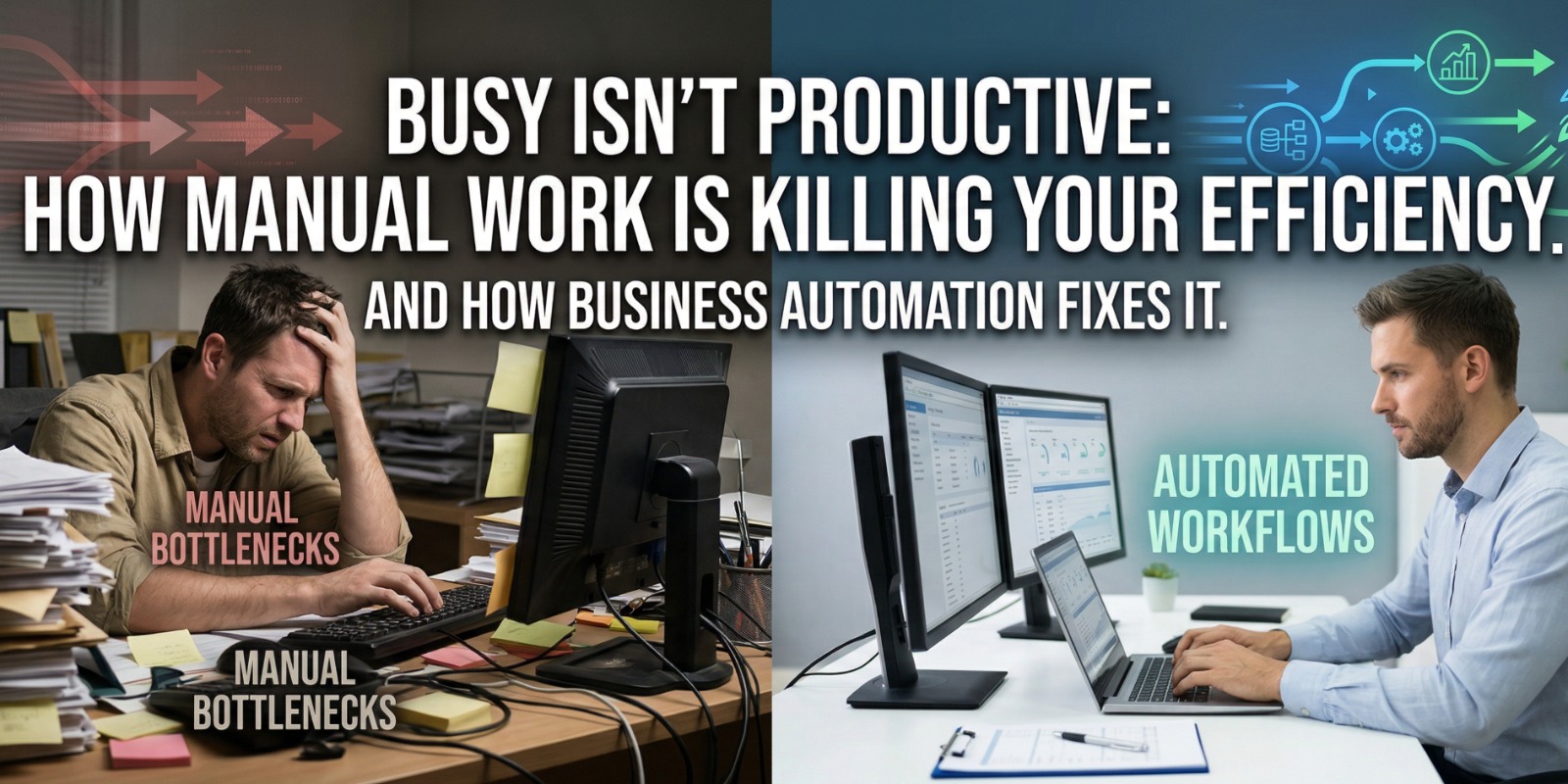
Why Growing Companies Are Replacing Repetitive Tasks With Intelligent Workflows
Table of Contents
Many businesses today mistake activity for productivity. Teams are busy, emails are flowing, spreadsheets are updated, and reports are generated. On the surface, everything appears to be moving. But behind the scenes, a large portion of this effort is spent on manual, repetitive work that adds little strategic value.
Employees copy data between systems, follow up on approvals, reconcile mismatched records, generate reports manually, and manage workflows through emails. These tasks consume time, increase errors, and slow decision-making.
The problem isn’t that teams aren’t working hard.
The problem is that manual work is quietly killing productivity.
The Real Pain Point: Time Spent on Repetitive Tasks
In many organizations, employees spend hours each week on tasks that could easily be automated:
- Copying data from CRM to accounting systems
- Sending manual approval emails
- Updating inventory spreadsheets
- Creating invoices manually
- Preparing reports from multiple sources
These activities not only reduce productivity but also increase operational risk. Human errors, missed updates, and delayed communication become common.
Over time, manual work creates a bottleneck that prevents businesses from scaling.
What Manual Workflows Look Like
A typical manual business process often involves multiple handoffs.
| Step | Manual Process | Impact |
|---|---|---|
| Lead received | Entered manually into CRM | Time-consuming |
| Order created | Shared via email | Risk of delay |
| Invoice generated | Created manually | Duplicate effort |
| Payment tracked | Updated separately | Data mismatch |
| Report generated | Compiled manually | Delayed insights |
Each step requires human intervention, which slows down operations.
The Hidden Cost of Manual Operations
Manual work doesn’t just slow processes—it affects overall business performance.
| Area | Manual Impact | Business Result |
|---|---|---|
| Operations | Repetitive tasks | Reduced productivity |
| Finance | Manual reconciliation | Errors and delays |
| Sales | Slow follow-ups | Lost opportunities |
| Reporting | Time-consuming | Delayed decisions |
| Customer Experience | Slow response | Lower satisfaction |
These inefficiencies compound as the business grows.
The Solution: Business Automation
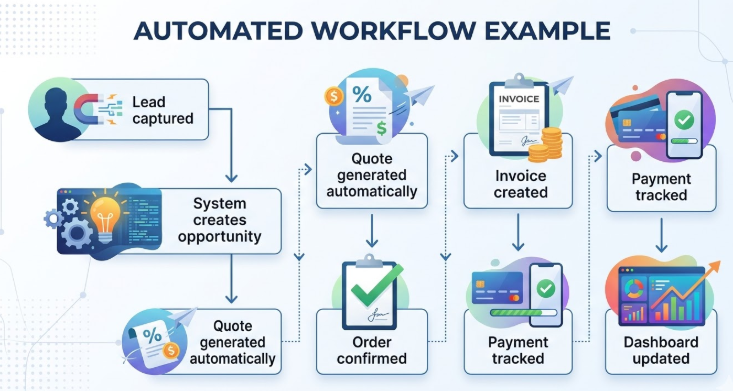
Business automation eliminates repetitive tasks by allowing systems to handle routine workflows. Instead of employees manually moving data, systems communicate automatically.
Automation connects departments such as sales, finance, HR, and operations into one seamless workflow.
No manual intervention. No delays.
Manual vs Automated Workflow
| Factor | Manual Work | Automated Workflow |
|---|---|---|
| Speed | Slow | Fast |
| Accuracy | Error-prone | Reliable |
| Reporting | Delayed | Real-time |
| Effort | High | Low |
| Scalability | Limited | High |
Automation shifts teams from repetitive work to strategic activities.
Real Case Study: Service Company Productivity Boost
A consulting firm managing multiple clients relied on manual processes for project tracking, billing, and reporting.
Challenges:
- Manual invoice generation
- Time-consuming reporting
- Delayed project tracking
- Data scattered across tools
After implementing business automation:
| Metric | Before | After |
|---|---|---|
| Invoice Creation | Manual | Automated |
| Reporting Time | 2 days | Real-time |
| Project Tracking | Manual | Centralized |
| Productivity | Low | Improved |
Employees spent less time on administrative work and more time delivering value.
Where Automation Creates Immediate Impact
Automation delivers the highest ROI in repetitive workflows.
| Department | Automation Benefit |
|---|---|
| Sales | Automated lead tracking |
| Finance | Auto invoicing & reconciliation |
| HR | Employee onboarding automation |
| Operations | Workflow automation |
| Customer Support | Faster response time |
These improvements reduce manual workload across teams.
The Strategic Advantage
When businesses automate workflows:
- Teams focus on high-value tasks
- Errors decrease significantly
- Decisions become faster
- Operations scale efficiently
Automation doesn’t replace people—it enhances their productivity.
Signs Manual Work Is Slowing Your Business
Your business likely needs automation if:
- Teams rely heavily on spreadsheets
- Data is manually transferred between systems
- Reports take hours or days
- Approvals happen via email
- Processes depend on manual follow-ups
These are indicators of inefficient workflows.
Final Thoughts
Manual work may feel necessary, but it is one of the biggest barriers to productivity. As businesses grow, repetitive tasks multiply and create operational bottlenecks.
Business automation removes these inefficiencies, allowing teams to focus on meaningful work and enabling organizations to scale.
Companies that automate workflows gain speed, accuracy, and clarity. Those who continue relying on manual processes struggle to keep up.
The goal isn’t to work harder.
It’s to build systems that work smarter.





Post Comment