

How Smart Businesses Are Moving From Manual Finance to Intelligent Financial Operations
Table of Contents
Accounting has always been the backbone of business operations. It tracks revenue, manages expenses, ensures compliance, and helps leaders make financial decisions. But in 2026, traditional accounting alone is no longer enough. Businesses are dealing with higher transaction volumes, multiple payment channels, complex compliance requirements, and the need for real-time financial visibility.
Yet many companies still rely on manual accounting workflows — spreadsheets, delayed reconciliation, manual invoicing, and periodic reporting. These processes slow down decision-making and increase the risk of errors.
The result is a growing gap between financial data availability and business decision speed.
This is where accounting, combined with automation, becomes the perfect pair. Together, they transform finance from a reactive function into a real-time decision engine.
The Real Pain Point: Accounting That Lags Behind the Business
Modern businesses operate in real time. Sales happen instantly, payments are received digitally, and operations move quickly. But accounting often trails behind.
Common challenges include:
- Manual invoice creation
- Delayed payment reconciliation
- Spreadsheet-based expense tracking
- Month-end reporting delays
- Lack of real-time financial visibility
Finance teams spend time updating data instead of analyzing it. By the time reports are ready, the information is already outdated.
What Accounting + Automation Looks Like
When automation is integrated into accounting, routine tasks are handled automatically.
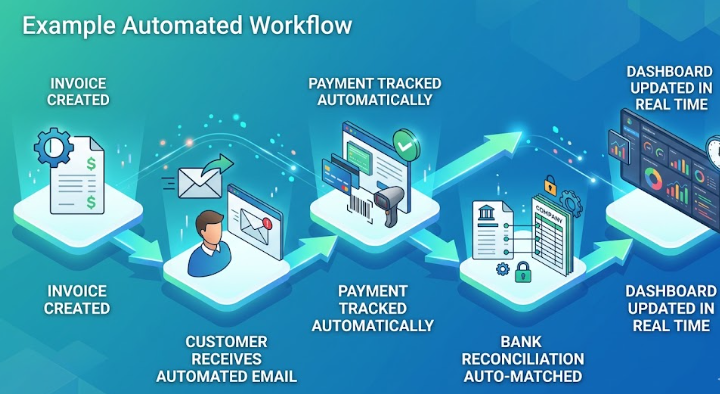
This removes manual steps and improves accuracy.
Manual Accounting vs Automated Accounting
| Factor | Manual Accounting | Accounting + Automation |
|---|---|---|
| Data Entry | Manual | Automated |
| Reconciliation | Time-consuming | Real-time |
| Reporting | Periodic | Live dashboards |
| Error Rate | High | Low |
| Decision Speed | Delayed | Instant |
Automation enables finance teams to focus on insights instead of data entry.
Real Case Study: Distribution Company Transformation
A distribution company handling hundreds of transactions daily relied on manual accounting processes. Their finance team spent hours generating invoices, reconciling payments, and preparing reports.
Challenges:
- Manual invoice tracking
- Delayed reconciliation
- Inaccurate cash flow visibility
- Time-consuming reporting
After implementing automated accounting:
| Metric | Before | After |
|---|---|---|
| Invoice Processing | Manual | Automated |
| Reconciliation Time | 2 days | Real-time |
| Cash Flow Visibility | Limited | Live |
| Reporting | Monthly | Instant |
The finance team shifted from operational work to strategic planning.
Where Automation Improves Accounting
Automation impacts multiple financial workflows.
| Accounting Area | Automation Benefit |
|---|---|
| Invoicing | Automatic generation & reminders |
| Payments | Real-time tracking |
| Expenses | Automated categorization |
| Reconciliation | Auto bank matching |
| Reporting | Real-time dashboards |
These improvements create a connected financial system.
Real-Time Financial Visibility
One of the biggest advantages of accounting automation is real-time insights.
Businesses can monitor:
- Revenue trends
- Outstanding invoices
- Expense breakdown
- Cash flow status
- Profitability metrics
This enables faster and smarter decision-making.
Why 2026 Requires Automated Accounting
Business environments are becoming more complex. Companies must handle:
- Multiple payment gateways
- Global transactions
- Tax compliance requirements
- Subscription-based billing
- High transaction volumes
Manual accounting cannot scale efficiently. Automation ensures accuracy and speed.
Strategic Benefits
When accounting and automation work together:
- Financial data stays updated
- Errors are reduced
- Teams save time
- Decisions become faster
- Businesses scale efficiently
Automation turns accounting into a proactive function.
Signs Your Accounting Needs Automation
Your business likely needs automated accounting if:
- Reconciliation takes hours or days
- Invoices are created manually
- Reports are delayed
- Cash flow visibility is unclear
- Finance teams rely on spreadsheets
These indicate manual accounting bottlenecks.
Accounting + Automation in Practice
Modern platforms integrate accounting with automation to create unified workflows:
- Sales generates invoice automatically
- Payment updates are accounted for instantly
- Expenses sync with financial reports
- Dashboards update in real time
This eliminates manual intervention.
The Future of Finance
Accounting in 2026 is not just about recording transactions. It is about delivering insights, improving decisions, and supporting growth.
Automation enables finance teams to move from:
Data entry → Analysis
Reporting → Forecasting
Manual work → Strategic planning
This is the shift modern businesses are making.
Final Thoughts
Accounting and automation together create a powerful combination. While accounting provides financial accuracy, automation delivers speed and efficiency.
Businesses that adopt automated accounting gain real-time visibility, reduce errors, and scale operations more effectively.
Those relying on manual processes will struggle with delays and inefficiencies.
In 2026, the question is no longer whether automation is useful.
The question is whether your accounting system is ready for it.
Because the perfect pair for modern business isn’t just accounting.
It’s accounting powered by automation.






Post Comment