

Table of Contents
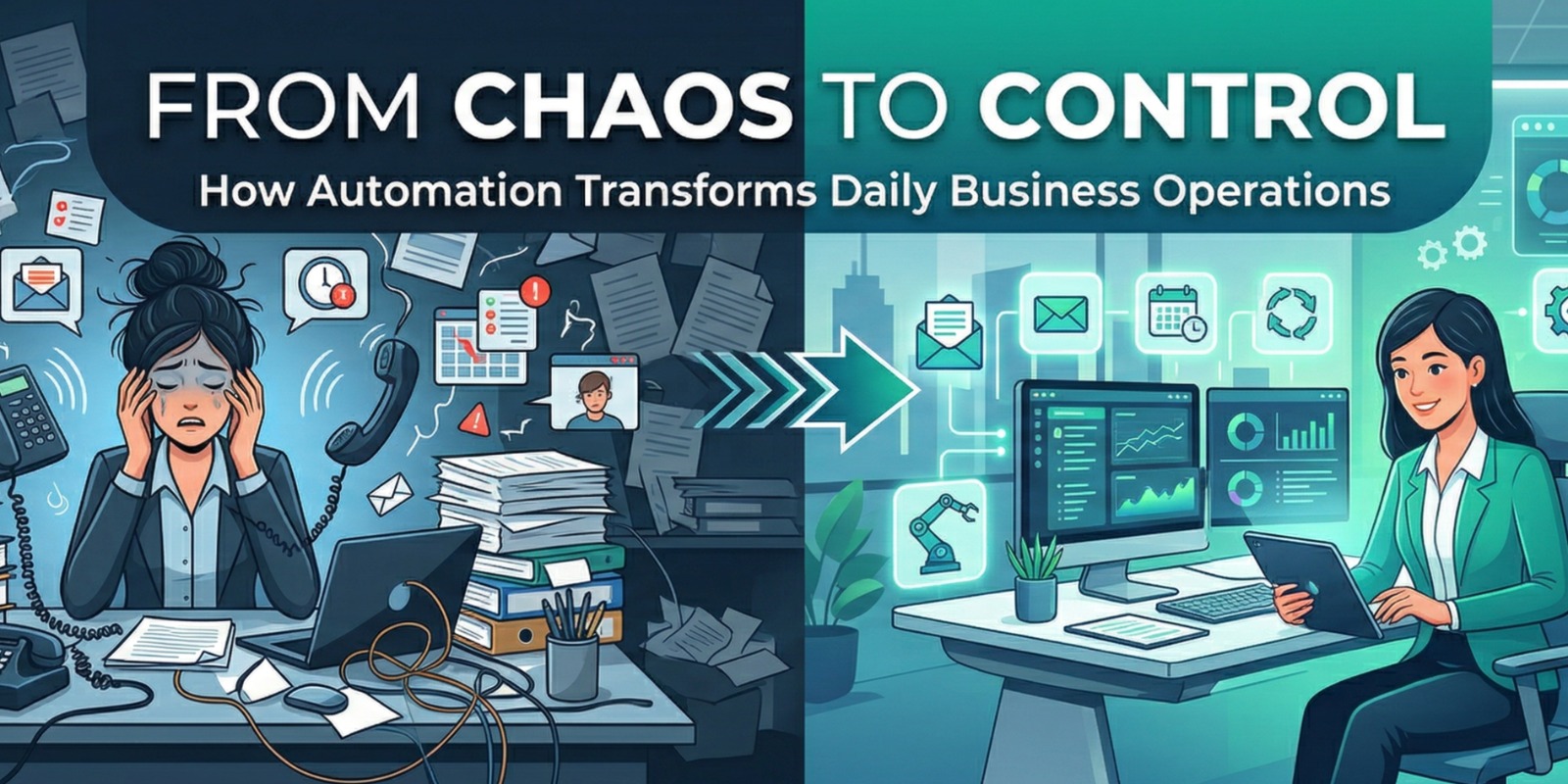
Every business reaches a point where growth starts creating chaos. Orders come from multiple channels, customer messages pile up, approvals get delayed, and teams spend more time managing spreadsheets than actually doing meaningful work. What once worked for a small team quickly becomes inefficient as operations expand. Businesses in the UAE, especially fast-growing SMEs and mid-sized companies, often face this exact challenge — too many manual processes and not enough control.
This is where automation transforms daily business operations. Instead of relying on manual updates, disconnected tools, and repetitive work, automation connects workflows, reduces delays, and gives business leaders complete visibility. The result is not just efficiency — it’s operational control.
The Daily Operational Chaos Businesses Face
Many UAE businesses still rely on manual or semi-digital processes. Sales teams track leads in Excel, finance teams manually reconcile invoices, HR approvals move through email chains, and inventory updates depend on someone remembering to update the system. These gaps create operational friction.
Common operational challenges include:
- Delayed approvals and bottlenecks
- Manual data entry errors
- Lack of real-time visibility
- Disconnected systems and tools
- Duplicate work across departments
- Missed customer follow-ups
- Inventory mismatches
- Slow reporting and decision-making
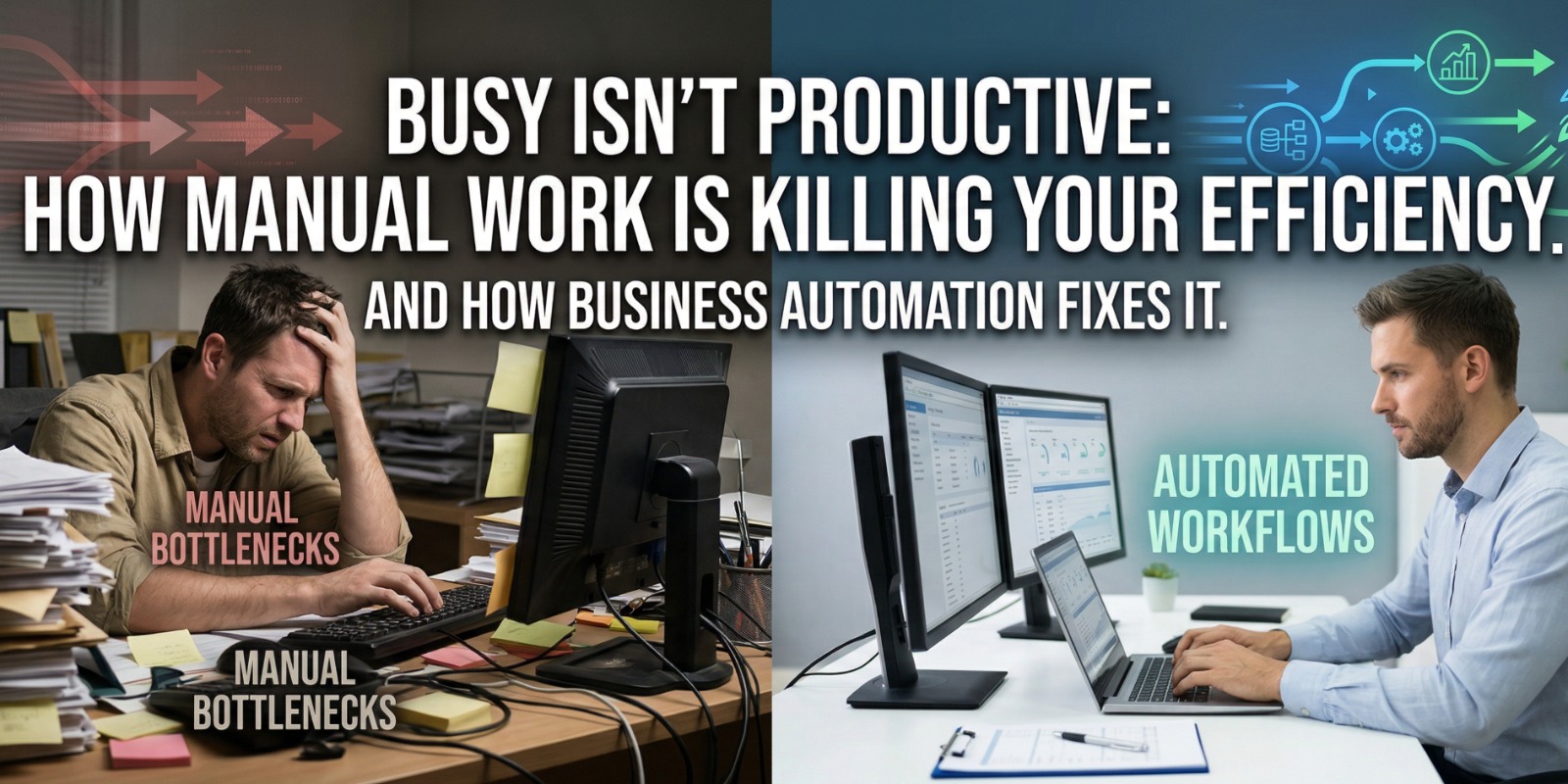
Over time, these inefficiencies compound. Teams work harder, but productivity does not improve. Managers spend hours chasing updates, and leadership lacks accurate data to make decisions.
Automation solves this by replacing manual coordination with structured workflows.
What Business Automation Really Means
Automation is not about replacing people. It’s about removing repetitive tasks and allowing teams to focus on strategic work. When workflows are automated, actions trigger automatically based on business rules.
For example:
- A new lead automatically creates a follow-up task
- A confirmed order triggers invoice creation
- Low stock automatically sends a purchase request
- Employee leave request routes to the correct manager
- Payment received automatically updates accounting
This eliminates delays and ensures processes move forward without manual intervention.
Before vs After Automation
| Operations Area | Without Automation | With Automation |
|---|---|---|
| Sales Follow-up | Manual reminders | Auto follow-up workflows |
| Invoice Creation | Created manually | Auto-generated from orders |
| Inventory Updates | Updated later | Real-time stock updates |
| Approvals | Email-based | Workflow-based approvals |
| Reporting | Excel consolidation | Live dashboards |
| Customer Support | Missed responses | Ticket automation |
| Procurement | Manual tracking | Auto reorder rules |
This shift creates operational clarity across departments.
How Automation Transforms Daily Operations
1. Sales Process Becomes Structured
Automation ensures no lead is missed. When a customer inquiry arrives, it automatically assigns to a salesperson, schedules follow-ups, and tracks communication history. Managers can see pipeline status in real time.
This improves response time and increases conversion rates.
2. Order to Cash Becomes Seamless
Once a quotation is approved, automation converts it into a sales order, generates an invoice, and tracks payment. Finance no longer needs to manually coordinate with sales.
This reduces delays and improves cash flow.
3. Inventory Management Becomes Predictable
Automation tracks stock levels continuously. When inventory reaches the minimum threshold, the system automatically creates purchase requests. This prevents stockouts and overstocking.
Warehouse teams work with accurate data.
4. Approval Workflows Become Faster
Instead of emails and calls, automation routes approvals based on roles and thresholds. For example:
- Purchase below AED 5,000 auto-approved
- Above AED 5,000 sent to finance manager
- Above AED 20,000 sent to director
This speeds up decision-making while maintaining governance.
5. Finance Operations Become Accurate
Automation connects sales, purchases, and accounting. Invoices are generated automatically, taxes are calculated correctly, and payments are reconciled without manual work.
This reduces accounting errors and saves time.
6. HR Operations Become Organized
Leave requests, expense claims, onboarding, and payroll approvals are automated. HR teams no longer manage email threads.
Employees get faster responses.
Real-World Scenario: UAE Distribution Company
A mid-sized distribution company in Dubai managed operations using Excel and email. Their challenges included:
- Delayed order processing
- Frequent stock mismatches
- Manual invoicing errors
- Slow approvals
- No real-time reporting
After implementing automation:
- Order processing time reduced by 40%
- Inventory accuracy improved to 98%
- Invoice creation became automatic
- Approvals reduced from 2 days to 2 hours
- Management gained live dashboards
The biggest impact was visibility. Leadership could finally see operations in real time.
Key Areas Businesses Should Automate First
Businesses don’t need to automate everything at once. Start with high-impact processes.
| Priority | Process | Impact |
|---|---|---|
| 1 | Lead Management | Faster conversions |
| 2 | Sales to Invoice | Faster cash flow |
| 3 | Inventory Replenishment | Avoid stockouts |
| 4 | Approval Workflows | Faster decisions |
| 5 | Procurement | Cost control |
| 6 | Customer Support | Better satisfaction |
| 7 | Reporting | Real-time insights |
This phased approach ensures smooth adoption.
Benefits of Business Automation
Automation delivers measurable improvements:
- Reduced manual work
- Faster operations
- Fewer errors
- Improved customer experience
- Better team productivity
- Real-time visibility
- Faster decision making
- Scalable operations
- Cost reduction
- Stronger operational control
For UAE businesses dealing with growth, multiple branches, and increasing competition, automation is no longer optional. It is a foundation for scaling efficiently.
From Reactive to Proactive Operations
Without automation, businesses react to problems. Stock runs out, customers complain, approvals get delayed, and teams scramble to fix issues.
With automation, businesses become proactive. The system anticipates needs, triggers workflows, and provides alerts before issues occur.
This shift changes how organizations operate. Teams stop firefighting and start focusing on growth.
The Future of Business Operations in the UAE
As UAE businesses adopt digital transformation, automation is becoming central to daily operations. Companies that automate early gain a competitive advantage. They operate faster, serve customers better, and scale without increasing operational complexity.
Automation brings structure, visibility, and control. Instead of chaos, businesses run on defined workflows. Instead of manual coordination, systems handle routine tasks. Instead of delayed decisions, leaders get real-time insights.
This is the transition from chaos to control.
Businesses that embrace automation today build operations ready for tomorrow.




Post Comment