

Table of Contents
CRM Is No Longer Just a Contact Book
A few years ago, CRM software was mainly used to store customer names, phone numbers, and follow-up notes. In today’s fast-moving business world, that is no longer enough.
Customers expect quick replies, personalized offers, smooth billing, and consistent service across email, phone, WhatsApp, websites, and even social media. To meet these expectations, CRM systems are becoming smarter, faster, and more connected to accounting and operations.
As we move toward 2026, platforms like Zoho and Odoo are redefining what CRM really means. They are not just managing customers; they are building complete customer relationship ecosystems.
This article explains, in simple language, how Zoho and Odoo are shaping the future of CRM and accounting together.
Why CRM and Accounting Are Merging in 2026
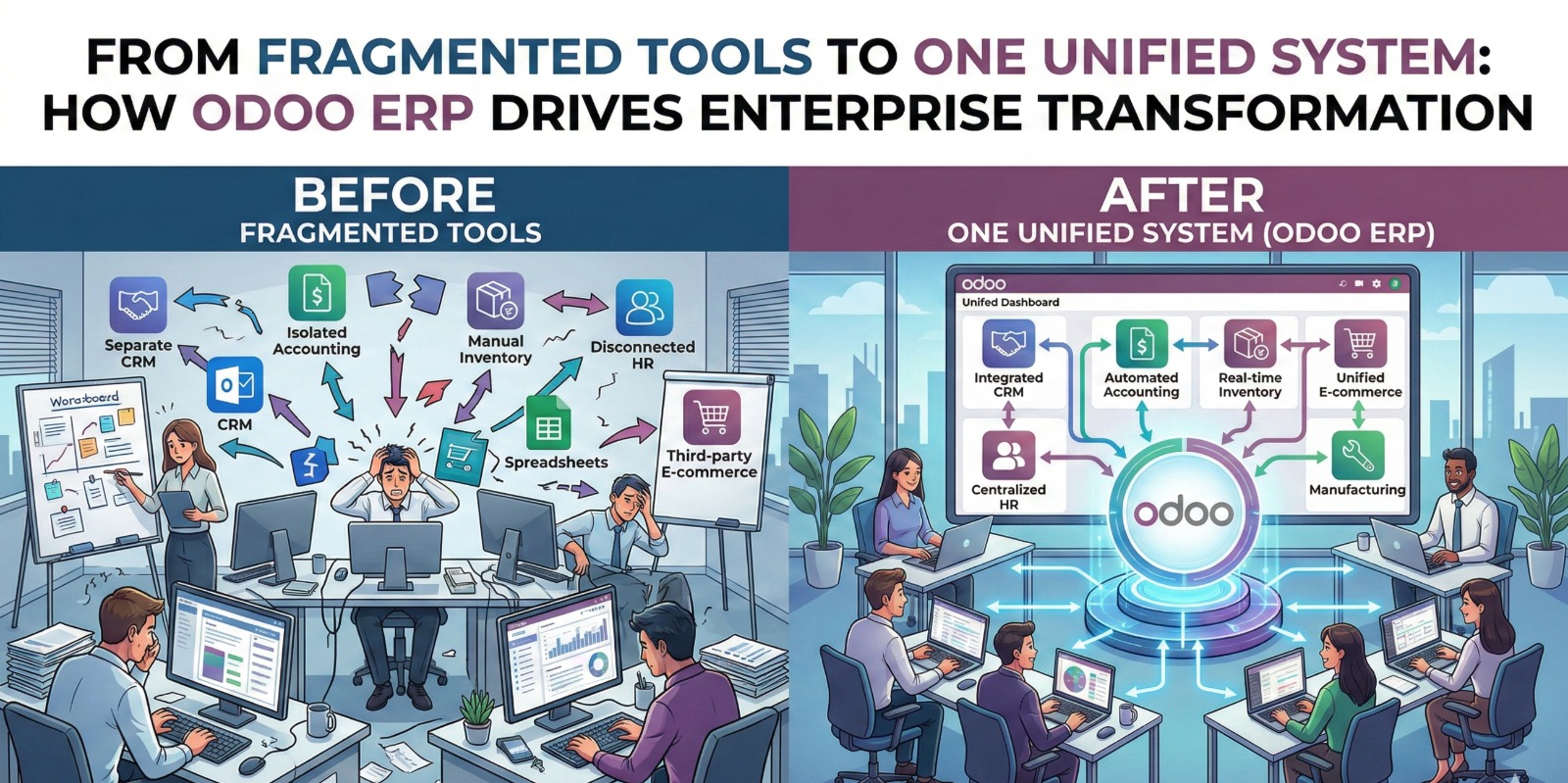
In many businesses, CRM and accounting still work separately. Sales teams use CRM, while finance teams use accounting software. This separation creates delays, errors, and confusion.
In 2026, this gap is closing fast.
Modern CRM systems now:
- Show real-time invoice status to sales teams
- Track payments, credits, and subscriptions automatically
- Connect customer behavior with revenue data
Zoho and Odoo are leading this change by tightly linking CRM with accounting, inventory, projects, and support.
The result is simple: better decisions, happier customers, and faster growth.
Zoho CRM 2026: Smart, Predictive, and Human-Friendly
Zoho’s vision for CRM is focused on automation with a human touch.
Key New Features in Zoho CRM
1. AI That Understands Customers
Zoho’s AI assistant analyzes emails, calls, and past deals to predict:
- Which leads are most likely to convert
- When a customer may stop buying
- What product or service to suggest next
2. Real-Time Finance Visibility
Sales teams can now see:
- Pending invoices
- Overdue payments
- Customer lifetime value
This helps salespeople sell smarter, not harder.
3. Omnichannel Conversations
Zoho CRM brings email, phone, WhatsApp, live chat, and social media into one screen. No more switching between apps or losing messages.
4. Simple Automation for Everyone
Non-technical users can create workflows like:
- Send a reminder when an invoice is overdue
- Notify sales when payment is received
- Auto-create tasks after a deal is closed
Zoho’s strength lies in ease of use and quick adoption, especially for small and mid-sized businesses.
Odoo CRM 2026: Fully Connected and Deeply Customizable
Odoo approaches CRM as part of a full business system rather than a standalone tool.
What’s New in Odoo CRM
1. One Platform for Everything
Odoo CRM connects directly with:
- Accounting
- Inventory
- Manufacturing
- Projects
- Helpdesk
When a deal closes, invoices, deliveries, and project tasks can be created automatically.
2. Advanced Customer Journeys
Businesses can design custom customer flows, such as:
- Lead → Quotation → Order → Invoice → Support
All in one system, with full tracking.
3. Flexible Customization
Odoo allows businesses to:
- Add custom fields
- Create custom dashboards
- Modify workflows based on industry needs
This makes it ideal for manufacturing, trading, and service-heavy organizations.
4. Strong Reporting and Forecasting
Odoo combines CRM data with accounting data to give:
- Accurate sales forecasts
- Revenue and margin reports
- Customer profitability insights
Odoo is powerful for businesses that want control and scalability.
Zoho vs Odoo: A Simple Comparison
| Area | Zoho CRM | Odoo CRM |
| Ease of use | Very easy | Moderate |
| Customization | Limited but simple | Very high |
| Accounting integration | Built-in Zoho Books | Native accounting module |
| Best for | SMEs, startups, service firms | Manufacturing, trading, complex operations |
| Deployment | Cloud-first | Cloud and on-premise |
Both platforms are strong. The right choice depends on business size, industry, and growth plans.
How CRM 2026 Improves Customer Relationships
With these new features, CRM systems now help businesses:
- Respond faster to customer needs
- Personalize communication
- Avoid billing surprises
- Build long-term trust
Customers feel understood, not tracked. That is the biggest shift happening in CRM.
Real-World Example
Imagine a growing trading company:
- A sales executive closes a deal
- An invoice is generated automatically
- The accounts team sees the payment status
- Customer receives delivery updates
- Support team gets the full history if issues arise
All of this happens without emails, Excel files, or manual follow-ups. This is CRM in 2026.
CRM 2026 Is About Relationships, Not Just Sales
The future of CRM is not about collecting data. It is about using data wisely.
Zoho and Odoo are showing that when CRM and accounting work together, businesses become more responsive, more transparent, and more customer-friendly.
As we move into 2026, companies that adopt these smarter CRM systems will not just manage customers better; they will build stronger, longer-lasting relationships.
The question is no longer “Do we need a CRM?”
The real question is “Is our CRM ready for the future?”
What is the main difference between Zoho and Odoo?
The main difference is approach. Zoho focuses on ease of use and quick setup, while Odoo focuses on deep customization and full business control.
Which CRM is better for small businesses, Zoho or Odoo?

Zoho is better for small businesses because it is easy to use, cloud-based, and requires very little technical setup. It is ideal for startups and service companies.
Is Odoo suitable for large or complex businesses?
Yes. Odoo is well suited for manufacturing, trading, and enterprise businesses that need customized workflows, advanced reporting, and strong accounting integration.
Does Zoho include accounting features?
Yes. Zoho CRM integrates smoothly with Zoho Books, allowing businesses to manage invoices, payments, and customer financial data in one ecosystem.
Does Odoo have built-in accounting?
Yes. Odoo includes a native accounting module that works directly with CRM, inventory, sales, and operations, making it a full ERP solution.
Which platform is better for customization?
Odoo offers more flexibility and customization. Businesses can modify workflows, dashboards, and modules to match their exact operational needs.



Post Comment