

Table of Contents
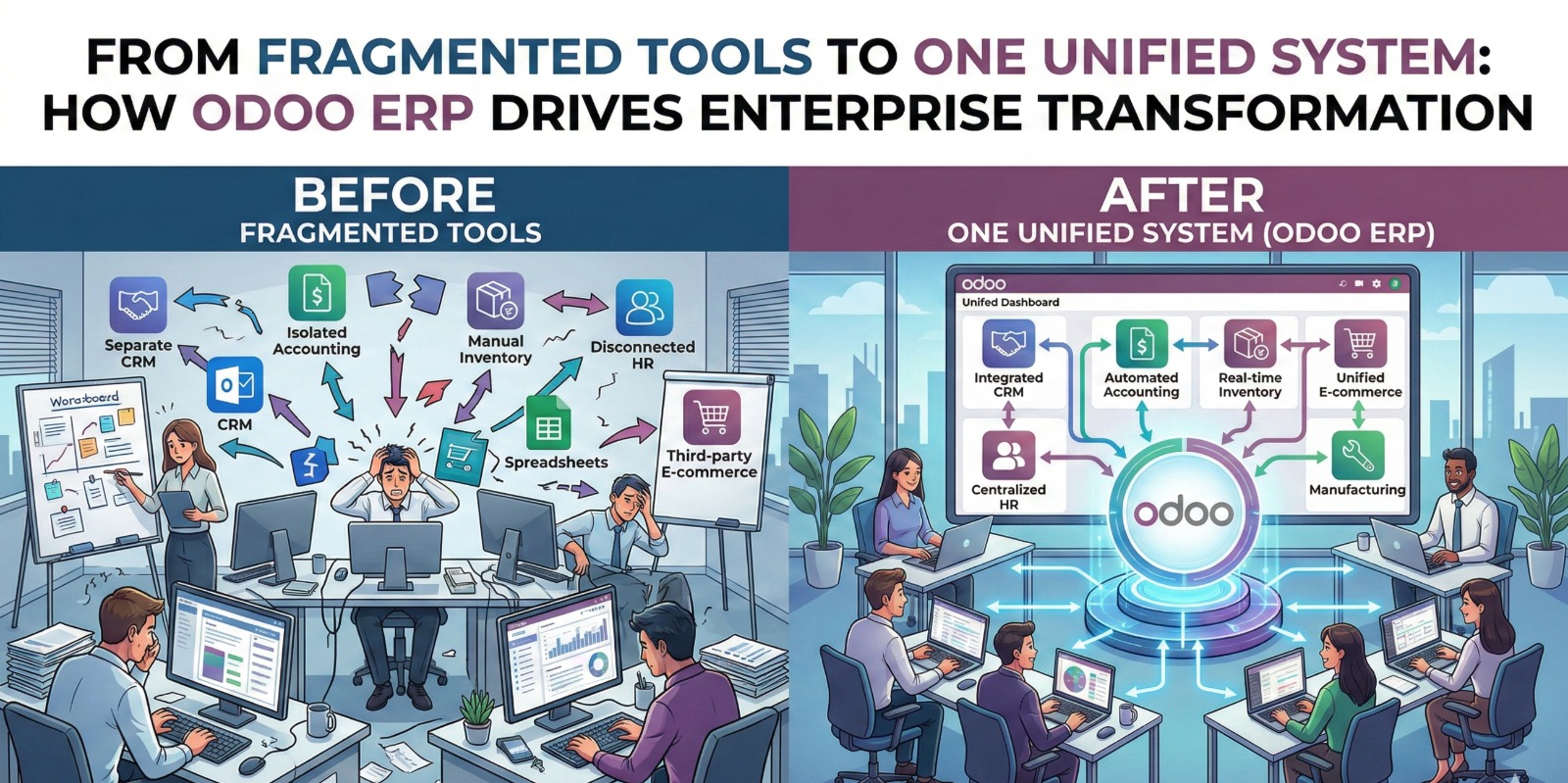
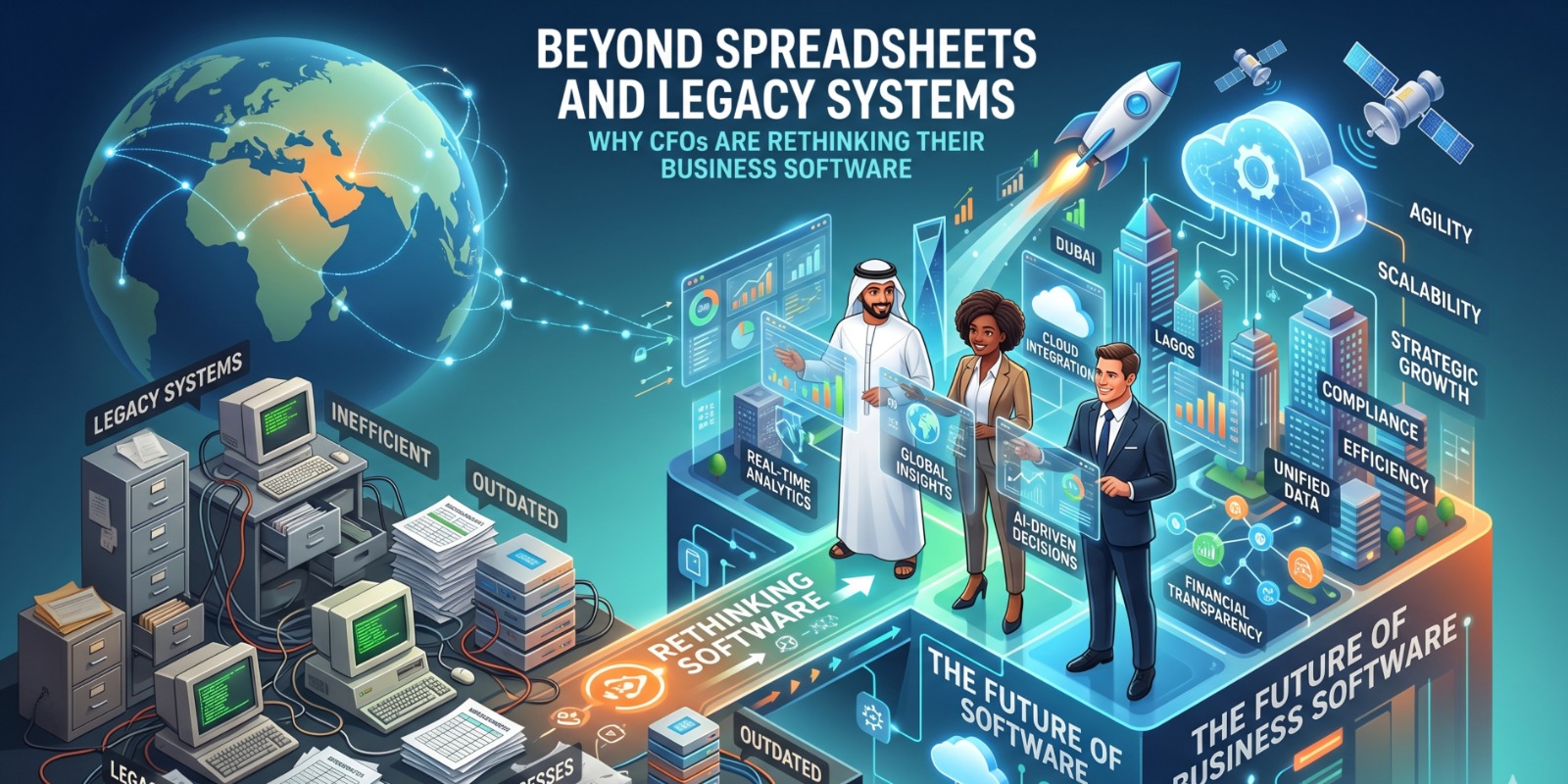
For CIOs and COOs, digital transformation rarely fails due to a lack of technology. It fails because of fragmentation. Over time, organizations accumulate specialized tools—CRM for sales, accounting software for finance, standalone HR systems, inventory spreadsheets, and third-party project trackers. Each system works independently. None works together.
The result? Disconnected data, reporting delays, duplicate efforts, and strategic blind spots.
Enterprise leaders are no longer asking, “Which tool should we add next?”
They are asking, “How do we unify what we already have?”
This is where Odoo ERP becomes a transformation platform—not just another application.
The Real Cost of Fragmentation
In cross-industry environments—manufacturing, retail, distribution, professional services—fragmentation creates hidden inefficiencies:
| Fragmented Environment | Business Impact |
| Multiple logins & systems | Low productivity |
| Manual data reconciliation | Reporting delays |
| Disconnected financial visibility | Poor cash flow forecasting |
| Redundant data entry | Increased error rate |
| Siloed KPIs | Strategy misalignment |
For CIOs, this means rising IT overhead.
For COOs, this means operational unpredictability.
The Unified ERP Architecture
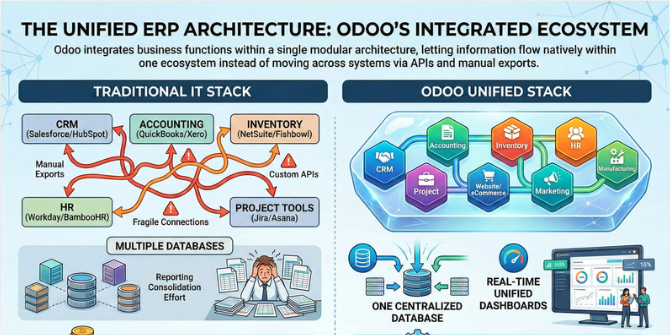
Odoo integrates business functions within a single modular architecture. Instead of data moving across systems via APIs and manual exports, information flows natively within one ecosystem.
Traditional Stack vs Odoo Unified Stack
| Traditional IT Stack | Odoo Unified Stack |
| CRM + Accounting + Inventory + HR + Project Tools | Single Integrated Platform |
| Multiple databases | One centralized database |
| Custom integrations | Native cross-module connectivity |
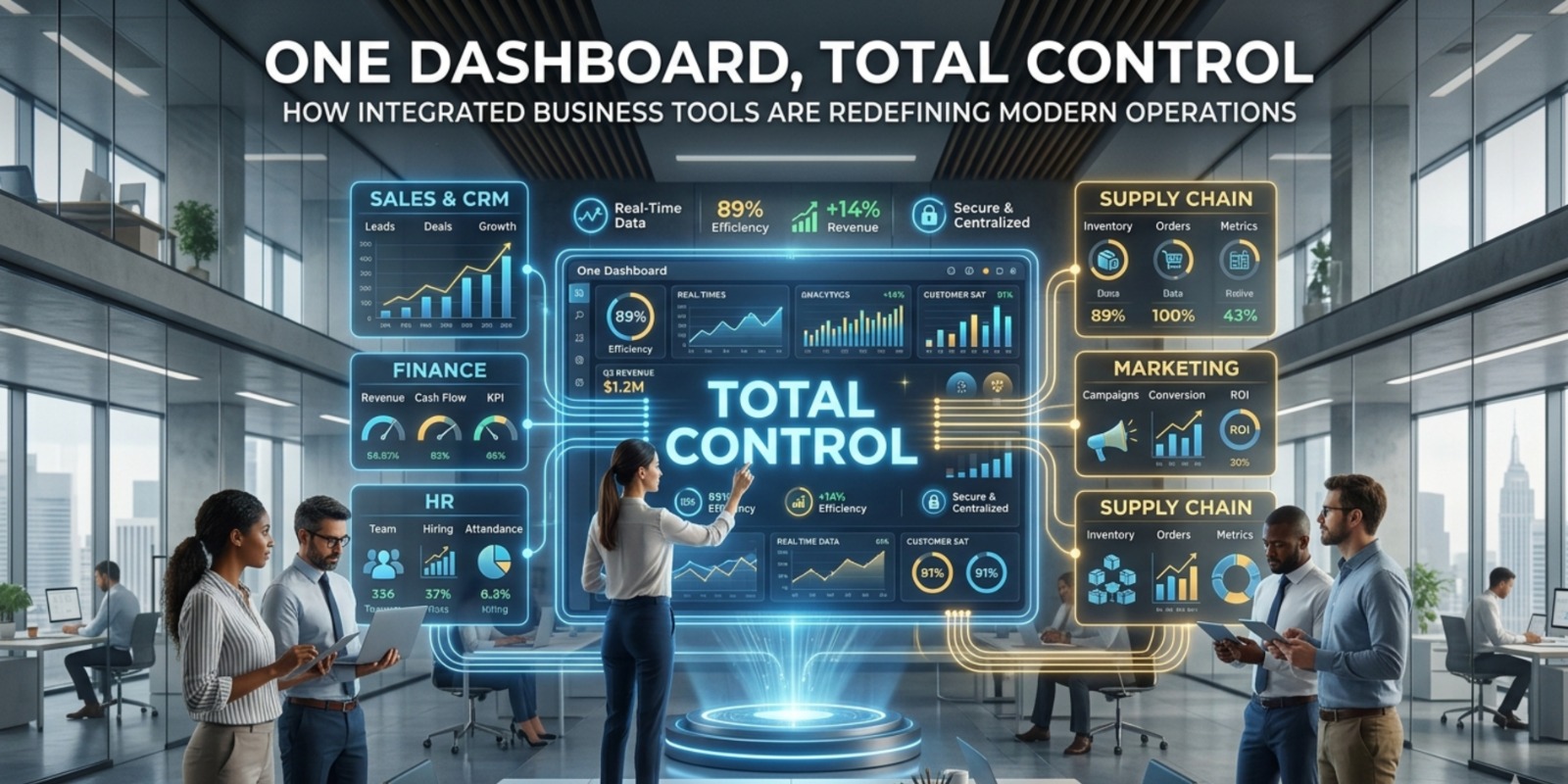
| Reporting consolidation effort | Real-time unified dashboards |
| High maintenance cost | Streamlined IT governance |
How the Unified Flow Works
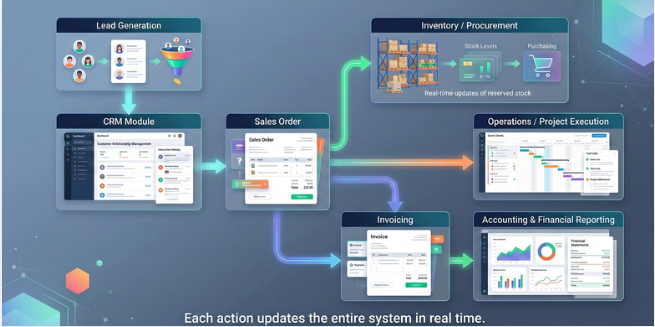
Lead Generation
↓
CRM Module
↓
Sales Order
↓
Inventory / Procurement
↓
Operations / Project Execution
↓
Invoicing
↓
Accounting & Financial Reporting
Each action updates the entire system in real time.
For example:
• Sales closes a deal → inventory reserves stock automatically
• Operations completes delivery → invoice is generated
• Invoice posts → accounting reflects revenue instantly
No reconciliation. No lag.
Executive-Level Transformation Outcomes
KPI Impact After ERP Unification
| Metric | Before ERP | After Odoo |
| Financial Close Cycle | 10–15 days | 3–5 days |
| Inventory Accuracy | 80–85% | 97–99% |
| Report Preparation Time | Manual (weekly) | Real-time |
| Inter-department Coordination | Email-based | Workflow-driven |
| IT Maintenance Cost | High (multiple vendors) | Reduced by consolidation |
Unified systems reduce operational friction and elevate executive visibility.
Real Cross-Industry Case Example
Case 1: Multi-Location Retail Group
Problem:
• POS software separate from accounting
• Stock inconsistencies across branches
• Delayed financial consolidation
Solution:
• Implemented Odoo Sales, Inventory, Accounting
• Centralized database across locations
Result (9 months):
• 30% faster inventory reconciliation
• 25% reduction in stock-outs
• Real-time margin tracking per branch
Case 2: Manufacturing & Distribution Company
Problem:
• CRM separate from ERP
• Production planning manual
• Finance disconnected from operations
Solution:
• Odoo MRP + CRM + Accounting integration
Result:
• Lead-to-cash cycle reduced by 22%
• Production planning accuracy improved
• Working capital optimized through better demand forecasting
Visualizing the Transformation
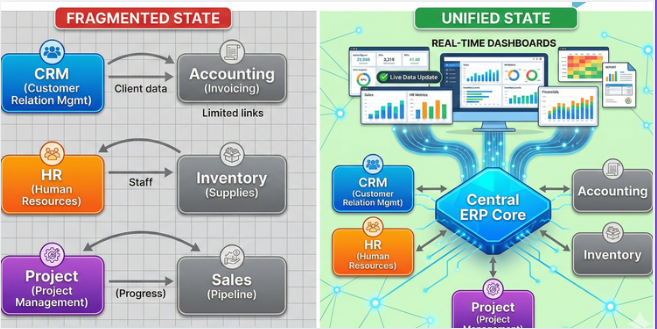
Fragmented State
CRM → Accounting
HR → Inventory
Project → Sales
(No real-time synchronization)
Unified State
All Departments → Central ERP Core → Real-Time Dashboards
Strategic Benefits for CIO & COO
For CIOs
• Reduced vendor complexity
• Simplified security governance
• Lower integration maintenance
• Scalable modular architecture
• Standardized data structure
For COOs
• End-to-end operational visibility
• Automated workflows
• Reduced manual intervention
• Data-driven forecasting
• Faster decision cycles
Financial Visibility: The Leadership Advantage
In fragmented environments, leadership dashboards are backward-looking. Data must be consolidated manually before insights are produced.
With Odoo:
• Revenue recognition is immediate
• Cost allocations update automatically
• Budget vs actual reports are live
• Department performance is measurable daily
This shifts management from reactive to predictive.
ROI Visualization
Operational Efficiency ↑
Reporting Time ↓
IT Cost ↓
Decision Speed ↑
The compounding impact over 12–24 months becomes significant—not only operationally but strategically.
Why Unified ERP is a Board-Level Decision
Fragmentation limits scalability. As organizations expand—new branches, new product lines, new geographies—the complexity multiplies.
Adding more tools increases risk.
Unifying systems reduces entropy.
Odoo’s modular structure allows enterprises to start with core modules and expand progressively—without re-platforming.
This transforms controlled rather than disruptive.
Conclusion: Transformation Is Not About Adding Tools
For CIOs and COOs, the future of enterprise performance lies in simplification.
Fragmented tools create friction.
Unified systems create momentum.
Odoo ERP is not merely a software migration.
It is an operating model shift—from disjointed processes to synchronized execution.
The organizations that move from tool accumulation to system integration will outperform in speed, accuracy, and strategic clarity.
In today’s competitive environment, unification is no longer optional.
It is foundational.




Post Comment