
Table of Contents
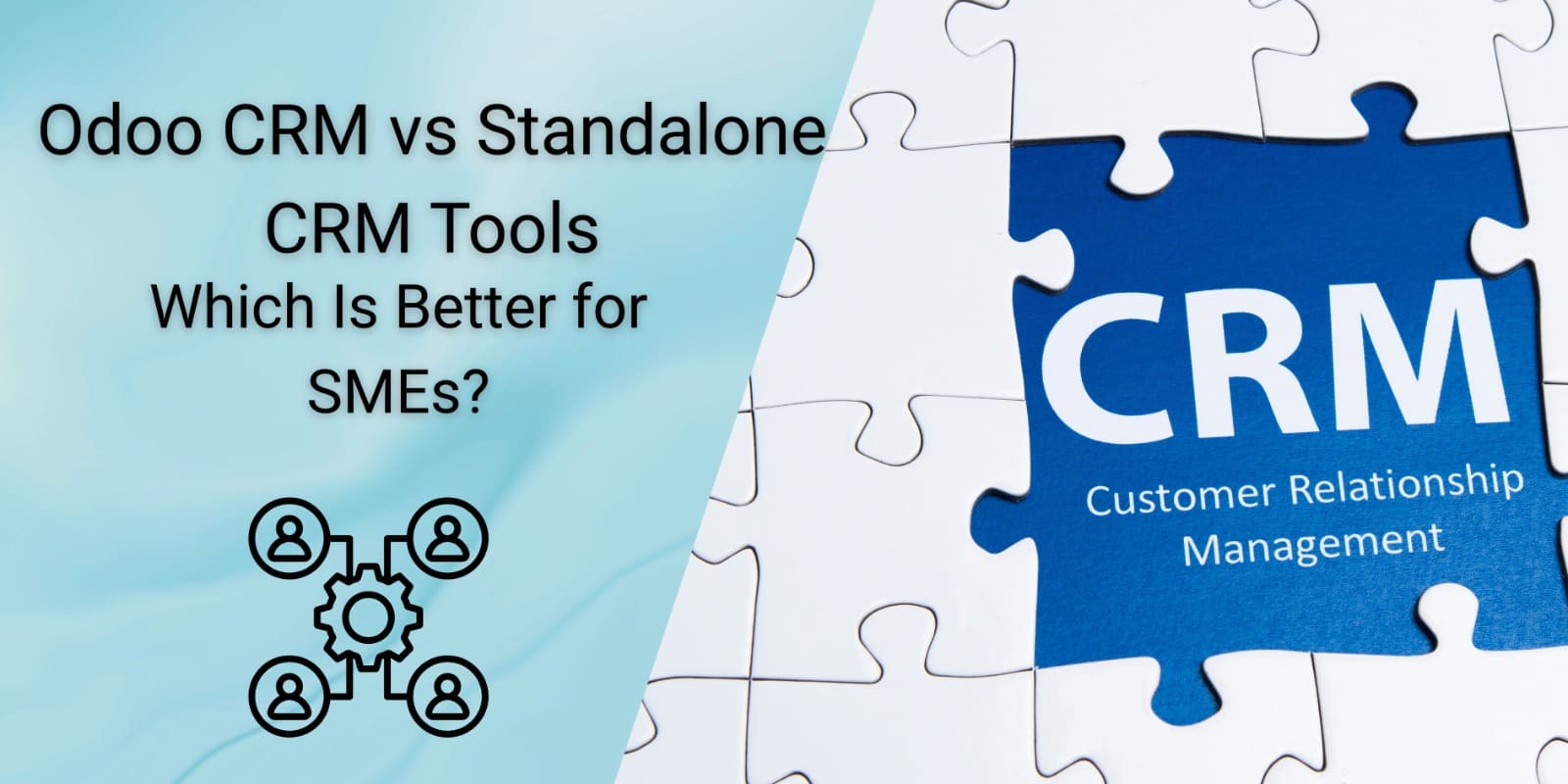
For most small and medium-sized business owners, managing customers is not the real challenge—managing information about customers is. Many SMEs start with standalone CRM tools because they look simple and affordable. Over time, however, these tools often create more confusion than clarity. This is where the comparison between a standalone CRM and Odoo CRM becomes important.
This blog explains the difference in simple terms and helps business owners understand which option truly supports growth.
The Reality of CRM in Small Businesses
In the early stages, a standalone CRM works fine. It helps track leads, customer details, and follow-ups. But as the business grows, sales activities start touching many other areas—pricing, invoicing, inventory, delivery, and payments.
At this point, business owners begin to notice gaps:
- Sales data does not match invoices
- Sales teams promise stock that is not available
- Customer follow-ups depend on manual updates
- Management lacks a clear picture of sales performance
These problems are not caused by the CRM itself, but by disconnected systems.
What Standalone CRM Tools Do Well (And Where They Fall Short)
Standalone CRM tools focus only on sales and customer communication. They are easy to start with, but limited when the business becomes operationally complex.
| Area | Standalone CRM |
| Lead tracking | Good |
| Sales follow-ups | Good |
| Invoice visibility | Limited or none |
| Inventory awareness | Not connected |
| Payment status | Manual tracking |
| Business overview | Fragmented |
As a result, sales teams often work with incomplete information.
The Odoo CRM Difference: One System, One View
Odoo CRM works differently. It is not just a sales tool—it is part of the entire business system.
When a lead becomes a customer in Odoo:
- The quotation is created from the same system
- The invoice is generated automatically
- Inventory availability is visible to sales
- Payment status is tracked without follow-ups
Everything is connected. There is no need to switch tools or reconcile data later.
Simple Comparison: Odoo CRM vs Standalone CRM
| Feature | Standalone CRM | Odoo CRM |
| Lead management | Yes | Yes |
| Sales pipeline | Yes | Yes |
| Quotation & invoicing | No | Yes |
| Inventory visibility | No | Yes |
| Customer payment status | Manual | Automatic |
| Business scalability | Limited | High |
For SMEs, this integration makes daily operations smoother and faster.
Real-Life SME Example
A service-based SME with 12 sales staff was using a standalone CRM for follow-ups and Excel for invoicing.
Before Odoo
- The sales team could not see the invoice status
- Frequent follow-ups for already paid customers
- Management spent time matching sales and revenue
After Switching to Odoo CRM
- The sales team saw the payment status instantly
- Fewer customer complaints
- Clear sales-to-revenue visibility
The business did not hire more staff—it simply removed confusion.
Why This Matters for Business Owners
For business owners, CRM is not about managing leads—it is about control and clarity. When systems are disconnected:
- Decisions are delayed
- Reports are unreliable
- Growth feels chaotic
Odoo CRM gives owners one clear view of:
- What is being sold
- What has been invoiced
- What has been paid
This clarity helps businesses grow confidently.
The Hidden Cost of Standalone CRM Tools
Standalone CRM tools often look cheaper at first. But the hidden cost appears later:
- Extra tools for invoicing
- Manual data entry
- Time spent fixing mismatches
- Poor decision-making due to incomplete data
Odoo CRM reduces these hidden costs by replacing multiple tools with one system.
Trending Insight: SMEs Are Choosing Integrated CRM
Today’s SMEs want less software, not more. Instead of managing 4–5 tools, they prefer one system that grows with them. This is why integrated CRM systems like Odoo are becoming more popular among growing businesses.
Final Takeaway
Standalone CRM tools are useful for early-stage businesses. But for SMEs planning growth, they quickly become limiting.
Odoo CRM offers:
- Simple sales tracking
- Clear customer visibility
- Seamless connection with invoicing and payments
- Better control for business owners
For SMEs, the real question is not “Which CRM is cheaper?”
It is “Which CRM helps me run my business better?”
For many growing businesses, Odoo CRM is the better long-term choice.
1. What is the main difference between Odoo CRM and standalone CRM tools?
Standalone CRM tools focus only on leads and follow-ups, while Odoo CRM connects sales with invoicing, payments, and inventory in one system.
2. Is Odoo CRM suitable for small businesses?
Yes. Odoo CRM is simple to use and works well for small and growing businesses that want better control as they scale.
3. Why do standalone CRM tools become difficult as businesses grow?
As businesses grow, sales data needs to connect with invoices, payments, and stock. Standalone CRM tools cannot provide this full visibility.
4. Does Odoo CRM replace accounting and invoicing tools?
Yes. Odoo CRM works together with Odoo invoicing and accounting, reducing the need for separate tools.
5. Which CRM is better for the long-term growth of SMEs?
For long-term growth, Odoo CRM is better because it scales with the business and avoids data gaps between departments.



Post Comment