

Table of Contents
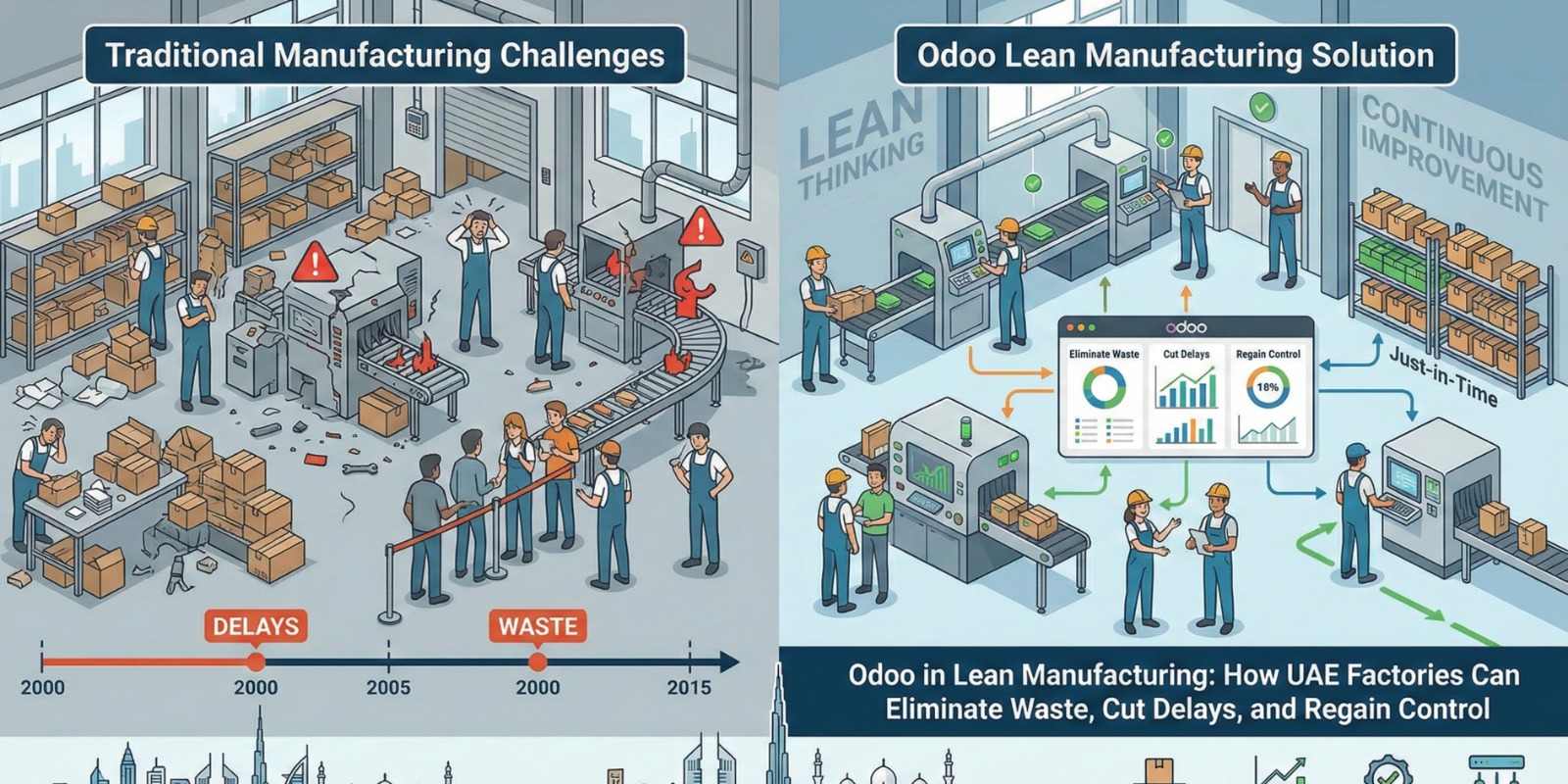
Manufacturing businesses today operate under constant pressure—shorter delivery timelines, rising costs, unpredictable demand, and increasing customer expectations. Yet many manufacturers still rely on disconnected tools, manual planning, and delayed reporting to manage production. This gap between how factories operate and how they are managed is where inefficiencies begin. Odoo Manufacturing was built to close this gap by giving manufacturers real-time control over production, materials, and performance from a single system.
At its core, Odoo Manufacturing is designed to help businesses move from reactive production to planned, visible, and predictable operations.
The Core Challenge in Manufacturing Today
Most production delays and cost overruns do not come from machines or people—they come from a lack of visibility. Production plans are created in isolation, inventory data is outdated, and shop floor progress is reported after the fact. This leads to missed deadlines, excess inventory, and last-minute firefighting.
Manufacturers need one clear answer to three questions every day:
- What should we produce?
- Do we have the materials?
- Are we on schedule?
Odoo Manufacturing answers these questions in real time.
How Odoo Manufacturing Works as One Connected System
Odoo Manufacturing does not treat production as a standalone activity. It connects sales, inventory, purchasing, and accounting directly to manufacturing operations. When a sales order is confirmed, production requirements are automatically calculated. When raw materials are received, availability updates instantly. When production is completed, inventory and financial records update without manual effort.
This end-to-end connection eliminates guesswork and ensures that decisions are based on current data, not assumptions.
From Sales Order to Finished Product: A Clear Production Flow
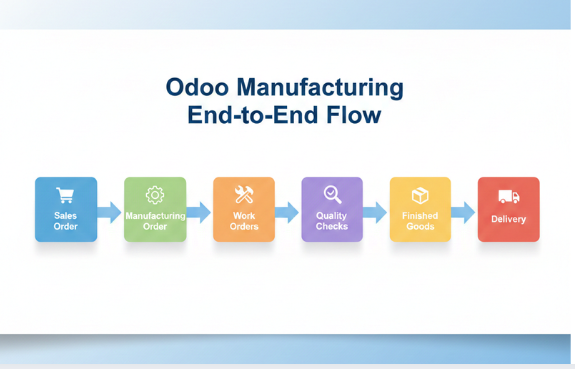
Sales Order → Manufacturing Order → Work Orders → Quality Checks → Finished Goods → Delivery
Every step is tracked, timed, and visible. Managers no longer need to wait for reports to understand what is happening on the shop floor.
Key Features That Transform Manufacturing Operations
1. Bill of Materials (BoM) with Real Control
Odoo allows manufacturers to define single-level or multi-level Bills of Materials. Each component, quantity, and operation is clearly defined. This ensures accurate material planning and cost calculation before production even begins.
2. Real-Time Work Order Tracking
Work orders are executed digitally on the shop floor. Operators update progress as they work, giving supervisors live visibility into job status, delays, and completion times.
3. Capacity and Work Center Planning
Odoo shows machine load and work center availability using simple planning views. Bottlenecks are visible early, allowing planners to reschedule before delays occur.
4. Inventory Linked to Production
Raw material availability is checked automatically before production starts. If materials are missing, Odoo triggers purchase or replenishment actions—preventing last-minute stoppages.
Traditional Manufacturing vs Odoo Manufacturing
| Area | Traditional Setup | Odoo Manufacturing |
| Production planning | Manual or Excel-based | Automated & connected |
| Shop floor tracking | Paper or verbal updates | Real-time digital tracking |
| Inventory coordination | Disconnected | Fully integrated |
| Delay detection | After the fact | Immediate |
| Cost visibility | Estimated | Actual & real-time |
The difference is not just operational—it is strategic.
Real-Life Manufacturing Case Example
A mid-sized manufacturer producing custom components struggled with frequent production delays and material shortages.
Before Odoo
- Production planned in Excel
- Materials checked manually
- Delays discovered only at shift-end
- High overtime to meet deadlines
After Implementing Odoo Manufacturing
- Automated production planning from sales orders
- Live material availability checks
- Real-time shop floor updates
- Proactive rescheduling based on capacity
Results within 6 months
- 25% reduction in production delays
- Improved on-time delivery
- Lower overtime costs
- Better use of machines and labor
Production Analytics That Support Better Decisions
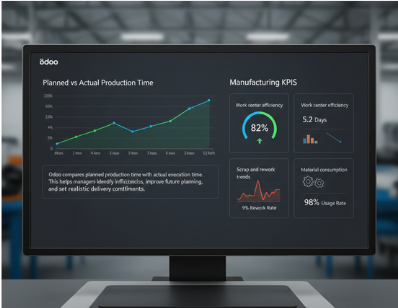
Odoo compares planned production time with actual execution time. This helps managers identify inefficiencies, improve future planning, and set realistic delivery commitments.
- Work center efficiency
- Production lead time
- Scrap and rework trends
- Material consumption
These insights turn production data into actionable intelligence.
Manufacturing at Scale: Simple for SMEs, Powerful for Enterprises
Odoo Manufacturing scales naturally. Small manufacturers can start with basic production and inventory control. As operations grow, they can add:
- Quality checks
- Maintenance
- Subcontracting
- Barcode-based shop floor control
There is no need to replace the system as the business grows—only to extend it.
Why Manufacturers Are Choosing Odoo Today
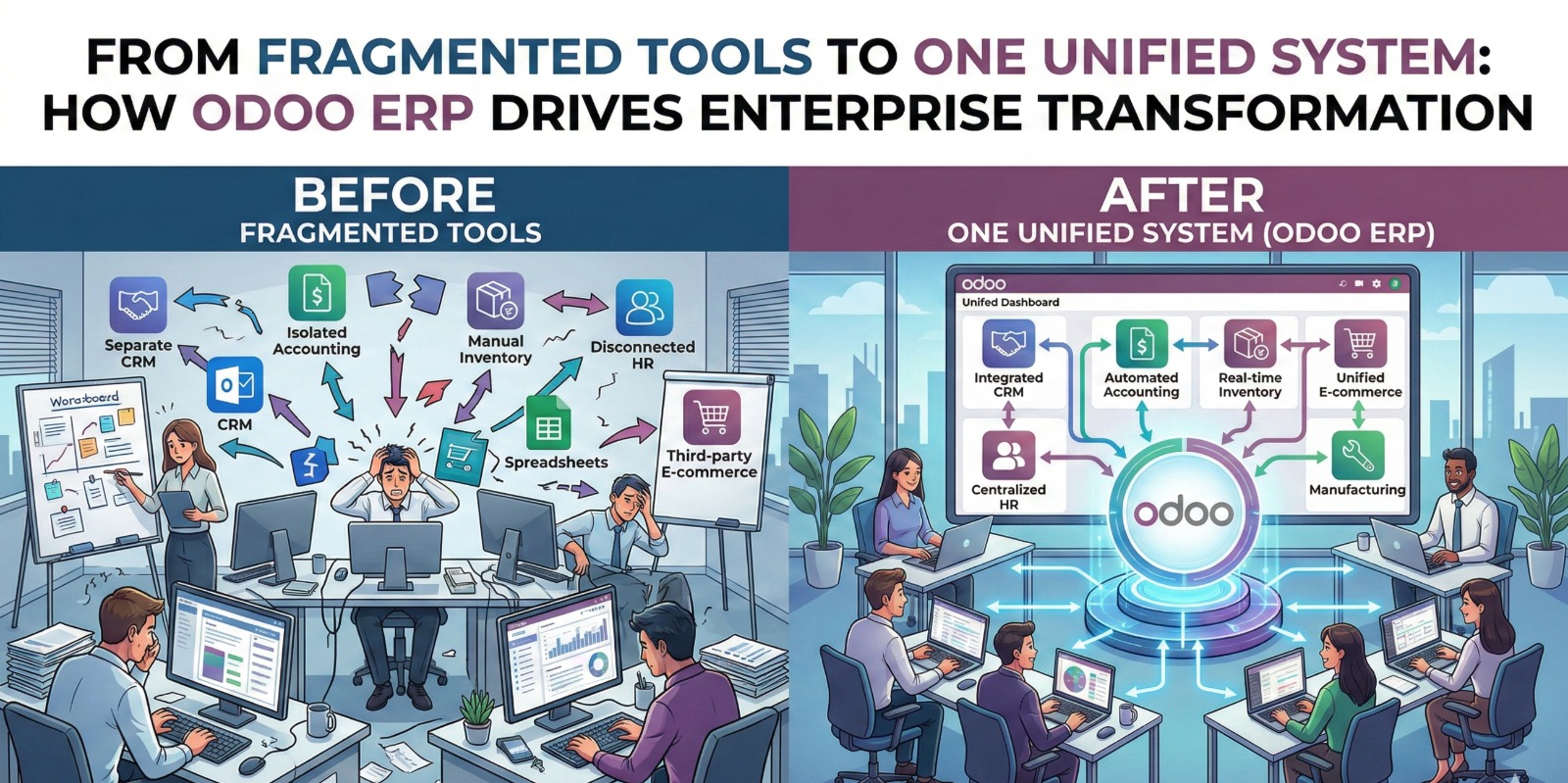
Manufacturers choose Odoo not because it is complex, but because it is practical. It replaces multiple disconnected tools with one system that reflects real operations. It reduces manual work, improves coordination, and provides management with confidence in their numbers.
Most importantly, Odoo helps manufacturers move from firefighting to controlled execution.
Final Perspective
Manufacturing success today depends on visibility, coordination, and speed. Systems that rely on delayed updates and manual reporting cannot support modern production demands.
Odoo Manufacturing provides a clear, connected, and real-time view of production—from raw materials to finished goods. For manufacturers looking to improve delivery performance, reduce costs, and scale with confidence, Odoo Manufacturing is not just a tool—it is an operational advantage.
1. What is Odoo Manufacturing used for?
Odoo Manufacturing is used to plan, track, and manage production processes, including bills of materials, work orders, inventory, and shop floor operations.
2. How does Odoo Manufacturing reduce production delays?
Odoo provides real-time visibility into work orders, material availability, and machine capacity, allowing managers to identify and resolve delays early.
3. Can Odoo Manufacturing handle small and large factories?
Yes. Odoo Manufacturing is scalable and works for small manufacturers as well as multi-location production facilities.
4. Does Odoo Manufacturing integrate with inventory and sales?
Yes. Odoo connects sales orders, inventory, purchasing, and manufacturing into one system, ensuring accurate planning and execution.
5. Is Odoo Manufacturing suitable for make-to-order and make-to-stock?
Yes. Odoo supports both make-to-order and make-to-stock production strategies.




Post Comment