


How Odoo Delivers Real-Time Inventory Accuracy for Multi-Warehouses Distribution
Table of Contents
In logistics and distribution, inventory accuracy is not an operational metric—it is a financial and reputational risk factor. For warehouse directors managing multiple storage locations, even minor discrepancies compound into stockouts, overstocking, delayed shipments, and dissatisfied customers.
Multi-warehouse operations add layers of complexity. Goods move between locations. Safety stock levels vary. Transfer orders are frequent. Without real-time synchronization, inventory data quickly becomes unreliable.
This is where Odoo Inventory transforms distribution control. By centralizing stock visibility and automating warehouse workflows, Odoo enables directors to manage multi-location distribution networks with clarity and precision.
The Hidden Cost of Multi-Warehouse Inaccuracy
Warehouse directors typically face:
- Stock mismatches between physical and system counts
- Delayed inter-warehouse transfers
- Inaccurate availability shown to sales teams
- Overstocking in one location while another faces shortages
- Limited real-time reporting
In high-volume distribution environments, these inefficiencies translate into lost revenue and rising operational costs.
The core problem is fragmented visibility.
How Odoo Centralizes Multi-Warehouse Operations
Odoo Inventory connects all warehouse locations into one unified system. Each warehouse operates independently yet remains fully synchronized with the central database.
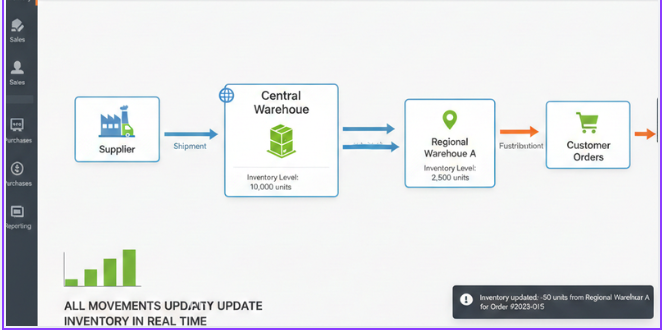
With Odoo, directors gain:
- Livestock quantities per location
- Automated transfer workflows
- Real-time product availability
- Batch and serial tracking
- Automated replenishment rules
This eliminates guesswork across facilities.
Real-Time Stock Accuracy Across Locations
When stock moves from Warehouse A to Warehouse B, Odoo updates quantities instantly. Sales teams see accurate availability. Procurement teams trigger replenishment automatically when minimum stock thresholds are reached.
No manual adjustments. No spreadsheet reconciliation.
Traditional Multi-Warehouse Setup vs Odoo Integrated Model
| Area | Traditional Setup | Odoo Inventory |
| Stock updates | Manual / delayed | Real-time |
| Transfer tracking | Email-based | System-driven |
| Visibility | Location-specific | Unified dashboard |
| Replenishment | Reactive | Automated rules |
| Reporting | End-of-day | Live analytics |
Operational complexity reduces significantly when systems are integrated.
Inter-Warehouse Transfer Automation
In distribution networks, stock balancing is continuous. Odoo enables automated transfer rules based on demand patterns.
For example:
- Regional Warehouse stock falls below the threshold
- Odoo triggers an internal transfer request
- Central warehouse confirms dispatch
- Receiving warehouse updates stock instantly
This reduces emergency procurement and improves delivery reliability.
Real-World Distribution Case Example
A regional distributor managing three warehouses struggled with inventory inconsistencies.
Before Odoo
- Manual stock reconciliation across sites
- Frequent stockouts in fast-moving SKUs
- Overstocking in slower-moving warehouses
- Delayed fulfillment
After Odoo Implementation
- Unified stock visibility
- Automated inter-warehouse transfers
- Real-time dashboards for warehouse directors
Results Within 6 Months
- 25% reduction in stock discrepancies
- Improved order fulfillment accuracy
- Faster internal stock balancing
- Reduced emergency procurement costs
The distribution network shifted from reactive adjustments to proactive planning.
Intelligent Replenishment & Demand Forecasting
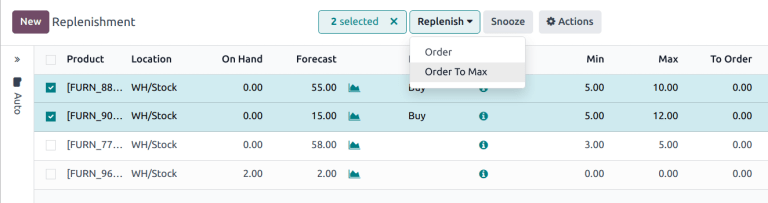
Odoo supports minimum stock rules and demand-based forecasting. Warehouse directors can configure automatic reordering policies per location, ensuring inventory levels remain optimized.
This improves:
- Service levels
- Inventory turnover
- Working capital efficiency
Inventory accuracy becomes a strategic advantage rather than a daily challenge.
Advanced Tracking for Logistics Operations
Odoo also supports:
- Lot and serial number tracking
- Expiry management
- Barcode scanning integration
- Multi-step routes (Pick → Pack → Ship)
These features improve compliance and reduce picking errors in high-volume distribution environments.
Executive-Level Benefits for Warehouse Directors
With Odoo Inventory, leadership gains:
- Complete visibility across all warehouse locations
- Reduced operational errors
- Data-driven stock optimization
- Faster inter-warehouse coordination
- Real-time KPI dashboards
Inventory management shifts from manual correction to structured automation.
Final Perspective
Multi-warehouse distribution does not fail because of workload. It fails because of disconnected systems and delayed data.
Odoo Inventory centralizes stock control, automates warehouse workflows, and delivers real-time visibility across every location. For warehouse directors responsible for operational precision, this integration ensures inventory accuracy becomes predictable—not reactive.
1. How does Odoo manage multiple warehouses?
Odoo allows businesses to configure multiple warehouse locations under one system, enabling real-time stock tracking and automated internal transfers.
2. Can Odoo automate inter-warehouse transfers?
Yes. Odoo can trigger transfer requests automatically based on stock thresholds and demand levels.
3. Does Odoo support barcode scanning?
Yes. Odoo integrates with barcode systems to improve picking, packing, and shipping accuracy.
4. How does Odoo improve inventory accuracy?
Odoo updates stock levels instantly after every transaction—sales, transfers, or receipts—reducing discrepancies.
Stock chaos is not inevitable.
It is a system problem—and system problems require structured solutions.




Post Comment