

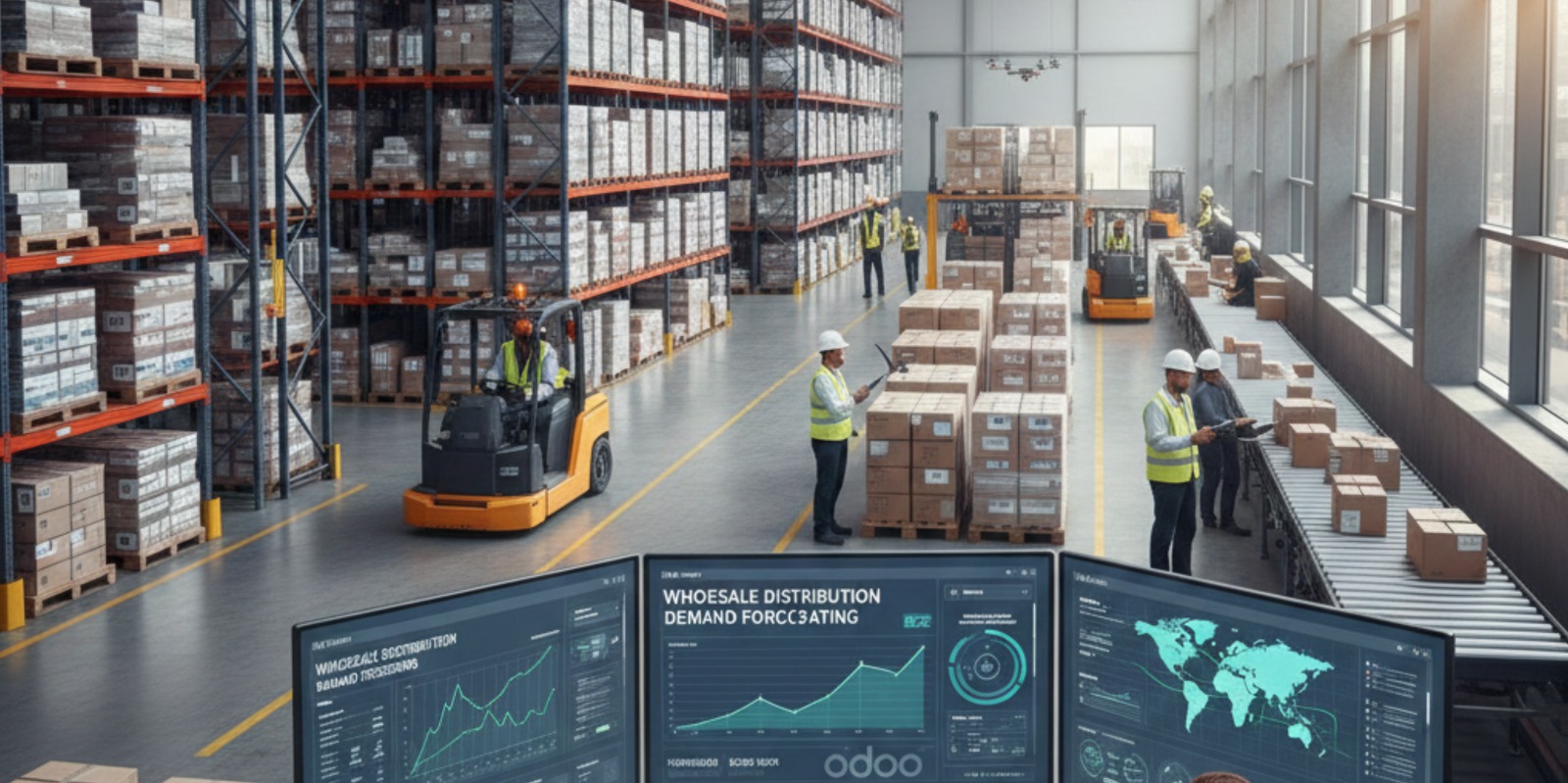
From Stockouts & Overstock to Predictable, Data-Driven Inventory Control
Table of Contents
In wholesale distribution, demand volatility is not an exception — it is the operating environment. Seasonal spikes, supplier lead-time variability, multi-warehouse coordination, and price fluctuations create constant uncertainty. For demand planners and COOs, the core challenge is simple yet brutal: How do we stock the right products, in the right quantity, at the right time — without locking capital in excess inventory?
Traditional forecasting methods — spreadsheets, static ERP reports, or disconnected BI tools — are reactive. They analyze yesterday’s data while operations move at tomorrow’s speed. Modern distributors are moving toward integrated forecasting within their ERP ecosystem, and Odoo has emerged as a practical, scalable solution.
The Real Cost of Poor Forecasting in Wholesale
Demand forecasting errors directly affect three financial metrics:
- Working capital utilization
- Order fulfillment rate
- Gross margin stability
Operational Impact Snapshot
| Forecasting Issue | Immediate Effect | Strategic Impact |
| Overstocking | Excess carrying cost | Reduced cash flow |
| Stockouts | Lost sales | Customer churn |
| Manual planning | Slow decisions | Reduced agility |
| Disconnected systems | Data inconsistency | Poor executive visibility |
For COOs, forecasting accuracy is not a planning exercise — it is a balance sheet decision.
Why Legacy Systems Fall Short
Most legacy ERP systems treat forecasting as a reporting feature rather than a decision engine. Forecast data is often siloed from procurement, sales, and warehouse modules.
Traditional Forecasting Flow
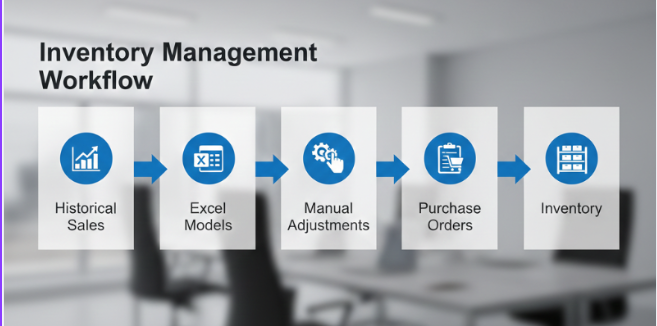
This linear structure introduces delays, version control issues, and limited scenario planning capability.
Integrated Forecasting with Odoo
Odoo embeds demand forecasting directly within the ERP workflow. Sales history, procurement, inventory turnover, vendor lead times, and warehouse stock levels are connected in real time.
Modern Forecasting Flow in Odoo
Sales History + Lead Time + Seasonality
↓
Demand Forecast Engine
↓
Automated Reordering Rules
↓
Purchase Planning + Inventory Optimization
↓
Real-Time KPI Dashboard
This creates a closed-loop system where forecast data automatically influences procurement and stock decisions.
Key Features for Demand Planners
| Feature | Business Benefit |
| Automated Reordering Rules | Prevent stockouts |
| Forecasted Inventory Reports | Better purchase timing |
| Multi-Warehouse Planning | Regional optimization |
| Vendor Lead Time Integration | Smarter procurement |
| Real-Time Inventory Valuation | Accurate working capital view |
Unlike disconnected tools, Odoo synchronizes demand forecasts with operational execution.
Comparative View: Legacy vs Odoo
| Parameter | Legacy ERP | Odoo |
| Forecast Integration | External tool | Built-in ERP workflow |
| Data Refresh | Periodic | Real-time |
| Multi-Warehouse Visibility | Limited | Native support |
| Scenario Planning | Manual | Configurable rules |
| User Interface | Complex | Intuitive dashboard |
The difference lies in agility. Odoo reduces planning latency from days to minutes.
Case Study: Mid-Sized FMCG Distributor
A wholesale FMCG distributor managing 4 regional warehouses faced:
- 18% average overstock in slow-moving SKUs
- 9% monthly stockouts in fast-moving SKUs
- Manual Excel-based forecasting
- High emergency procurement cost
After implementing Odoo demand forecasting:
- Overstock reduced to 7%
- Stockouts reduced to 2%
- Procurement cycle optimized by 22%
- Inventory turnover improved by 30%
The system used automated reordering rules combined with historical sales trend analysis and vendor lead time mapping.
The key improvement was not only forecasting accuracy but also forecast execution alignment.
Demand Planning KPIs Improved with Odoo
| KPI | Before | After |
| Inventory Turnover | 5.2x | 6.8x |
| Order Fulfillment Rate | 89% | 96% |
| Carrying Cost Ratio | 21% | 14% |
| Emergency Purchase Rate | High | Minimal |
COOs gain consolidated dashboards with real-time financial impact visibility.
Strategic Advantages for COOs
- Improved cash flow through optimized stock levels
- Lower warehousing and holding costs
- Better negotiation leverage with suppliers
- Data-backed procurement decisions
- Reduced dependency on manual planning
Demand forecasting shifts from a reactive spreadsheet activity to a predictive control system.
Architecture Overview
Sales Orders
↓
Forecast Engine (Historical + Trend)
↓
Reordering Rules
↓
Procurement Planning
↓
Warehouse Allocation
↓
Executive KPI Dashboard
This architecture ensures forecasting is embedded into operations rather than being an external analytical exercise.
Future-Ready Forecasting
Odoo’s modular architecture allows integration with:
- AI-based demand prediction tools
- Advanced BI dashboards
- Multi-company distribution models
- E-commerce channel sales integration
As wholesale distribution becomes omnichannel and data-intensive, demand forecasting must evolve beyond static projections.
Executive Perspective
Wholesale distribution margins are tightening globally. Inventory mismanagement directly impacts EBITDA. The ability to forecast demand accurately and execute procurement efficiently is now a competitive differentiator.
Odoo provides a practical middle ground — robust enough for enterprise-level control yet flexible enough for mid-sized distributors.
For demand planners, it replaces spreadsheet dependency.
For COOs, it delivers financial predictability.
The real question is not whether forecasting matters.
It is whether your current ERP enables it, or obstructs it.



Post Comment