


Table of Contents
Modern businesses run on technology. Yet paradoxically, the more tools organizations adopt, the less control they often have. Marketing uses one system, finance another, inventory sits in spreadsheets, and customer communication lives in email threads or messaging apps. Each tool promises efficiency—but together they create fragmentation.
This fragmentation leads to operational blind spots, delayed decision-making, and lost growth opportunities. For leadership teams, the challenge is no longer finding new software. The real challenge is unifying the existing ecosystem.
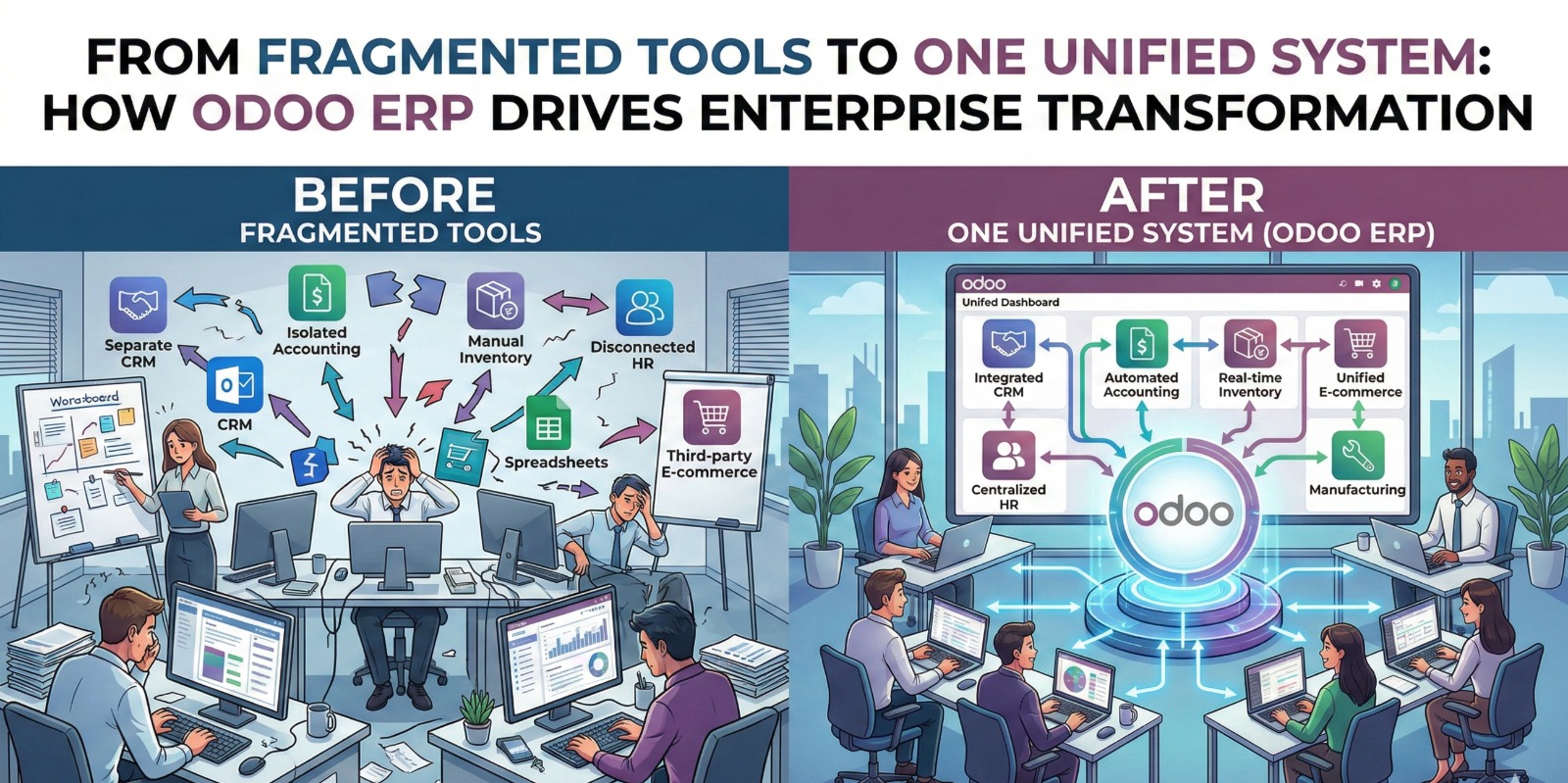
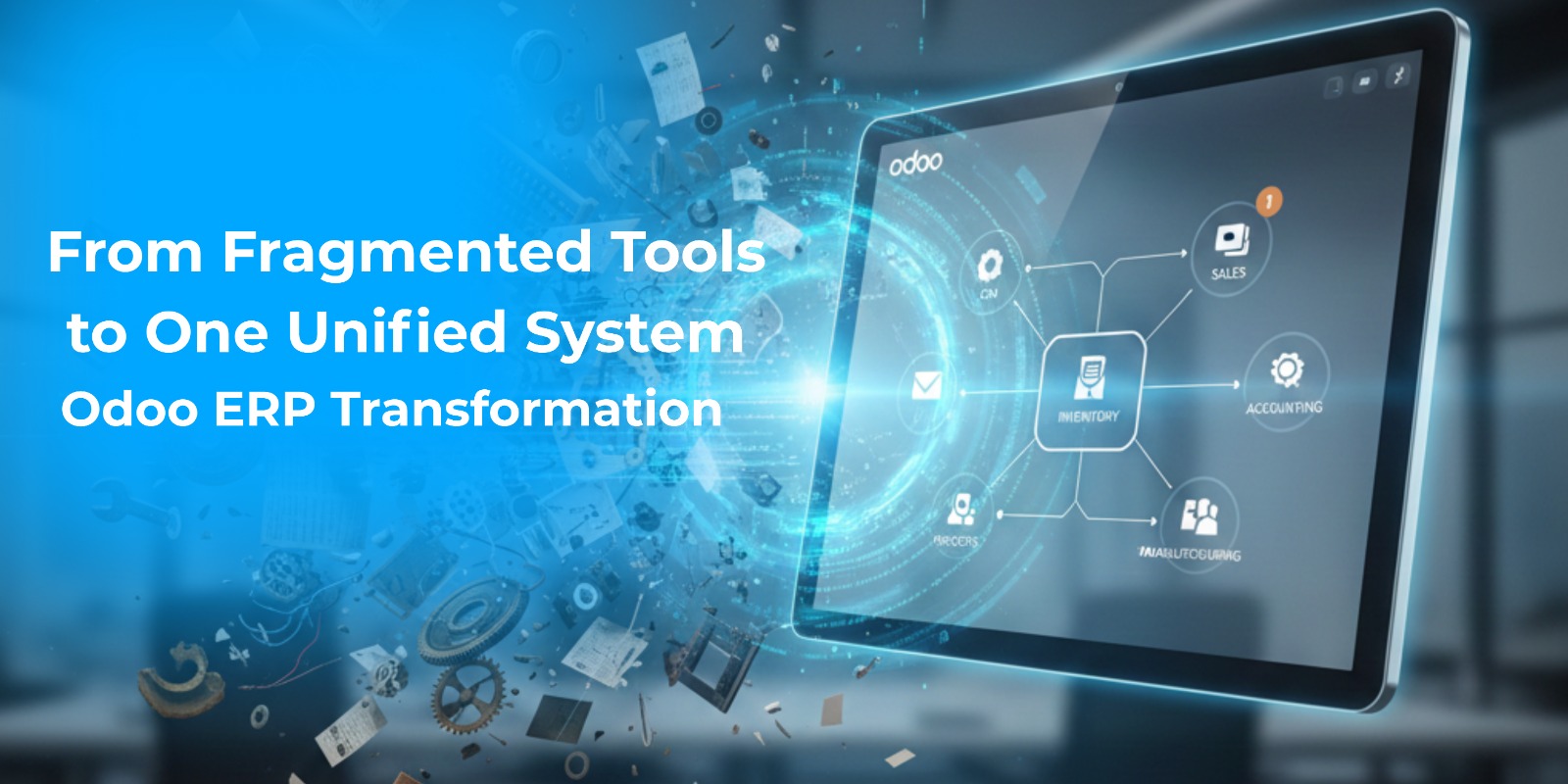
Enterprise Resource Planning (ERP) systems address this problem by bringing business operations into one integrated platform. Among modern ERP solutions, Odoo has emerged as a flexible and scalable system designed to eliminate tool fragmentation and restore operational clarity.
The Hidden Cost of Too Many Business Tools
At first glance, specialized software appears beneficial. Each department adopts tools tailored to its function. Over time, however, these systems create a fragmented technology stack.
| Department | Typical Tools Used | Resulting Issue |
| Sales | CRM platform | Data isolated from finance |
| Accounting | Accounting software | Delayed revenue visibility |
| Inventory | Spreadsheet or warehouse tool | Stock inaccuracies |
| HR | Separate HR management system | Employee data duplication |
| Marketing | Email and automation tools | Lead tracking gaps |
The real problem emerges when leaders attempt to answer simple questions such as:
- What is our real-time revenue?
- Which products are most profitable?
- How many orders are delayed?
- What is our actual inventory value today?
Without integration, these answers require manual reconciliation.
Fragmented System vs Unified ERP
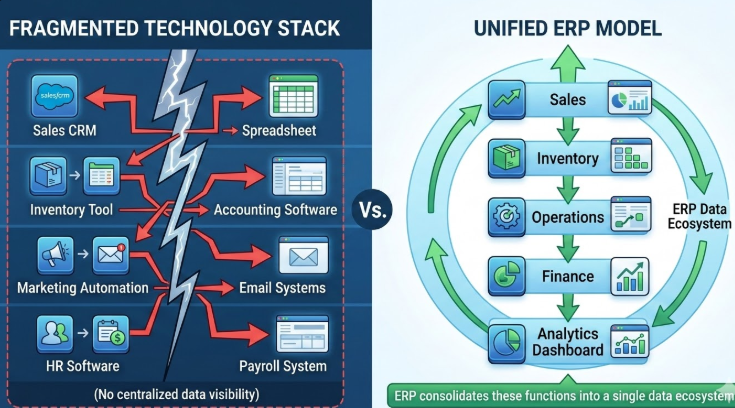
Fragmented Technology Stack
Sales CRM → Spreadsheet
Inventory Tool → Accounting Software
Marketing Automation → Email Systems
HR Software → Payroll System
(No centralized data visibility)
Unified ERP Model
Sales
↓
Inventory
↓
Operations
↓
Finance
↓
Analytics Dashboard
ERP consolidates these functions into a single data ecosystem.
Understanding the ERP Concept
Enterprise Resource Planning systems connect every core business function into one platform. Instead of moving information manually between tools, data flows automatically between departments.
| ERP Function | Business Benefit |
| Sales Management | Track leads, quotations, and orders |
| Inventory Control | Real-time stock visibility |
| Accounting | Automated financial reporting |
| Procurement | Smart purchase planning |
| HR Management | Employee lifecycle tracking |
| Project Management | Cross-team coordination |
ERP ensures that when an action happens in one department, all relevant systems update instantly.
For example:
- When sales confirm an order, inventory automatically reserves stock.
- When goods ship, the system generates the invoice.
- When payment is received, financial reports update instantly.
This synchronization eliminates delays and errors.
Why Odoo ERP Stands Out
Odoo differentiates itself from traditional ERP systems by offering modular flexibility. Businesses can start small and expand gradually.
Key Advantages of Odoo
| Feature | Advantage |
| Modular architecture | Add modules as business grows |
| Unified database | One source of truth |
| Real-time dashboards | Instant insights |
| Automation workflows | Reduced manual tasks |
| Scalable deployment | Suitable for SMEs and enterprises |
Traditional ERP systems often require heavy customization and long implementation cycles. Odoo’s modular design reduces complexity while maintaining enterprise-grade functionality.
Real Case Example: Retail Business Transformation
A mid-sized retail company operating across multiple locations faced serious operational inefficiencies.
Challenges before ERP implementation:
- Inventory tracked in spreadsheets
- Accounting is handled in separate software
- Sales reports generated manually
- Frequent stock mismatches between branches
These issues led to delayed decisions and lost sales opportunities.
Implementation Approach
The company implemented Odoo modules for:
- Sales Management
- Inventory Control
- Accounting
- Procurement
Results After 8 Months
| Metric | Before ERP | After Odoo |
| Inventory Accuracy | 82% | 97% |
| Sales Reporting Time | 2 days | Real-time |
| Stock-Out Incidents | Frequent | Reduced by 40% |
| Financial Closing Time | 10 days | 3 days |
Management gained instant visibility into operations and improved forecasting accuracy.
Operational Efficiency Impact
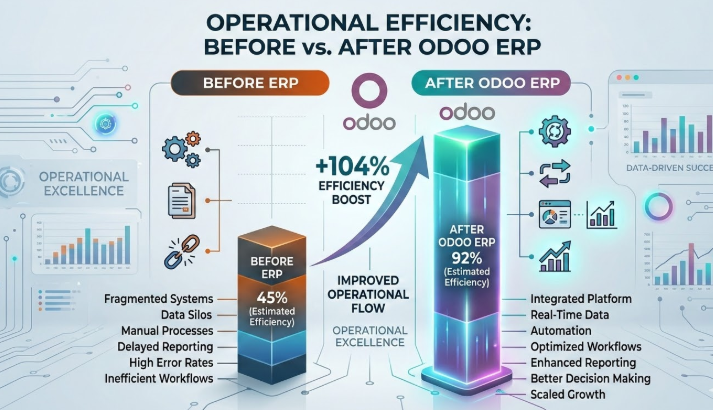
ERP does not simply automate processes—it transforms how decisions are made.
Why ERP Is Critical for Business Growth
Fragmented tools create operational friction. As companies grow, this friction compounds.
Typical symptoms include:
- Duplicate data entry
- Inconsistent reporting
- Delayed financial visibility
- Poor coordination between departments
ERP removes these barriers by creating a centralized information system.
With unified data, leadership teams gain clarity on:
- Profit margins
- Operational performance
- Customer behavior
- Supply chain efficiency
This clarity enables faster strategic decisions.
The Strategic Value of ERP
Organizations that implement ERP typically experience improvements across three dimensions:
| Dimension | Impact |
| Operational Efficiency | Reduced manual processes |
| Financial Visibility | Accurate real-time reporting |
| Strategic Agility | Faster decision-making |
ERP shifts companies from reactive management to proactive planning.
Control Is the Foundation of Growth
Businesses today face a paradox. Technology should simplify operations, yet excessive tools often create complexity.
When information is scattered across multiple platforms, leadership loses visibility, teams lose efficiency, and growth slows.
ERP solves this problem by bringing operations under one system.
Odoo, with its modular and scalable architecture, offers organizations a practical pathway toward operational clarity and sustainable growth.
Companies that unify their systems gain something far more valuable than software.
They gain control.
Call to Action
If your business is struggling with:
- Multiple disconnected tools
- Delayed reporting
- Inventory confusion
- Lack of operational visibility
It may be time to unify your operations.
👉 Book an ERP consultation today and discover how Odoo can simplify and scale your business.



Post Comment