

Table of Contents
Inventory is one of the largest investments on a company’s balance sheet—yet it is also one of the most poorly managed. Across trading, retail, manufacturing, and distribution businesses, poor inventory tracking silently erodes profit every day. The losses are rarely visible in one place; instead, they appear as stock shortages, excess inventory, delayed sales, and inaccurate financial reporting.
This article explains how poor inventory tracking directly causes financial loss, why traditional tools fail, and how Odoo Inventory solves the problem through real-time, integrated control.
How Poor Inventory Tracking Translates into Real Money Loss
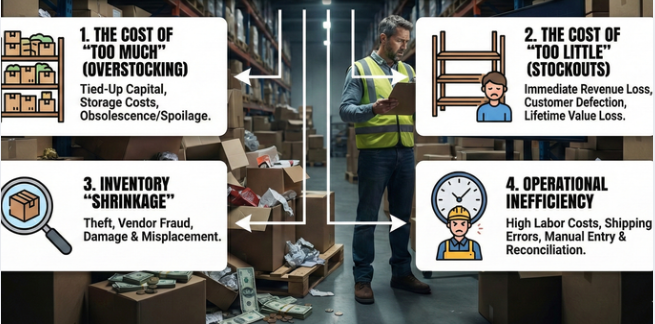
Most businesses assume inventory problems are operational. In reality, they are financial leaks.
1. Overstocking: Cash Locked on Shelves
Without accurate stock visibility, businesses over-purchase “just to be safe.”
Impact:
- Cash tied up in slow-moving items
- Higher storage and handling costs
- Risk of damage, expiry, or obsolescence
Hidden cost: Reduced working capital that could fund growth.
2. Understocking: Lost Sales You Never Recover
When inventory data is outdated:
- Sales teams promise unavailable items
- Customers walk away
- Competitors win
Lost sales are rarely tracked, but they directly reduce revenue and customer lifetime value.
3. Manual Errors and Reconciliation Costs
Businesses relying on spreadsheets or disconnected systems face:
- Data entry mistakes
- Time-consuming stock counts
- End-of-month reconciliation chaos
Staff spend time fixing data instead of selling or optimizing operations.
Where Traditional Inventory Tracking Fails
| Method | Why It Fails |
| Excel sheets | No real-time updates, error-prone |
| Standalone inventory software | Disconnected from sales & accounting |
| Manual stock counts | Reactive, not preventive |
| Department-wise systems | Multiple versions of “truth” |
These methods cannot support modern, fast-moving businesses.
The Financial Chain Reaction of Poor Inventory
Poor inventory tracking triggers a cascade:
- Inaccurate stock data
- Wrong purchasing decisions
- Overstock + understock simultaneously
- Cash flow pressure
- Inaccurate profit reporting
This is why many profitable-looking businesses struggle with liquidity.
Real-Life Business Case: Trading Company Example
Scenario
A mid-sized trading company managing inventory across:
- One warehouse
- Two sales channels
Before Odoo
- Inventory tracked in Excel
- Purchases based on intuition
- Frequent stock-outs on fast movers
- Excess stock on slow items
Financial Impact
- 20–25% capital stuck in dead stock
- Regular lost sales due to unavailability
- Delayed month-end closing
After Implementing Odoo Inventory
With Odoo Inventory:
- Real-time stock visibility
- Automated reorder rules
- Inventory linked to sales and accounting
Measured Results (within 90 days):
- 30% reduction in excess inventory
- Faster inventory turnover
- Improved cash flow
- Accurate profit reporting
Why Odoo Solves Inventory Loss at the Root
Odoo does not treat inventory as a standalone function. It treats it as a core financial engine.
Key Capabilities That Prevent Loss
| Odoo Feature | Financial Benefit |
| Real-time stock updates | No overselling or blind purchasing |
| Integrated sales & inventory | Accurate demand-driven planning |
| Automated reordering | Reduced stock-outs |
| Inventory valuation | Clear cost and margin visibility |
| Multi-location control | Optimized stock distribution |
Inventory Accuracy = Financial Accuracy
In Odoo:
- Every stock movement affects accounting
- Inventory valuation updates automatically
- Cost of goods sold (COGS) is always accurate
This means management decisions are based on facts, not assumptions.
Strategic Insight: Inventory Is a Profit Lever
Most businesses focus on increasing sales to improve profit.
High-performing businesses optimize inventory to unlock hidden profit.
Even a 5–10% improvement in inventory accuracy can:
- Free significant working capital
- Improve margins
- Reduce operational stress
Final Takeaway
Businesses do not lose money because they lack demand.
They lose money because they cannot see, trust, or control their inventory.
Poor inventory tracking creates:
- Locked cash
- Lost sales
- Inaccurate reporting
- Slow decision-making
By centralizing inventory, sales, and accounting into one real-time system, Odoo eliminates the blind spots that cause financial loss.
Ready to Stop Inventory Losses?
If your business still relies on spreadsheets or disconnected tools, you are likely losing money without realizing it.
Book a free Odoo inventory assessment and uncover where profit is leaking—and how to fix it.
1. How does poor inventory tracking cause financial loss?
Poor inventory tracking leads to overstocking, understocking, lost sales, excess storage costs, and inaccurate financial reporting—directly reducing profitability.
2. Why is Excel not suitable for inventory management?
Excel lacks real-time updates, integration with sales and accounting, and is prone to manual errors, making it unreliable for growing businesses.
3. How does inventory affect cash flow?
Excess inventory locks working capital, while stock-outs reduce revenue. Accurate inventory tracking improves cash flow by balancing stock levels.
4. How does Odoo help reduce inventory losses?
Odoo provides real-time inventory visibility, automated reordering, and integration with sales and accounting, eliminating blind spots that cause losses.
5. Is Odoo inventory suitable for SMEs and trading companies?
Yes. Odoo is widely used by SMEs, retailers, and trading companies due to its scalability, affordability, and real-time inventory control.






Post Comment