


Table of Contents
A Turning Point in Business Operations
Accounting has always been the backbone of any business—tracking numbers, ensuring compliance, and maintaining financial discipline. But today, the role of accounting is undergoing a quiet yet powerful transformation. It is no longer limited to recording transactions or preparing reports at the end of the month. With the rise of intelligent systems and integrated platforms like Odoo, accounting is evolving into a real-time, decision-making engine. Businesses are no longer asking, “What happened last month?”—they are asking, “What is happening right now, and what should we do next?”
The Problem: Accounting Still Stuck in the Past

Despite advancements in technology, many businesses still rely on outdated accounting processes. Data is entered manually, reconciliations are done at the end of the month, and reports are generated after delays. This creates a gap between operations and finance. By the time insights reach decision-makers, the opportunity to act has already passed.
For example, a growing retail business may not realize it is running low on high-demand products until sales reports are reviewed days later. Similarly, cash flow issues often become visible only when payments are due, not when risks first appear. These inefficiencies are not just operational challenges—they directly impact profitability and growth.
The Shift: From Reactive Accounting to Intelligent Automation
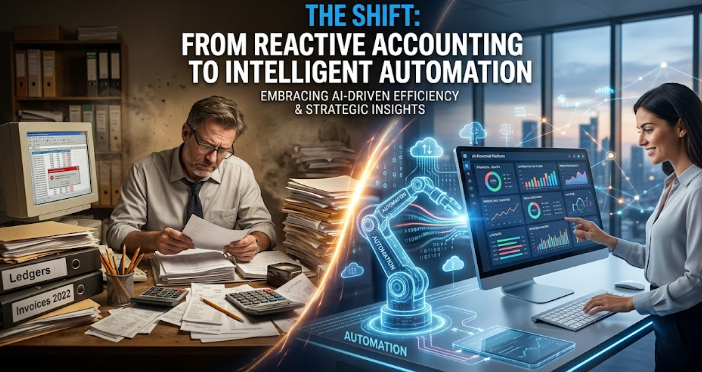
Modern business systems are changing the way accounting functions. Instead of waiting for data to be processed, systems now capture, organize, and analyze financial information in real time. Platforms like Odoo integrate accounting with sales, inventory, procurement, and HR, creating a unified environment where every transaction automatically updates financial records.
This shift eliminates the need for repetitive tasks such as manual data entry or cross-checking between systems. More importantly, it enables businesses to move from reactive decision-making to proactive strategy. When financial data is always up to date, leaders can identify trends early, respond to risks faster, and seize opportunities with confidence.
Automation in Action: What Changes on the Ground
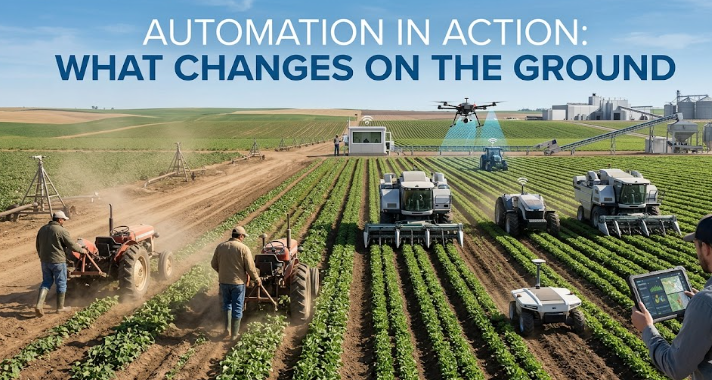
The impact of automation is best understood through everyday business activities. Consider invoicing—traditionally, invoices are created manually after a sale is completed. In an automated system, invoices are generated instantly when a sales order is confirmed. Payments can be tracked in real time, and reminders are sent automatically.
Bank reconciliation is another area where automation creates value. Instead of matching transactions manually, the system aligns bank entries with internal records, highlighting discrepancies instantly. Tax calculations, often a complex and error-prone process, are handled seamlessly based on predefined rules.
These changes may seem incremental, but together they create a significant shift. Teams spend less time on routine tasks and more time analyzing data, improving processes, and contributing to business growth.
Case Study: A Retail Business Transformation
Business Background:
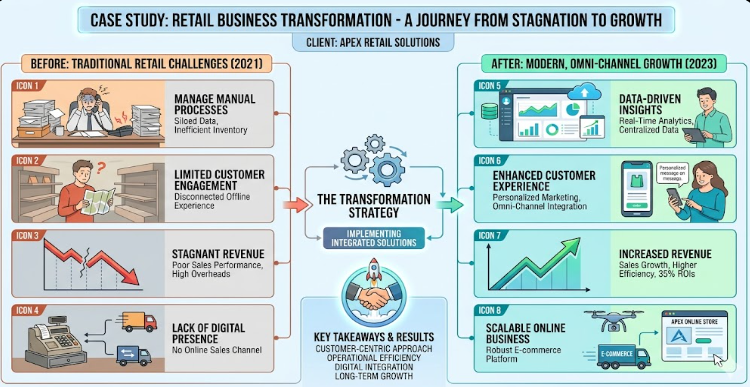
A mid-sized retail company operating across multiple locations faced challenges in managing its financial operations. The company used separate systems for sales, inventory, and accounting. This led to frequent data mismatches, delayed reporting, and limited visibility into profitability.
Challenges Faced:
- Manual data entry across systems
- Delayed financial reports (weekly or monthly)
- Inaccurate inventory valuation
- Difficulty in tracking cash flow
Solution Implemented:
The company adopted an integrated ERP platform, leveraging Odoo to unify its operations. Accounting was connected directly with sales and inventory modules, enabling automatic data flow across departments.
Results Achieved:
- 70% reduction in manual data entry: Transactions were recorded automatically across systems
- Real-time financial visibility: Management could track revenue, expenses, and margins instantly
- Improved inventory accuracy: Financial data reflected actual stock levels
- Faster decision-making: Pricing and procurement strategies were adjusted based on live insights
Outcome:
Within six months, the company not only improved operational efficiency but also increased profitability by identifying high-performing products and reducing unnecessary costs. The shift from fragmented systems to an integrated platform proved to be a turning point.
Strategic Advantage: Beyond Efficiency
While automation reduces workload, its true value lies in the strategic advantage it provides. When accounting is integrated with business operations, it becomes a source of insight rather than just a record of transactions. Leaders can analyze patterns, forecast trends, and plan for the future with greater accuracy.
For instance, a manufacturing company can monitor production costs in real time and adjust processes to maintain margins. A service-based business can track project profitability as work progresses, ensuring that resources are allocated efficiently. These capabilities transform accounting into a tool for growth, not just compliance.
Scalability and Flexibility: Preparing for the Future
As businesses grow, their financial requirements become more complex. Managing multiple entities, handling different currencies, and complying with regional regulations require systems that can adapt quickly. Traditional accounting tools often struggle to keep up with this complexity.
Integrated platforms like Odoo are designed with scalability in mind. Businesses can start with basic accounting and expand into other modules as needed. This modular approach ensures that the system evolves alongside the organization, supporting growth without requiring frequent replacements or costly upgrades.
The Human Element: Empowering Teams, Not Replacing Them

One common misconception about automation is that it replaces human roles. In reality, it enhances them. By eliminating repetitive tasks, automation allows finance teams to focus on higher-value activities such as analysis, planning, and strategy.
Accountants are no longer just record-keepers—they become advisors who contribute to business decisions. This shift not only improves job satisfaction but also strengthens the overall performance of the organization.
Conclusion: The Future Starts Now
The integration of intelligent systems into accounting is not a distant possibility—it is already reshaping how businesses operate. Companies that embrace this shift are gaining a competitive edge through efficiency, accuracy, and real-time insights.
The question for business owners is no longer whether to adopt automation, but when. Those who act early can build stronger, more agile organizations that are prepared for the challenges of tomorrow. Platforms like Odoo are leading this transformation, offering a glimpse into a future where accounting is not just about numbers, but about driving business success.




Post Comment