

Table of Contents
Growing businesses rarely struggle because of a lack of sales—they struggle because systems don’t talk to each other. Customer data sits in one tool, invoices live in another, and inventory is tracked somewhere else, often in spreadsheets. Over time, this fragmentation creates delays, errors, and blind spots that slow down decision-making.
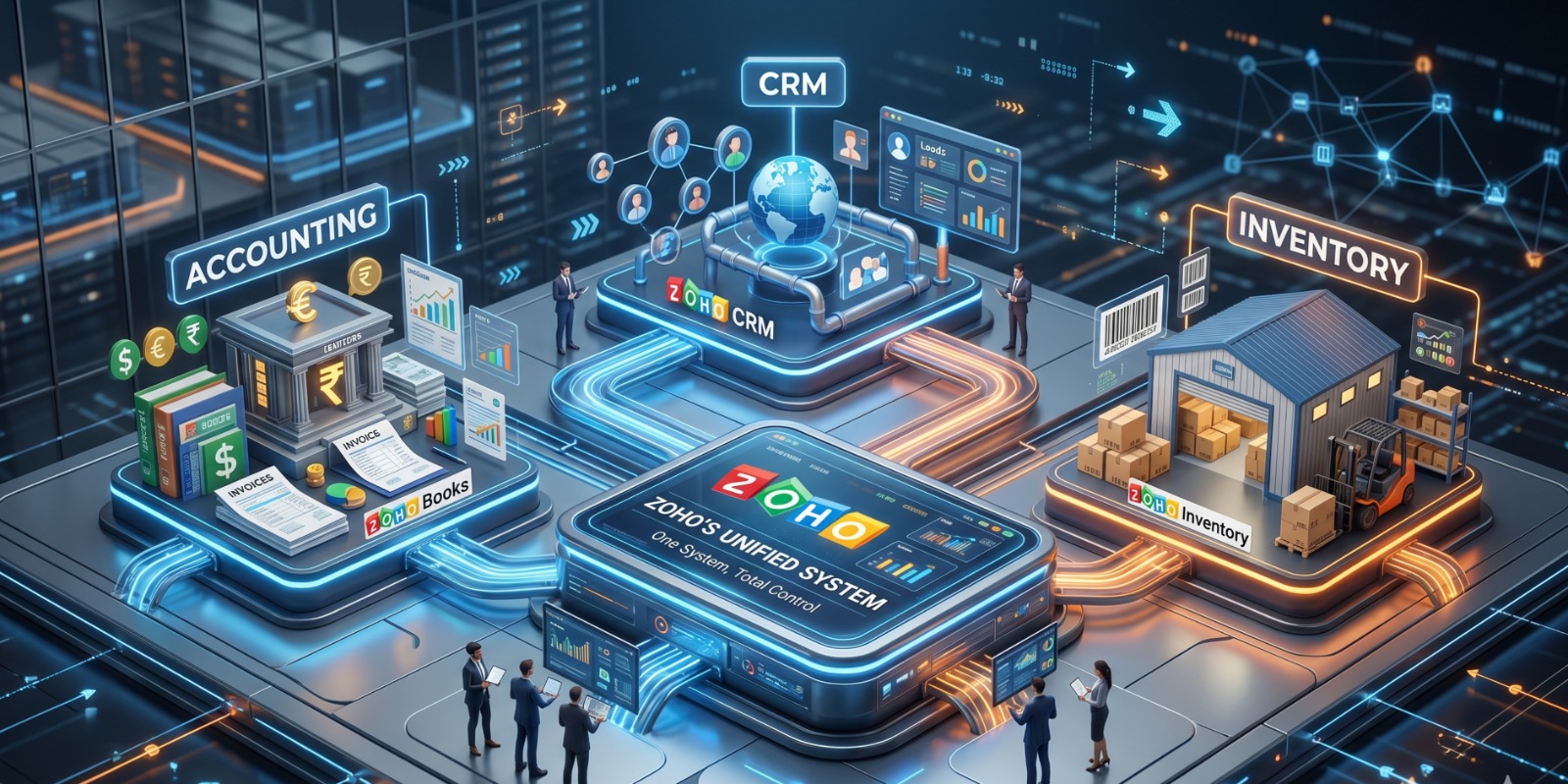
This is where Zoho’s ecosystem stands out. Instead of offering disconnected applications, Zoho has built an integrated suite where Accounting, CRM, and Inventory work together as one business system. The result is simpler operations, clearer visibility, and better control for business leaders.
The Real Problem: Disconnected Business Functions
Most businesses start with separate tools:
- CRM for sales follow-ups
- Accounting software for invoicing and compliance
- Inventory tools or Excel for stock tracking
At low volumes, this setup may seem manageable. But as transactions increase, problems become visible. Sales teams promise delivery without checking stock. Finance teams chase data to close books. Inventory teams react late to shortages.
The issue is not the people—it’s the lack of integration.
Zoho’s Ecosystem Approach
Zoho takes a different approach by designing its applications to work together from day one. Zoho CRM, Zoho Books, and Zoho Inventory share data automatically, eliminating the need for manual syncing or complex integrations.
When a lead becomes a customer, the information flows seamlessly into billing and fulfillment. When inventory changes, sales and finance see it instantly. This creates a single, reliable source of truth.
From Lead to Payment: One Continuous Flow
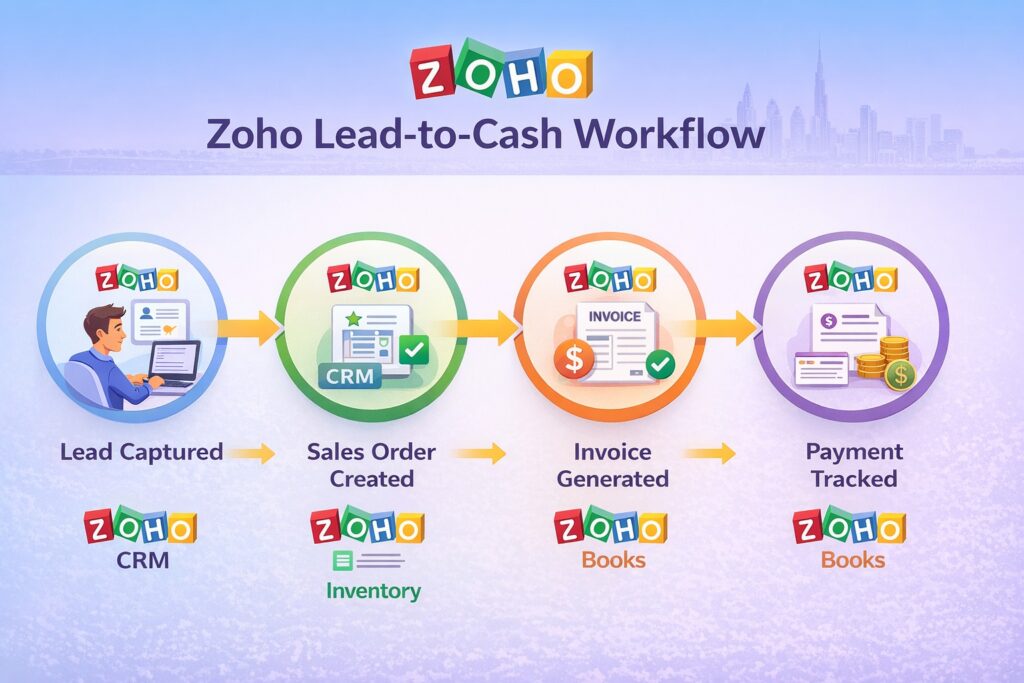
This connected flow ensures nothing is lost between departments, and every team works with the same data.
How Zoho CRM Supports Smarter Sales
Zoho CRM is more than a contact database. It gives sales teams visibility into:
- Customer history
- Open quotations
- Outstanding invoices
- Product availability
Sales teams no longer work in isolation. They sell with context—knowing what the customer has ordered before, what has been billed, and what can be delivered.
Accounting Without Manual Reconciliation
Zoho Books handles invoicing, payments, expenses, and compliance, while staying connected to sales and inventory. When a sale is confirmed:
- Invoices are created automatically
- Tax calculations remain accurate
- Payments update customer records instantly
This reduces manual data entry and speeds up month-end closing.
Inventory That Moves with the Business
Zoho Inventory ensures stock levels are always accurate. Whether products are sold online, through sales teams, or via multiple warehouses, inventory updates in real time.
This prevents:
- Overselling
- Stock-outs
- Last-minute fulfillment delays
Inventory becomes proactive instead of reactive.
Zoho Ecosystem vs Disconnected Tools
| Area | Disconnected Tools | Zoho Ecosystem |
| Customer data | Spread across systems | Centralized |
| Invoicing | Manual creation | Automatic |
| Inventory sync | Delayed | Real-time |
| Reporting | Fragmented | Unified |
| Scalability | Limited | High |
The difference lies in operational simplicity.
Real-Life Business Case
A mid-sized trading company used separate tools for CRM, accounting, and inventory.
Before Zoho
- Sales and finance data mismatched
- Frequent inventory errors
- Delays in invoicing
After Moving to Zoho
- Sales orders flowed directly to invoicing
- Inventory updated automatically
- Management dashboards showed real-time performance
Results
- Faster order processing
- Improved cash flow
- Better customer experience
Growth became structured instead of chaotic.
Clear Reporting for Business Leaders
Zoho’s ecosystem provides unified dashboards that show:
- Sales performance
- Outstanding receivables
- Inventory health
- Revenue trends
Leaders no longer wait for reports. They see the business as it operates.
Why Businesses Choose Zoho
Zoho’s strength is not complexity—it is practical integration. Businesses choose Zoho because:
- It reduces tool overload
- It minimizes manual work
- It scales with growth
- It remains affordable
Instead of stitching systems together, companies operate from one ecosystem.
Final Perspective
Accounting, CRM, and inventory are not separate functions—they are parts of the same business process. When these systems operate independently, inefficiency is unavoidable.
Zoho’s ecosystem simplifies operations by connecting every step—from customer interaction to cash collection and stock movement. For businesses looking to grow with clarity, control, and confidence, Zoho offers a unified foundation that supports sustainable success.
1. What is Zoho’s ecosystem?
Zoho’s ecosystem is a suite of integrated business applications that connect CRM, accounting, inventory, and other functions into one unified system.
2. How does Zoho simplify accounting and CRM together?
Zoho automatically shares customer, sales, and invoice data between CRM and accounting, removing manual data entry and reconciliation.
3. Can Zoho manage inventory in real time?
Yes. Zoho Inventory updates stock levels automatically as sales orders and invoices are processed.




Post Comment