
Table of Contents
From Fragmentation to Clarity
There was a time when businesses operated comfortably with separate tools for every department. Sales had their CRM, finance had accounting software, HR used standalone systems, and operations relied on spreadsheets. While this approach worked in simpler times, it no longer fits today’s fast-moving business environment.
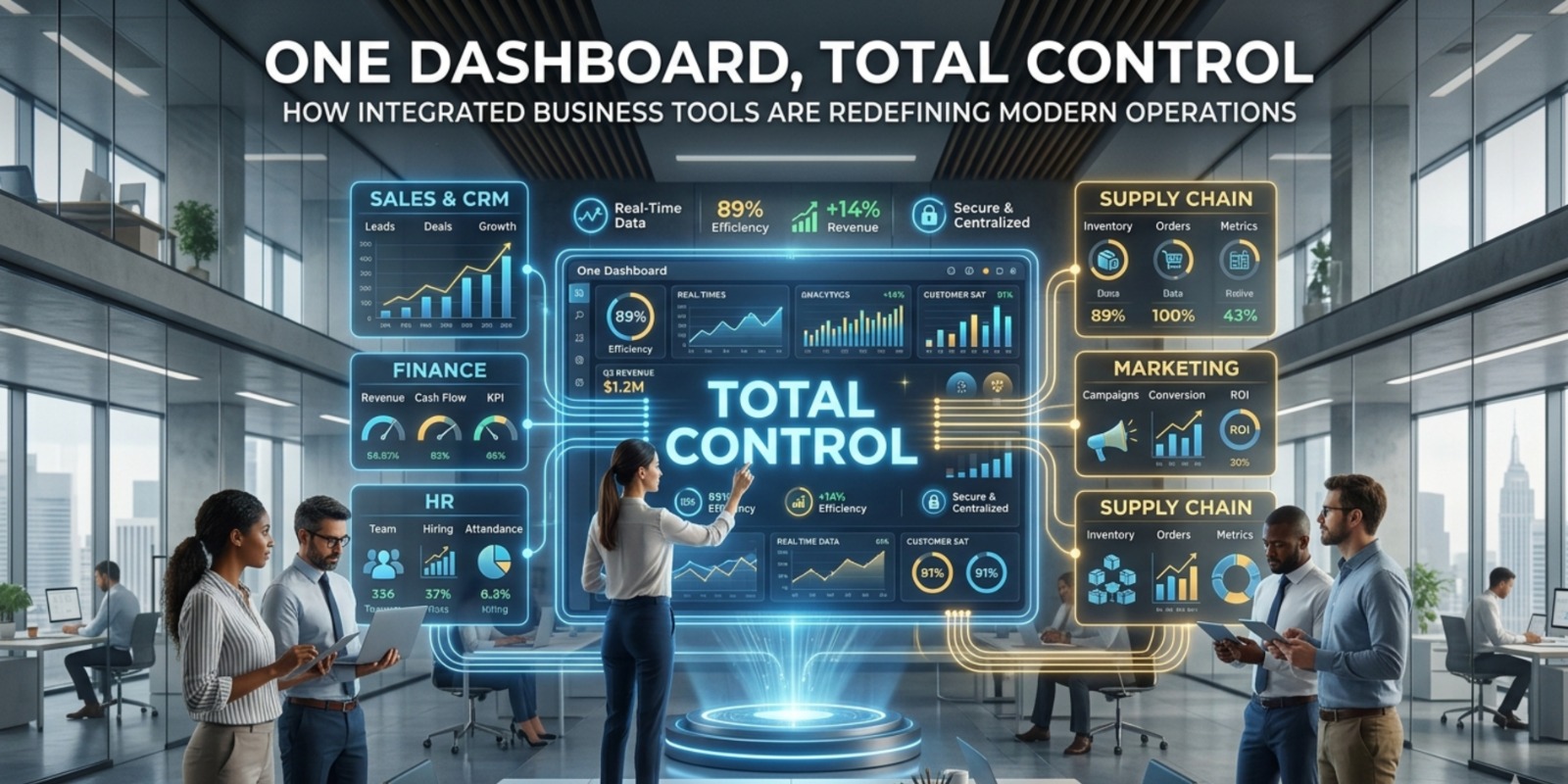
Modern businesses need speed, clarity, and coordination. Leaders want answers in real time, not at the end of the month. Teams need to collaborate without jumping between multiple systems. This is where the concept of “one dashboard, all departments” is changing how organizations operate. Platforms like Odoo are leading this shift by bringing all business functions into a single, unified system.
The Problem: Too Many Tools, Too Little Visibility

Many businesses today are not short of tools—they are overwhelmed by them. Each department uses its own software, often chosen independently, leading to a fragmented system landscape.
The result is familiar:
- Sales reports do not match finance data
- Inventory numbers differ across systems
- HR information is disconnected from operations
- Managers rely heavily on spreadsheets to reconcile data
- Decision-making becomes slow and uncertain
Instead of enabling productivity, multiple tools create confusion. Teams spend more time searching for information than acting on it.
The Shift Toward Integration
The new approach is simple in concept but powerful in impact: bring all business operations into one integrated platform.
With systems like Odoo, businesses can manage:
- Sales and customer relationships
- Accounting and financial reporting
- Inventory and supply chain
- Human resources and payroll
- Projects and operations
All from a single dashboard.
This integration ensures that data flows automatically between departments. A sales order updates inventory. Inventory changes reflect in financial reports. Payroll entries connect with accounting. Everything stays aligned without manual intervention.
Why One Dashboard Matters
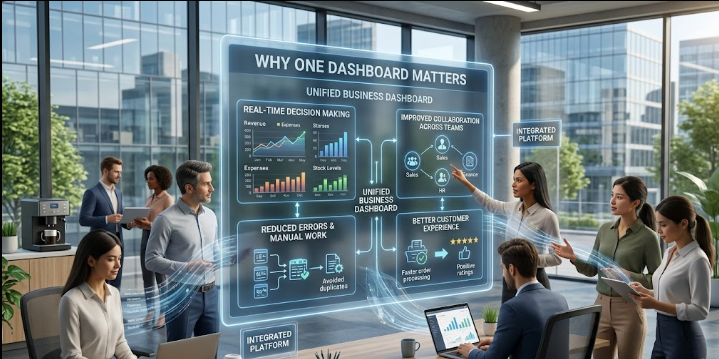
Real-Time Decision Making
In today’s environment, waiting for reports is no longer acceptable. Business owners need to know what is happening right now.
A unified dashboard provides live insights into revenue, expenses, stock levels, employee performance, and more. This allows leaders to make informed decisions quickly, whether it’s adjusting pricing, managing costs, or responding to market changes.
Improved Collaboration Across Teams
When all departments work within the same system, collaboration becomes natural.
Sales teams can check inventory before committing to clients. Finance teams can track revenue without waiting for updates. HR can align workforce planning with business needs.
The result is a more connected organization where teams work together instead of in isolation.
Reduced Errors and Manual Work
Manual data entry across multiple systems is one of the biggest sources of errors.
Integrated platforms eliminate duplicate work. Data entered once is used everywhere. This reduces mistakes, saves time, and improves overall accuracy.
Better Customer Experience
Customers expect faster responses, accurate information, and seamless service.
When systems are connected, businesses can deliver on these expectations. Orders are processed faster, queries are resolved quickly, and service quality improves.
Case Study: Manufacturing Company Streamlines Operations
A mid-sized manufacturing company was managing operations using separate tools for sales, inventory, and accounting. Each department maintained its own data, leading to frequent discrepancies.
Challenges included:
- Delays in order processing
- Stock mismatches
- Inaccurate financial reporting
- High dependency on manual reconciliation
After implementing an integrated ERP system:
Within Six Months:
- Order processing time reduced significantly
- Inventory accuracy improved
- Financial reports became real-time
- Manual workload decreased
- Cross-department coordination improved
The company not only improved efficiency but also gained the ability to scale operations with confidence.
The Cost of Staying Disconnected
While businesses often hesitate to move away from familiar systems, staying disconnected comes with hidden costs:
- Lost productivity due to manual work
- Poor decision-making due to outdated data
- Increased operational errors
- Higher software and maintenance costs
- Slower response to market changes
Over time, these issues can limit growth and competitiveness.
The Role of Leadership in Driving Change
Adopting an integrated system is not just a technical decision—it is a strategic one.
Leaders need to recognize that business efficiency is directly linked to system efficiency. Investing in the right tools can unlock productivity, improve transparency, and create a strong foundation for growth.
The transition may require change management, training, and initial effort, but the long-term benefits far outweigh the challenges.
Why Integrated Systems Are the Future
The move toward integrated business tools is not a trend—it is a necessity.
As businesses grow, complexity increases. Managing this complexity with disconnected systems becomes unsustainable. Integrated platforms provide a scalable solution that grows with the business.
They offer:
- Flexibility to add new modules
- Scalability for expanding operations
- Real-time insights for better decisions
- A unified experience for teams
This combination makes them essential for modern organizations.
Signs Your Business Needs One Dashboard
You may need an integrated system if:
- You use multiple tools that don’t connect
- Reports take too long to prepare
- Data inconsistencies are common
- Teams struggle to collaborate
- Decision-making feels slow
- Growth is creating operational chaos
Recognizing these signs early can help businesses avoid larger challenges in the future.
Conclusion: Simplicity Is the New Advantage
In a world where speed and accuracy define success, simplicity has become a competitive advantage.
The idea of “one dashboard, all departments” is not just about convenience—it is about control, clarity, and growth. Businesses that adopt integrated systems like Odoo are better equipped to handle complexity, respond to change, and scale efficiently.
The future of business operations is not about managing more tools.
It is about managing everything from one place—with confidence.
And for companies ready to move forward, that future has already begun.



Post Comment