


Table of Contents
The First 10 Employees Feel Easy—Then Everything Changes

Many businesses experience their fastest momentum in the early stage. With a small team of five to ten people, communication is direct, decisions are quick, and founders stay close to every task. Problems are solved in real time because everyone knows what is happening. There are fewer layers, fewer approvals, and less complexity.
Then growth happens.
The company hires the eleventh employee, then the twelfth, and suddenly the same systems that worked before begin to fail. Communication slows down. Mistakes increase. Customers notice delays. Founders feel more stressed even though the team is bigger.
This stage surprises many business owners. They assume more people should automatically create more output. In reality, after ten employees, growth often becomes an operations challenge—not a people challenge.
Why 10 Employees Is a Turning Point
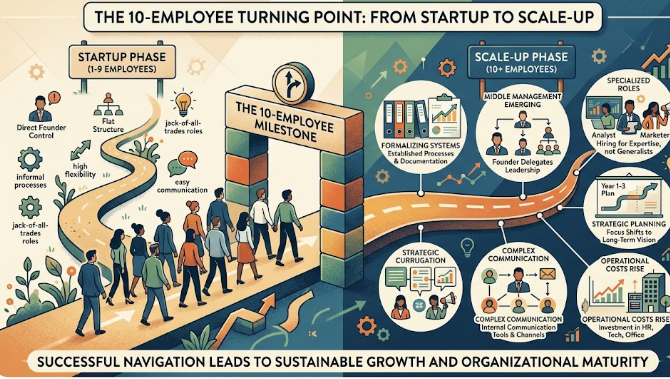
There is nothing magical about the number ten, but it often marks the moment where informal management stops working.
Before that stage:
- The founder knows every customer issue
- Staff can ask questions instantly
- Workflows are managed through chat or verbal instructions
- Team members handle multiple roles
After that stage:
- Information starts getting lost
- People wait for approvals
- Responsibilities become unclear
- Errors multiply across departments
The business has outgrown founder-led control, but it has not yet built professional systems.
This creates a dangerous middle zone where revenue may rise, but efficiency falls.
The Real Problems Most Businesses Face After 10 Employees

1. Communication Becomes Fragmented
In small teams, one conversation solves everything. In larger teams, messages spread across calls, chats, emails, and hallway discussions.
Sales promises something operations never heard about. Finance is waiting for paperwork nobody submitted. Customer service doesn’t know the latest policy change.
The issue is not poor staff. The issue is no single source of truth.
2. Founder Becomes the Bottleneck
Many businesses grow because the founder is highly capable. They solve issues quickly, build relationships, and make decisions fast.
But once the company grows, every team still depends on the founder for approvals, pricing, hiring, exceptions, and conflict resolution.
Soon, the founder becomes the busiest person in the company—and the biggest bottleneck.
If the founder takes one day off, progress slows.
That is not scale. That is dependency.
3. Processes Exist Only in People’s Heads
Early-stage companies rely on memory and experience.
One employee knows how invoices are processed. Another knows how stock is managed. Someone else knows how customer complaints are handled.
When those people are absent or leave, chaos begins.
A growing company needs documented workflows, not tribal knowledge.
4. Tools Stop Talking to Each Other
At first, businesses use separate tools:
- Spreadsheet for finance
- Messaging app for communication
- Basic CRM for leads
- Inventory software
- Manual reports
This patchwork may work for five people. It becomes painful at fifteen.
Now teams spend time updating systems instead of serving customers.
Disconnected tools create invisible costs:
- Duplicate work
- Wrong data
- Delayed decisions
- Poor accountability
5. Managers Are Promoted Too Early Without Support
A strong employee is often promoted into management because they perform well technically.
But managing people requires different skills:
- Delegation
- Coaching
- Prioritization
- Accountability
- Conflict handling
Without training or systems, new managers struggle. Team morale drops, and execution becomes inconsistent.
Case Study: A Retail Business Stuck at 12 Employees
A growing retail company expanded from 6 to 12 employees in two years. Revenue increased, but profits stalled.
Problems included:
- Orders delayed because stock data was outdated
- Founder approving every purchase request
- Finance chasing receipts manually
- Customer complaints rising
- Team blaming each other
The owner assumed the staff needed to “work harder.”
The real solution was operational redesign:
- Clear department responsibilities
- Approval matrix
- Shared dashboards
- Inventory linked with sales
- Weekly reporting rhythm
Within six months:
- Order delays dropped significantly
- Founder involvement in daily approvals reduced
- Team accountability improved
- Profit margins recovered
The business did not need more people. It needed structure.
What Growing Businesses Should Build Instead
Build Systems Before You Need Them
Do not wait for chaos.
Create repeatable workflows for:
- Sales handover
- Purchasing
- Customer support
- Hiring
- Invoicing
- Reporting
Good systems reduce stress and increase consistency.
Move From Founder Control to Team Ownership
Every decision should not go upward.
Define who owns what. Give decision authority with boundaries.
Example:
- Sales manager approves discounts up to a limit
- Operations manager handles supplier escalations
- Finance lead controls payment cycles
Ownership creates speed.
Use Integrated Platforms, Not Tool Patches
Many businesses delay this step too long.
Platforms like Odoo help growing businesses connect sales, inventory, accounting, HR, and reporting in one place.
Instead of asking five people for updates, leaders can see real-time data.
That changes management quality immediately.
Create Simple Reporting Cadence
You do not need complex corporate dashboards.
Start with weekly visibility:
- Sales pipeline
- Cash position
- Pending invoices
- Delivery delays
- Hiring needs
- Customer complaints
What gets reviewed gets improved.
Warning Signs You’ve Hit the 10+ Employee Wall
If these sound familiar, you are already there:
- Everyone is busy, but progress feels slow
- Founder works more than ever
- Customers complain more despite bigger team
- Staff ask the same questions repeatedly
- Reports take too long to prepare
- Hiring new people creates more confusion
This is not failure. It is a signal that the company must evolve.
The Growth Myth Most Owners Believe
Many owners think growth problems are solved by hiring more people.
But unmanaged growth only multiplies inefficiency.
Ten confused employees become fifteen confused employees.
The smarter path is:
- Better systems
- Better clarity
- Better leadership
- Better tools
Then hiring creates leverage instead of complexity.
Conclusion: The Next Level Requires a Different Business Model
What helped you reach ten employees will rarely help you reach fifty.
The early stage rewards hustle, speed, and founder energy. The next stage rewards systems, delegation, and operational discipline.
Most businesses struggle after ten employees because they are still running a larger company with a small-company mindset.
Growth does not break businesses. Lack of structure does.
Owners who understand this early create companies that scale with less stress, stronger profits, and healthier teams.






Post Comment