

Table of Contents
The Hidden Cost Businesses Rarely Notice
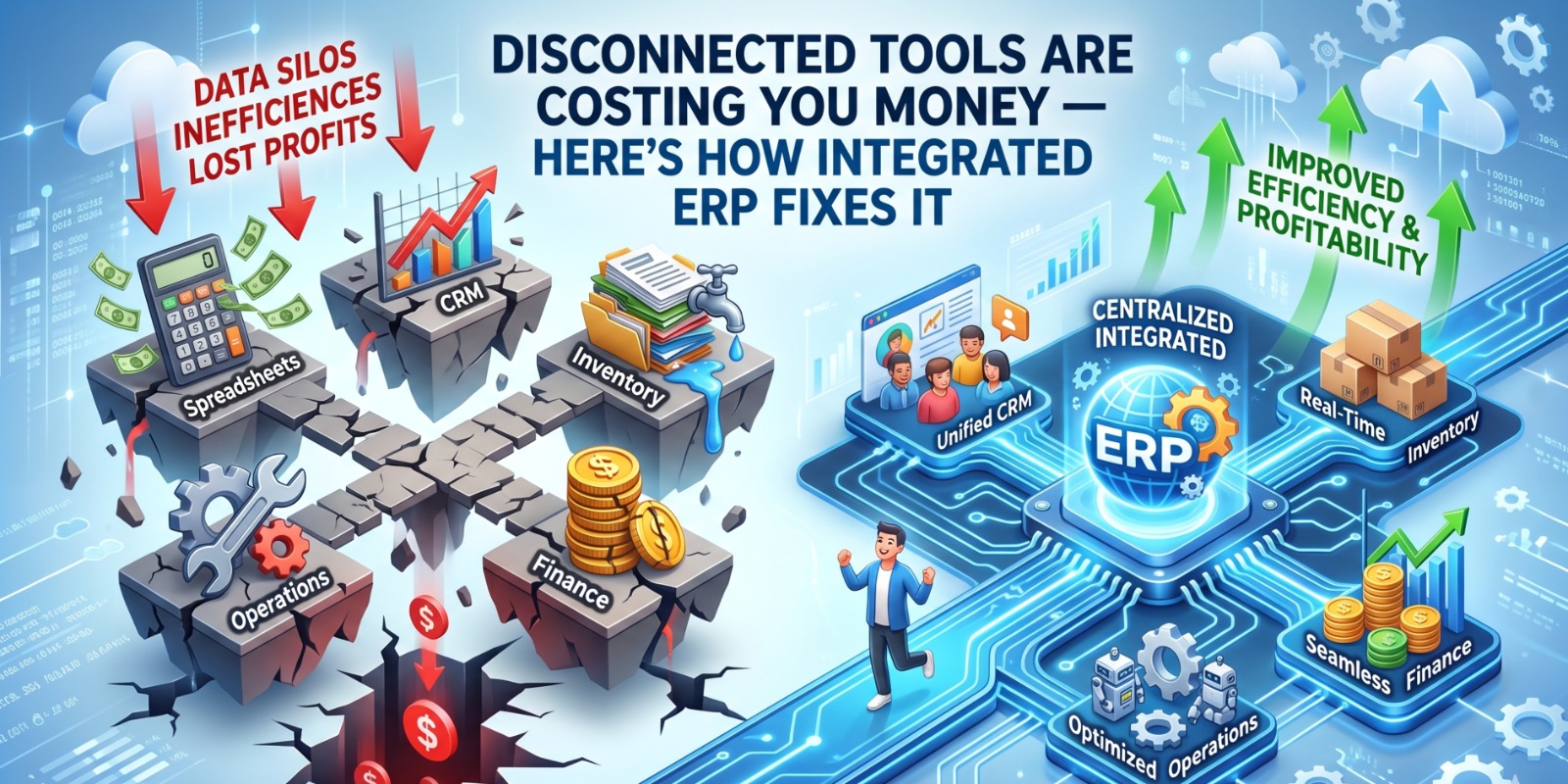
Most businesses do not realize how much money they lose because of disconnected systems.
At first, using different tools for different departments seems manageable. Sales uses one platform, finance works on spreadsheets, HR uses another application, and inventory is tracked somewhere else. Over time, however, these disconnected systems begin creating silent operational problems.
Teams spend hours searching for information. Reports never match. Manual data entry increases errors. Approvals slow down. Leadership loses visibility. Employees become frustrated.
The biggest problem is that these costs rarely appear directly on a balance sheet. They show up as wasted time, delayed decisions, operational inefficiency, and lost growth opportunities.
This is why businesses across industries are moving toward integrated ERP platforms like Odoo and Zoho. Integrated ERP is no longer just an IT upgrade—it has become a business necessity.
The Real Problem with Disconnected Tools
Most organizations do not intentionally create disconnected operations. It happens gradually.
A business starts with accounting software. Then it adds a CRM. Later, HR tools, inventory systems, payroll software, reporting dashboards, and communication platforms are introduced independently.
Each tool solves one problem. But together, they create a larger one.
The result is fragmented operations.
Common symptoms include:
- Duplicate data entry
- Different reports from different departments
- Manual reconciliation work
- Delayed approvals
- Lack of real-time visibility
- Communication gaps between teams
- Dependency on spreadsheets
As businesses grow, these inefficiencies multiply.
Where Businesses Actually Lose Money
Disconnected systems create financial loss in ways many leaders underestimate.
1. Time Loss Across Teams
Employees spend significant time switching between systems, searching for updates, and manually transferring information.
A finance team may re-enter sales data manually. HR may follow up through emails for approvals. Operations teams may wait for outdated inventory updates.
Hours disappear every week on non-productive work.
2. Reporting Errors and Decision Delays
When systems do not communicate, reports become inconsistent.
Sales numbers differ from finance records. Inventory reports are outdated. Leadership meetings focus on validating data instead of making decisions.
Poor visibility slows response time and affects business agility.
3. Customer Experience Suffers
Disconnected systems also affect customers.
Imagine a sales team promising delivery without live inventory visibility, or support teams lacking customer payment history.
These gaps create delays, confusion, and reduced customer trust.
4. Higher Operational Costs
Businesses often pay for:
- Multiple software subscriptions
- Separate maintenance costs
- Additional IT support
- Manual administrative effort
What initially looked affordable becomes expensive over time.
How Integrated ERP Changes the Game
Integrated ERP platforms solve these problems by connecting departments into one centralized ecosystem.
Instead of operating separately, sales, finance, HR, inventory, operations, and reporting work together in real time.
For example:
- A sales order automatically updates inventory
- Invoice generation syncs with finance
- HR attendance connects with payroll
- Dashboards update instantly across departments
This removes duplication and creates operational clarity.
The Shift from Data Collection to Business Intelligence
Traditional systems often focus on storing information.
Integrated ERP focuses on using information effectively.
With platforms like Odoo and Zoho, leadership teams gain:
- Real-time dashboards
- Department-level visibility
- Faster approvals
- Automated workflows
- Centralized reporting
This changes how decisions are made.
Instead of reacting to problems late, businesses can respond proactively.
Case Study: Trading Company Reduces Operational Chaos
A growing trading company operating across UAE and East Africa was using separate systems for:
- Sales tracking
- Inventory management
- Accounting
- HR approvals
As the company expanded, operational confusion increased.
Challenges included:
- Different reports from each department
- Inventory mismatches
- Delayed invoicing
- Slow management approvals
- Heavy dependency on spreadsheets
The business implemented an integrated ERP platform.
Within Five Months:
- Reporting accuracy improved significantly
- Invoice processing became faster
- Inventory visibility became real time
- Approval delays reduced dramatically
- Management gained centralized visibility
Most importantly, teams spent less time fixing operational problems and more time focusing on growth.
Why Businesses in UAE and Africa Are Moving Faster Toward ERP
Businesses across UAE and Africa are scaling rapidly. But fast growth exposes operational weaknesses quickly.
Companies in these regions are increasingly adopting ERP because they need:
- Multi-branch visibility
- Mobile accessibility
- Faster decision-making
- Cost efficiency
- Real-time reporting
- Better customer management
Modern ERP systems support these needs without the complexity of traditional enterprise software.
This is especially important in markets where agility creates competitive advantage.
The Human Side of Integration
ERP is not only about software. It changes the daily experience of employees.
When systems are integrated:
- Teams stop chasing information
- Managers approve faster
- Employees avoid repetitive tasks
- Departments collaborate more effectively
This reduces frustration and improves productivity naturally.
A smoother workflow often creates stronger workplace culture.
Signs Your Business Needs Integrated ERP
You may need ERP integration if:
- Teams use multiple disconnected tools
- Reports frequently conflict
- Employees rely heavily on spreadsheets
- Approvals are consistently delayed
- Leadership lacks real-time visibility
- Customer issues occur because of internal gaps
- Growth feels operationally messy
These are not technology problems alone—they are business growth barriers.
Why Simplicity Wins Over Complexity
Many businesses hesitate to adopt ERP because they assume it will be complicated.
Modern platforms are changing that perception.
Today’s ERP systems are:
- Cloud-based
- Easier to deploy
- Modular and scalable
- More user-friendly
- Accessible from anywhere
The focus is shifting from technical complexity to operational simplicity.
Businesses no longer want systems that require months to understand. They want tools that help teams work smarter immediately.
Conclusion: Integration Is No Longer Optional
Disconnected systems may seem manageable in the early stages of business. But as operations grow, fragmentation becomes expensive.
The companies growing successfully today are not just investing in sales or marketing. They are investing in operational clarity.
Integrated ERP platforms like Odoo and Zoho help businesses unify operations, improve visibility, reduce waste, and scale with confidence.
The goal is not simply to connect software.
The goal is to create a business that moves faster, operates smarter, and grows without chaos.
Because in modern business, disconnected tools are not just inconvenient.
They are expensive.




Post Comment