

Why Modular ERP Matters in the UAE Context
The United Arab Emirates is a thriving hub for innovation, entrepreneurship, and digital acceleration. From free zones and fintech startups to traditional SMEs entering new verticals, businesses in the UAE face a common challenge:
How can we scale our operations without scaling costs and complexity?
The answer increasingly lies in modular Enterprise Resource Planning (ERP) — and at the forefront of this approach is Odoo, an open-source ERP platform built around flexibility, integration, and incremental deployment.
Unlike monolithic systems that force heavy implementation upfront, Odoo allows UAE businesses to adopt what they need, when they need it — and scale seamlessly as their demands grow.
What Is Modular ERP?
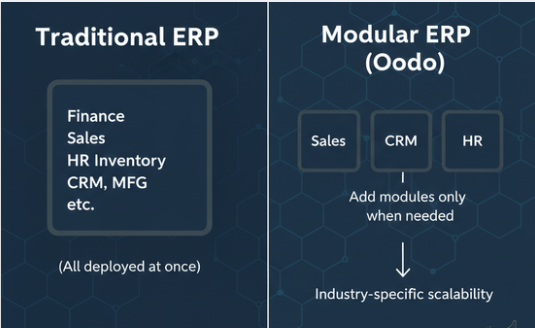
A modular ERP system is one where core business functions are divided into stand-alone but interoperable modules. Instead of deploying a full suite at once, businesses can start with only the modules that meet immediate needs — then add more as they grow.
ERP Deployment Models
Why UAE SMEs & Startups Choose Odoo
The UAE market is unique because:
- Rapid business evolution: Startups pivot; SMEs adopt new revenue streams.
- Regulatory variety: Different free zones have different compliance demands.
- Multilingual, multi-currency needs (AED, USD, EUR).
- Talent mobility requires flexible tech stacks.
Odoo addresses these with strength in:
| Business Need | Odoo Advantage |
| Budget constraints | Low TCO (Open-Source + No License Fees) |
| Regulatory compliance | Localisation & Tax Engine |
| Fast go-live | Modular implementation |
| Multilingual teams | Built-in language support |
| Rapid scaling | Add modules progressively |
Odoo’s Modular Architecture — Explained
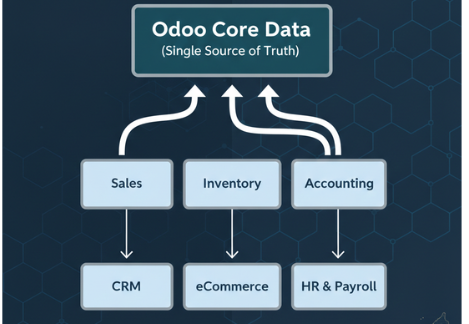
At its core, Odoo is built on a unified data model. This design eliminates data silos and reduces integration friction. That’s why adding a new module (e.g., HR, Accounting, POS) doesn’t require heavy customization or data migration.
Odoo Unified Modular Architecture
Explanation:
All modules share the same core database, meaning customer data created in CRM is directly available in Sales, Accounting, and Support, without replication or siloed systems.
Feature Comparison: Odoo vs Traditional ERP
Table: Modular vs Monolithic ERP
| Capability | Traditional ERP | Odoo Modular ERP |
| Upfront Cost | High | Low to Medium |
| Implementation Time | Long (6–18 months) | Short (4–12 weeks) |
| Flexibility | Rigid | Highly Flexible |
| Customisation Effort | High | Low (Modular picks) |
| Integration Complexity | Complex | Native Modules |
| Scalability | Difficult | Seamless |
Real-World UAE Case Studies
Case Study 1: Retail Startup — “Desert Threads”
Before Odoo:
• Multiple point systems for POS, inventory, and customer loyalty
• Manual reconciliation and stock errors
• Delayed financial closing
After Odoo:
• Single system for POS, Inventory, Accounting
• Real-time stock & sales visibility
• Same-day financial closures
Outcomes
| KPI | Before | After (6 months) |
| Inventory accuracy | 78% | 98% |
| Time to close books | 7 days | 1 day |
| Sales order cycle time | 2 hours | 30 mins |
Case Study 2: Logistics SME — “Gulf Movers”
Challenge:
Managing multimodal operations (road, sea), compliance documentation, and customer billing.
Odoo Impact:
• Added CRM → Quotation → Contract → Invoicing workflow
• Automated billing based on delivered EKMT (Export/Import milestones)
• Real-time tracking integration
Results
✔️ Customer quotes reduced from 48 hrs → 4 hrs
✔️ Billing discrepancies cut by 85%
✔️ Customer satisfaction jumped by 32%
Implementation Patterns in UAE SMEs
A. Quick Win Modules (0–8 Weeks)
| Priority | Ideal For |
| CRM | Sales pipelines |
| Sales Management | Faster deal closures |
| Inventory | Real-time stock |
| Accounting | Financial reporting |
B. Growth Modules (8–20 Weeks)
| Priority | Impact |
| Purchase | Better vendor control |
| Manufacturing | Production planning |
| HR | Payroll & attendance |
| eCommerce | Online sales channel |
Note: UAE free zones often require tax compliance and accounting localization — Odoo supports both with multiple localization apps.
Risks, Challenges & Best Practices
Top Challenges
| Challenge | Mitigation |
| Data Migration | Structured ETL, phased rollout |
| Change Management | End-user training, champions program |
| Customisation Overload | Keep it configuration-first |
| Module Sprawl | Governance board to prioritize modules |
ROI and Business Impact
Modular ERP delivers time to value 3x faster than traditional systems.
ROI Snapshot (UAE SME Example)
| Metric | Value |
| Implementation time | 8–12 weeks |
| Cost savings vs monolithic ERP | ~40% |
| Productivity improvement | ~30–60% |
| Inventory turnover rate | Increased 25% |
The Path to Scalable Digital Operations
In the UAE’s rapidly evolving business environment, the need for agile, scalable, and cost-effective digital systems has never been stronger. Odoo’s modular approach does more than solve isolated business problems — it positions companies for accelerated growth, digital maturity, and operational resilience.
For founders and CTOs, the strategic advantage lies in:
✔ Starting small and scaling fast
✔ Eliminating data silos
✔ Reducing implementation risk
✔ Supporting future digital initiatives (AI, automation, analytics)
Odoo isn’t just software — it’s a platform for sustainable scaling.




Post Comment