

Table of Contents
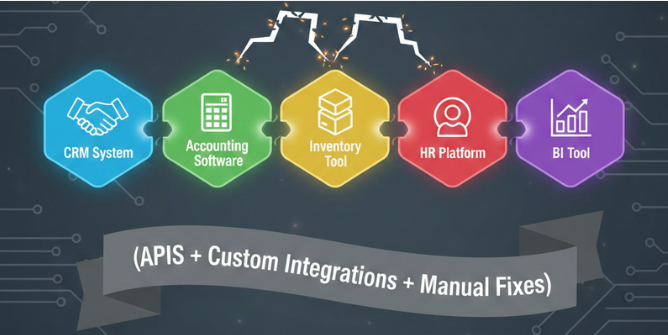
Across industries — manufacturing, wholesale distribution, retail, professional services — enterprises are facing a silent operational crisis. Over the years, departments adopted tools independently: CRM for sales, separate accounting software, spreadsheets for operations, standalone HR systems, third-party inventory tools, BI dashboards disconnected from core data.
Individually, each tool solves a problem. Collectively, they create fragmentation.
For CIOs and COOs, the consequences are measurable: inconsistent data, integration failures, security risks, duplicated work, and delayed executive decisions. The transformation toward a unified ERP platform is no longer optional. It is structural. And Odoo is increasingly becoming the consolidation layer.
The Fragmentation Problem
Modern enterprises often operate in this environment:
- CRM system not connected to accounting
- Inventory tool not synchronized with procurement
- HR software disconnected from payroll analytics
- BI dashboards pulling data from multiple APIs
- Spreadsheets bridging missing workflows
Operational Impact of Tool Fragmentation
| Fragmentation Issue | Immediate Effect | Executive Impact |
| Data Silos | Inconsistent reporting | Poor decision confidence |
| Manual Reconciliation | Time loss | Higher operational cost |
| Integration Failures | Workflow delays | Business risk |
| Security Gaps | Compliance issues | CIO liability |
| Duplicate Data Entry | Employee inefficiency | Reduced productivity |
Fragmentation increases IT complexity while decreasing operational clarity.
The Unified ERP Model
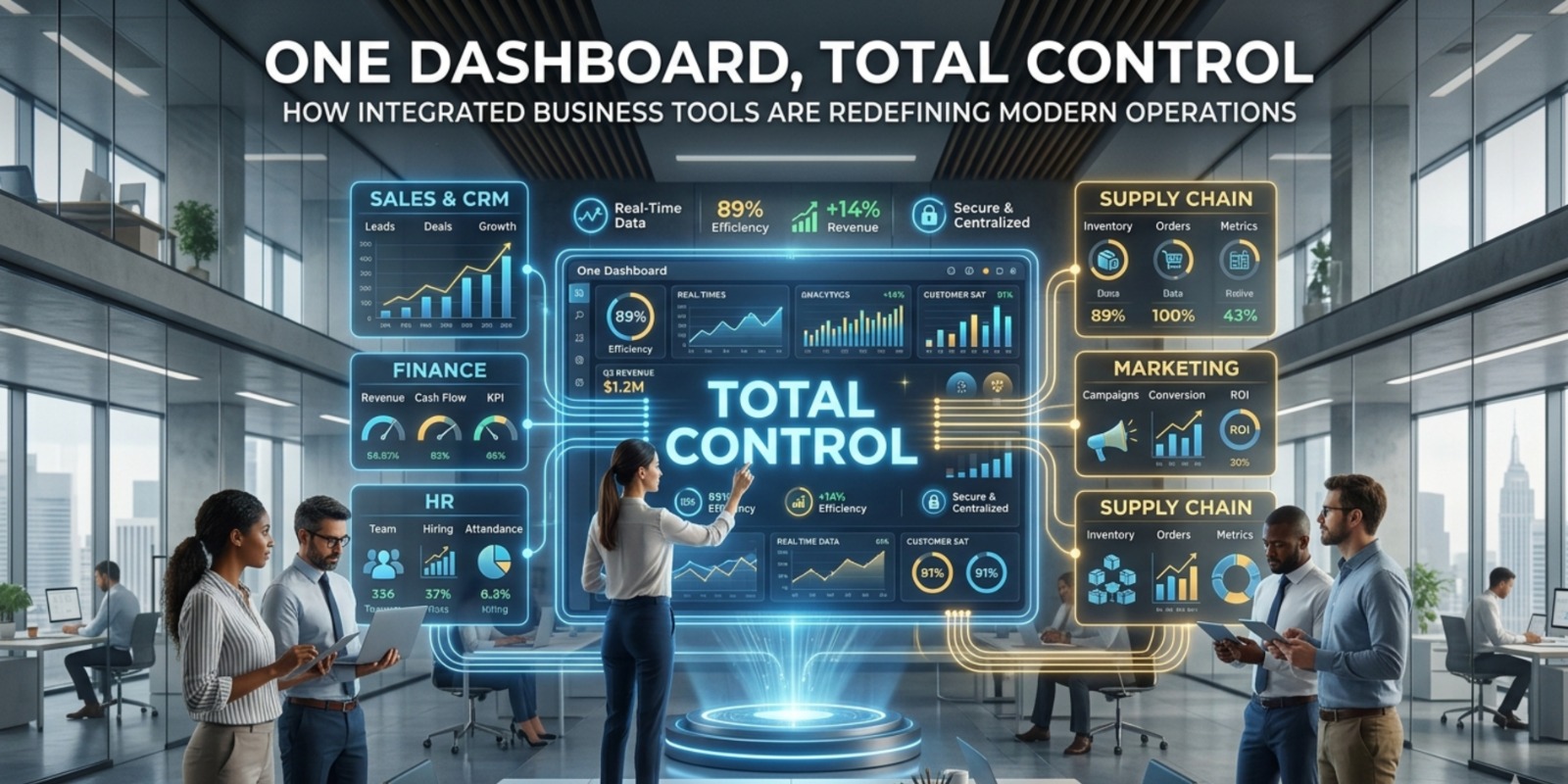
Odoo’s architecture consolidates business functions into a modular ecosystem. Instead of stitching together separate systems, enterprises operate on a single database with interconnected applications.
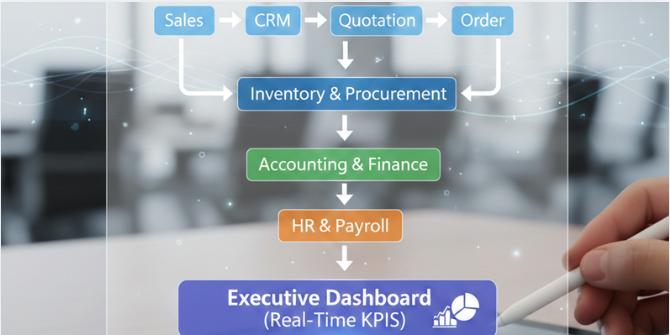
This eliminates duplication and ensures transactional consistency.
Legacy Multi-Tool Stack vs Unified Odoo ERP
Single Odoo Database
↳ CRM
↳ Sales
↳ Inventory
↳ Accounting
↳ HR
↳ Projects
↳ BI Dashboards
The difference is structural simplicity. Fewer integration points mean lower failure risk.
Case Study: Multi-Unit Distribution Enterprise
A cross-industry distribution company operating in retail and B2B wholesale managed operations through:
- Salesforce CRM
- Tally accounting
- Separate inventory software
- Manual Excel-based procurement planning
- Third-party payroll platform
Pain points included:
- 3-day delay in consolidated reporting
- 12% reconciliation errors between sales and accounting
- High integration maintenance cost
- Limited real-time executive dashboard
After migrating to Odoo:
- Reporting latency reduced to same-day visibility
- Reconciliation discrepancies reduced to near zero
- IT integration cost dropped by 40%
- Executives accessed unified KPI dashboards
The key transformation was not software replacement — it was operational synchronization.
Financial and Operational Comparison
| Parameter | Fragmented Tools | Odoo Unified ERP |
| Data Consistency | Moderate | High |
| Integration Cost | High | Low |
| Reporting Speed | Delayed | Real-Time |
| IT Complexity | High | Simplified |
| Total Cost of Ownership | Distributed & Hidden | Predictable |
CIOs value risk reduction. COOs value speed and execution alignment. A unified ERP satisfies both.
Strategic Benefits for CIO
- Reduced integration risk
- Lower cybersecurity exposure
- Centralized access control
- Simplified upgrade cycle
- Predictable IT budget structure
Strategic Benefits for COO
- Real-time cross-functional visibility
- Faster operational decision-making
- Improved KPI alignment
- Reduced workflow friction
- Enhanced scalability across business units
The transformation shifts focus from maintaining tools to optimizing performance.
Enterprise Architecture Overview
Users (Sales, Ops, Finance, HR)
↓
Odoo Unified ERP Platform
↓
Single Centralized Database
↓
Integrated Modules
↓
Real-Time Analytics & BI
A unified architecture ensures data flows seamlessly across departments without redundant synchronization.
Why Now? The Timing Imperative
Digital transformation pressures are intensifying:
- Cross-border compliance requirements
- Multi-currency operations
- Hybrid workforce models
- E-commerce integration
- Data-driven executive reporting
Fragmented systems slow transformation initiatives. Unified ERP accelerates them.
Executive Perspective
For CIOs, fragmentation increases operational risk and infrastructure overhead.
For COOs, it creates decision latency and workflow inefficiency.
Odoo ERP transformation is not about replacing tools; it is about replacing operational fragmentation with coherence.
In a cross-industry landscape where agility determines competitiveness, the unified system becomes a strategic foundation.
The real question is not whether tools work individually.
It is whether your organization can afford the inefficiency of keeping them disconnected.




Post Comment