


How Sales & Marketing Directors Turn Fragmented Pipelines into Predictable Revenue
Table of Contents
Customer Relationship Management (CRM) systems were originally designed to organize contacts and track deals. Yet in modern service and technology businesses, the customer journey has become far more complex. Prospects move across multiple digital touchpoints—websites, email campaigns, webinars, social media, and sales conversations—before converting into customers.
Despite this complexity, many organizations still rely on disconnected CRM tools, manual spreadsheets, or outdated systems that cannot keep pace with modern marketing automation and real-time analytics.
For Sales and Marketing Directors, the problem is clear: customer data exists everywhere, but actionable insight exists nowhere.
This is where a unified CRM platform like Odoo reshapes how organizations manage relationships, pipeline visibility, and growth strategy.
The Hidden Cost of Fragmented CRM Systems
In many companies, CRM is not a single system but a patchwork of tools:
- A CRM platform for sales tracking
- Email marketing software for campaigns
- Separate customer support systems
- Spreadsheet-based pipeline management
- Analytics dashboards disconnected from real-time operations
The result is operational friction.
CRM Fragmentation Snapshot
| Challenge | Immediate Impact | Long-Term Risk |
| Data silos | Incomplete customer view | Poor targeting |
| Manual reporting | Delayed insights | Missed opportunities |
| Disconnected tools | Workflow inefficiency | Revenue leakage |
| Inconsistent tracking | Sales forecast errors | Strategic misalignment |
When teams cannot access unified customer intelligence, growth becomes unpredictable.
Traditional CRM vs Unified CRM
Legacy CRM Workflow
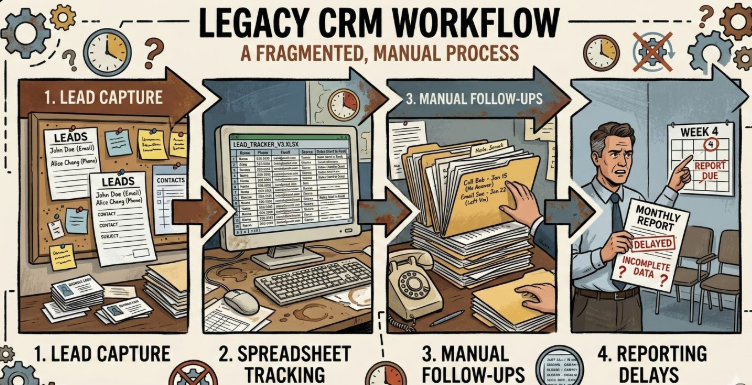
This approach often leads to missed leads, inconsistent communication, and inaccurate pipeline forecasting.
Unified CRM Workflow with Odoo
Lead Capture → Odoo CRM Pipeline → Automated Activities
↓
Marketing Campaign Integration
↓
Sales Opportunity Tracking
↓
Real-Time Revenue Dashboard
This transformation connects marketing, sales, and analytics in a single operational loop.
Key Capabilities of Odoo CRM
Odoo CRM integrates directly with marketing automation, customer support, invoicing, and project management modules.
Core Features for Sales & Marketing Teams
| Feature | Business Benefit |
| Visual Sales Pipeline | Clear deal progression |
| Lead Scoring | Prioritized opportunities |
| Automated Follow-ups | Higher conversion rates |
| Marketing Integration | Unified campaign insights |
| Sales Forecasting | Predictable revenue planning |
| Customer Lifecycle Tracking | Improved retention |
The platform shifts CRM from static contact storage to dynamic relationship intelligence.
Real-Time Case Study: Technology Consulting Firm
A mid-sized technology consulting firm managing B2B clients across multiple regions faced persistent CRM issues:
- Leads lost between marketing and sales teams
- No clear pipeline visibility
- Manual reporting for revenue forecasting
- Inconsistent follow-up processes
After implementing Odoo CRM:
- Lead response time reduced by 40%
- Conversion rates increased by 18%
- Sales forecasting accuracy improved significantly
- Marketing campaign ROI became measurable in real time
The primary transformation was alignment between marketing engagement data and sales pipeline management.
CRM Performance Impact
| KPI | Before Odoo CRM | After Odoo CRM |
| Lead Response Time | 48 hours | 12 hours |
| Conversion Rate | 14% | 22% |
| Forecast Accuracy | Moderate | High |
| Pipeline Visibility | Limited | Real-Time |
| Marketing Attribution | Weak | Data-driven |
These improvements enable directors to shift focus from operational reporting to strategic growth planning.
CRM System Architecture
Customer Touchpoints
(Web, Email, Social, Events)
↓
Odoo CRM
↓
Marketing Automation + Sales Pipeline
↓
Customer Data Intelligence
↓
Executive Revenue Dashboard
This architecture ensures that every customer interaction contributes to a unified data model.
Strategic Advantages for Sales & Marketing Directors
- Unified customer intelligence across departments
- Automated lead nurturing workflows
- Improved sales pipeline visibility
- Accurate forecasting for revenue planning
- Data-driven campaign optimization
By centralizing customer interactions, leadership teams gain a comprehensive view of the entire sales lifecycle.
The Future of CRM
Modern CRM platforms are evolving beyond sales tracking tools. They are becoming customer intelligence platforms capable of integrating artificial intelligence, predictive analytics, and behavioral insights.
As digital interactions continue to expand, organizations require systems that can unify communication, marketing automation, and customer data into a single operational environment.
Executive Perspective
For Sales and Marketing Directors, CRM is no longer simply about managing contacts—it is about orchestrating the entire customer journey.
Disconnected tools create blind spots.
Unified platforms create visibility.
By integrating marketing automation, pipeline management, and real-time analytics, Odoo CRM enables organizations to move from reactive sales operations to proactive relationship management.
In competitive service and technology markets, the companies that understand their customers best will inevitably outperform those that merely track them.
The future of CRM lies not in managing relationships—but in understanding them at scale.




Post Comment