

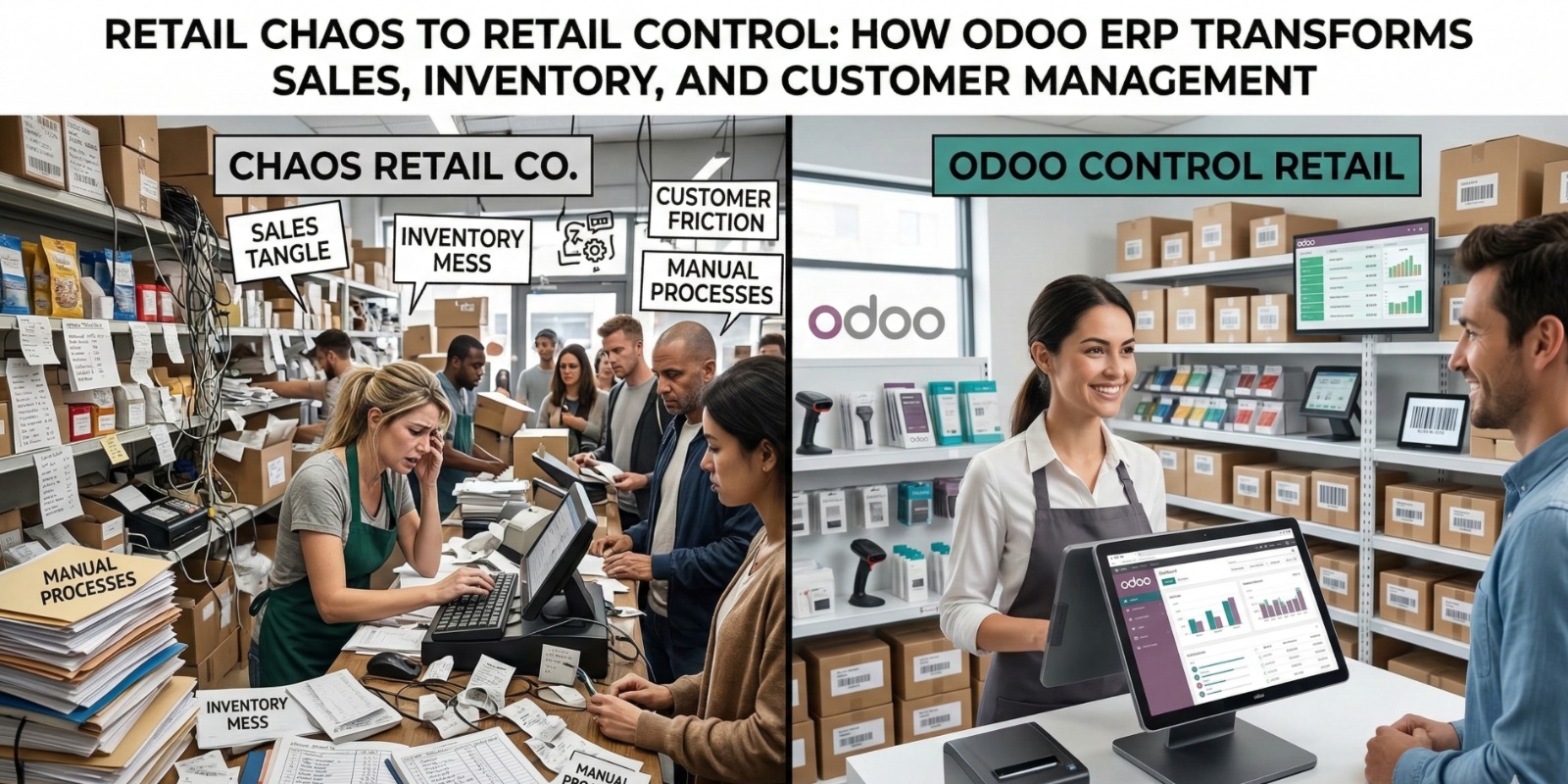
Turning Disconnected Retail Operations into Real-Time Intelligence
Table of Contents
Retail businesses today operate in one of the most competitive environments in history. Customers expect seamless shopping experiences across physical stores, websites, mobile apps, and marketplaces. At the same time, retailers must manage inventory fluctuations, track sales performance, and maintain strong customer relationships.
Yet many retail businesses still rely on fragmented tools: POS systems, accounting software, spreadsheets, and separate inventory tracking platforms.
The result? Operational chaos.
Without unified data, retailers struggle with stockouts, excess inventory, inaccurate reporting, and poor customer insights.
This is where Odoo ERP transforms retail operations—from fragmented systems into a centralized, intelligent platform.
The Retail Management Challenge
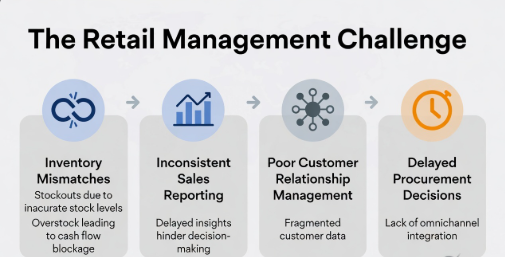
Retail businesses face multiple operational challenges:
- Inventory mismatches between stores and warehouses
- Inconsistent sales reporting
- Poor customer relationship management
- Delayed procurement decisions
- Lack of omnichannel integration
Operational Pain Points
| Retail Challenge | Immediate Impact | Long-Term Risk |
| Stockouts | Lost sales | Customer dissatisfaction |
| Overstock | Cash flow blockage | Increased storage costs |
| Fragmented customer data | Weak personalization | Lower loyalty |
| Manual reporting | Slow decision-making | Reduced competitiveness |
Retail success depends on operational visibility—and disconnected systems limit that visibility.
Traditional Retail Systems vs Unified ERP
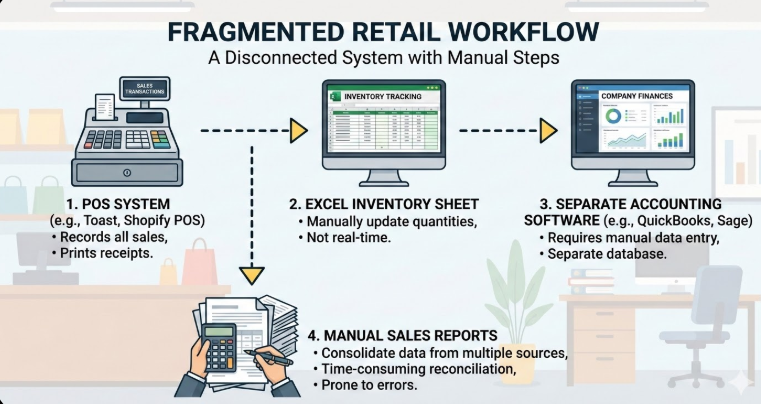
This model creates delays and errors in inventory and financial reconciliation.
Unified Retail Workflow with Odoo
Customer Purchase (POS / Online)
↓
Automatic Inventory Update
↓
Sales Analytics Dashboard
↓
Customer Data & Loyalty Tracking
↓
Procurement & Reordering Automation
This unified structure enables real-time operational intelligence.
Key Retail Capabilities of Odoo ERP
Odoo ERP integrates sales, inventory, customer management, and financial reporting into one system.
Core Retail Features
| Feature | Business Benefit |
| Integrated POS | Real-time sales tracking |
| Smart Inventory Management | Accurate stock visibility |
| Automated Reordering | Prevent stockouts |
| Customer CRM Integration | Personalized marketing |
| Multi-Store Management | Centralized operations |
| Sales Analytics | Data-driven decisions |
This integration ensures every transaction contributes to operational insight.
Real-World Case Study: Multi-Store Retail Brand
A regional fashion retailer operating five stores struggled with:
- Inventory mismatches across locations
- Manual end-of-day sales reconciliation
- No centralized customer database
- Inconsistent demand forecasting
After implementing Odoo ERP:
- Inventory accuracy improved by 30%
- Sales reporting became real-time
- Customer purchase history enabled targeted marketing campaigns
- Procurement cycles became automated
Within six months, the retailer improved operational efficiency while increasing customer retention.
Retail Performance Metrics
| KPI | Before Odoo ERP | After Odoo ERP |
| Inventory Accuracy | 72% | 95% |
| Stockout Frequency | Frequent | Reduced significantly |
| Sales Reporting | Daily manual reports | Real-time dashboards |
| Customer Insights | Limited | Comprehensive |
| Order Fulfillment Speed | Moderate | Improved |
Retail leaders gained immediate operational clarity.
ERP Architecture for Retail Operations
Retail POS + E-commerce
↓
Odoo ERP Core
↓
Inventory Management
↓
Customer CRM
↓
Financial Reporting
↓
Executive Retail Dashboard
This architecture ensures every sale, inventory movement, and customer interaction is recorded and analyzed centrally.
Strategic Advantages for Retail Leaders
- Unified sales and inventory visibility across stores
- Improved customer insights for targeted marketing
- Automated procurement and replenishment
- Data-driven pricing and promotion decisions
- Scalable operations for retail expansion
Retail leaders can make faster, more informed decisions when data flows seamlessly across departments.
The Future of Retail Management
Retail is rapidly evolving toward omnichannel experiences where customers interact with brands across physical and digital platforms.
Modern ERP systems must integrate:
- In-store POS
- Online store transactions
- Mobile payments
- Customer loyalty programs
- Marketing automation
Odoo’s modular architecture allows retailers to scale operations without increasing complexity.
Executive Perspective
For retail businesses, operational control directly influences profitability. Every stockout represents lost revenue. Every excess product represents locked capital. Every disconnected system increases management complexity.
Odoo ERP addresses these challenges by creating a unified operational ecosystem where sales, inventory, and customer data are integrated in real time.
Retail success is no longer determined solely by product selection—it is determined by operational intelligence.
Businesses that adopt unified ERP systems gain visibility, efficiency, and scalability.
And in modern retail, visibility is the difference between reacting to problems and preventing them.



Post Comment