

Table of Contents
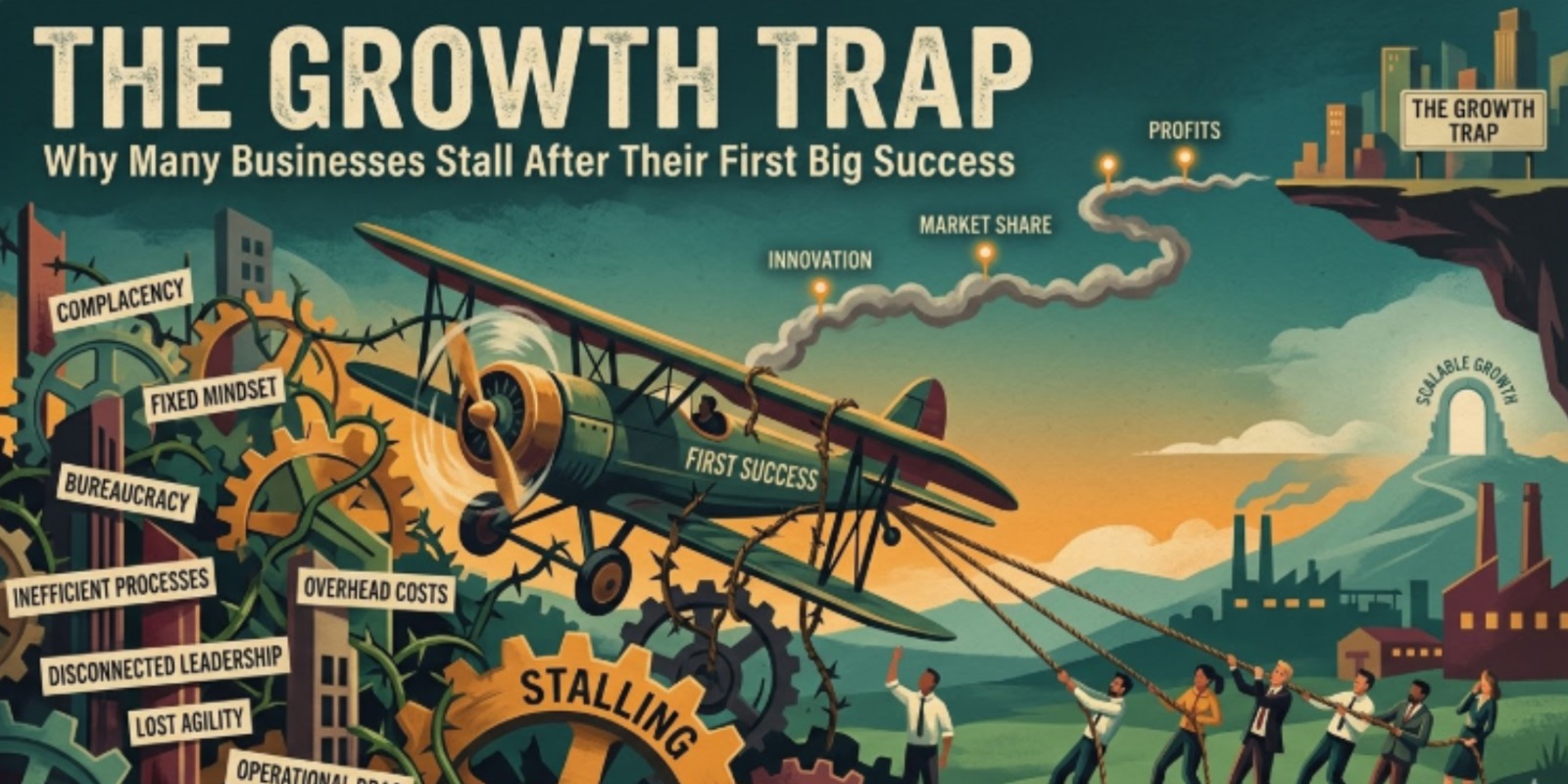
For many businesses, the first major success feels like proof that everything is working perfectly. Revenue grows, customers increase, and the team celebrates reaching an important milestone. Yet surprisingly, this is exactly the stage where many companies begin to struggle.
After the initial growth phase, operations become complex. Processes that worked smoothly when the business was smaller suddenly begin to break down. Orders increase, inventory becomes harder to manage, customer expectations rise, and internal coordination becomes more difficult.
What once felt like momentum starts turning into operational stress.
The problem is not the market, the product, or even the team. In most cases, the real issue is scalability. Businesses often grow faster than the systems supporting them.
The “First Success” Growth Trap
During the early stages, businesses typically rely on flexible tools such as spreadsheets, small accounting software, email coordination, and manual workflows. These solutions work well when operations are manageable and team sizes are small.
However, once demand increases, these tools start creating friction.

At low volumes, this workflow is manageable. But when orders double or triple, these manual processes create delays and errors.
Why Businesses Stop Scaling After Early Growth
Many companies experience a similar pattern: a successful product launch or market expansion creates rapid growth, but operational systems fail to keep up.
| Growth Stage | What Works Initially | What Starts Breaking |
|---|---|---|
| Startup | Manual tracking and spreadsheets | Lack of structure |
| Early Growth | Basic CRM and accounting tools | Data duplication |
| Expansion | Multiple software tools | Department silos |
| Scaling | Increasing complexity | Operational inefficiency |
Instead of enabling growth, existing systems begin to slow the organization down.
Common Operational Bottlenecks
Once businesses pass the early growth phase, they typically encounter several operational challenges.
| Area | Problem | Business Impact |
|---|---|---|
| Sales | Customer data scattered across systems | Missed opportunities |
| Inventory | Poor stock visibility | Stockouts or excess inventory |
| Finance | Manual reporting | Delayed financial decisions |
| Operations | Lack of process automation | Reduced productivity |
| Leadership | No unified data view | Slow strategic planning |
These issues often appear gradually, making them difficult to recognize until growth stalls.
Real Case Example: Retail Expansion Challenges
Consider a regional retail distributor that experienced rapid success after launching a new product line. Within two years, their sales volume tripled.
Initially, their operations relied on a mix of spreadsheets, accounting software, and a basic CRM.
While this setup worked during the early stages, rapid growth exposed several weaknesses:
- Sales orders were recorded in one system, but inventory was tracked in another.
- Warehouse teams relied on manual updates.
- Finance reports required several days to compile.
As order volume increased, operational delays began affecting customer satisfaction.
After implementing an integrated ERP system, the business transformed its workflow.
| Operational Metric | Before ERP | After ERP |
|---|---|---|
| Order Processing Time | 4 hours | 30 minutes |
| Inventory Accuracy | 80% | 97% |
| Financial Reporting | 2–3 days | Real-time |
| Operational Visibility | Limited | Centralized dashboards |
Instead of struggling with growth, the company regained control of its operations.
The Difference Between Growing and Scaling
Many businesses confuse growth with scaling.
Growth simply means increasing revenue or customer volume. Scaling means increasing revenue without proportionally increasing operational complexity or costs.
Growth vs Scaling Comparison
| Factor | Growth | Scaling |
|---|---|---|
| Operations | More manual work | Automated workflows |
| Team Size | Rapidly increases | Efficient resource use |
| Systems | Multiple tools | Integrated platform |
| Reporting | Delayed and fragmented | Real-time insights |
| Efficiency | Decreases over time | Improves continuously |
Scaling requires infrastructure that supports expansion rather than slowing it down.
The Role of Integrated ERP Systems
To move beyond early success, businesses must transition from fragmented tools to integrated operational systems.
An ERP platform connects key departments such as sales, inventory, finance, and operations into a unified ecosystem
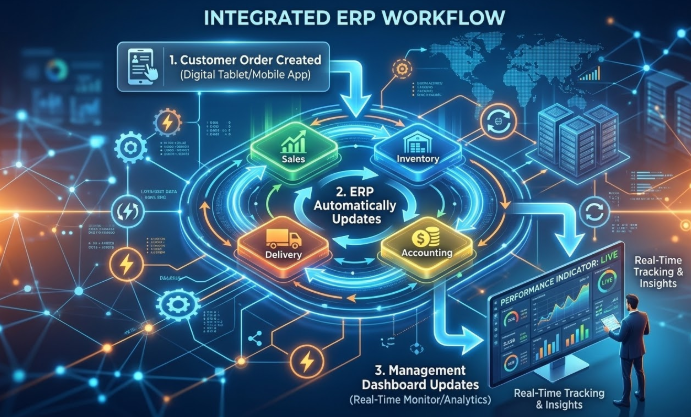
This integrated workflow eliminates manual data transfers and improves accuracy across departments.
Key Features That Enable Scalable Growth
Modern ERP platforms provide tools that allow businesses to expand operations without increasing complexity.
| ERP Feature | Business Advantage |
|---|---|
| Centralized Data | Single source of truth |
| Workflow Automation | Reduced manual tasks |
| Real-Time Dashboards | Faster decisions |
| Inventory Synchronization | Accurate stock levels |
| Financial Integration | Automated accounting |
By consolidating operations into one system, companies gain the visibility and efficiency needed to support larger volumes of business.
Leadership Insight: The Systems Mindset
One of the most important shifts for growing organizations is adopting a systems-first mindset. Instead of solving problems with additional tools or manual workarounds, successful companies invest in operational infrastructure that supports long-term scalability.
This mindset allows leadership teams to focus on strategy rather than operational firefighting.
Instead of asking:
“Why are our teams struggling to keep up?”
They begin asking:
“How can our systems make growth easier?”
Signs Your Business Is Stuck After Early Success
If your organization has experienced early growth but now feels operational pressure, you may notice these warning signs:
- Teams rely heavily on spreadsheets for daily operations
- Customer information exists across multiple systems
- Inventory mismatches occur frequently
- Financial reports take days to prepare
- Leadership lacks real-time business insights
These indicators suggest that operational systems have not evolved alongside business growth.
Final Thoughts
Early success is an exciting milestone for any business. However, it also marks the beginning of a new challenge: managing complexity.
Organizations that continue relying on fragmented tools often find themselves trapped between rising demand and inefficient operations.
Those that invest in integrated systems, automation, and data-driven decision-making gain a powerful advantage. They transform early success into sustainable growth.
The difference between businesses that stall and those that scale is rarely talent or ambition.
More often, it is the systems supporting the business behind the scenes.
The real question for growing companies is not whether they can generate demand.
It is whether their operations are ready to handle it.




Post Comment