

Table of Contents
When Production Planning Becomes a Bottleneck
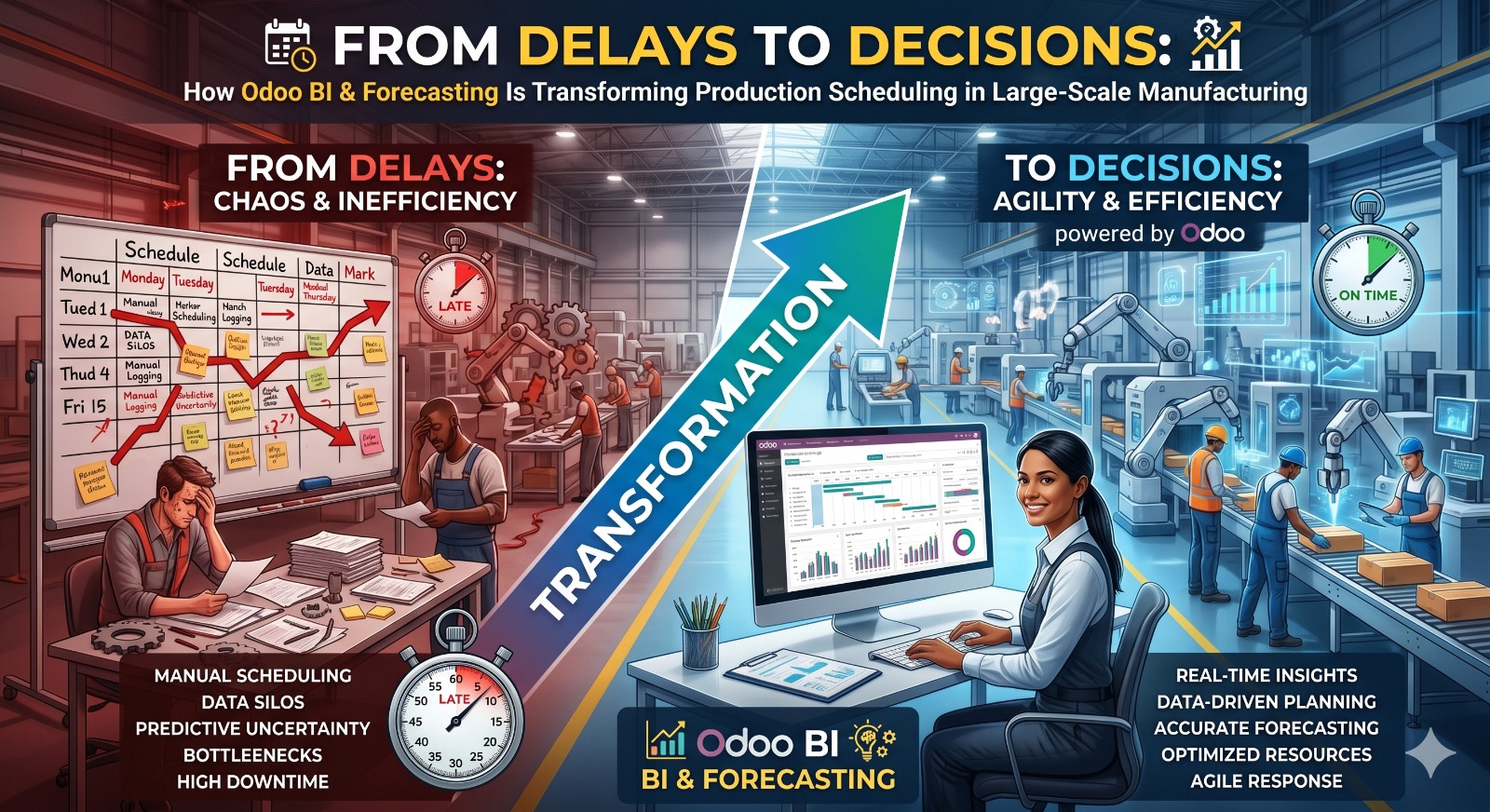
In large-scale manufacturing, production scheduling is not just an operational task—it is the backbone of efficiency, cost control, and customer satisfaction. Yet, many operations leaders still rely on static planning tools, spreadsheets, or disconnected systems that fail to reflect real-time conditions on the shop floor. The result is predictable: delays, overproduction, idle resources, and missed delivery timelines. In a market where margins are tight and demand is volatile, these inefficiencies are no longer acceptable. This is where platforms like Odoo are redefining how production is planned and executed, using business intelligence (BI) and forecasting to turn uncertainty into actionable insights.
The Core Problem: Reactive Scheduling in a Dynamic Environment
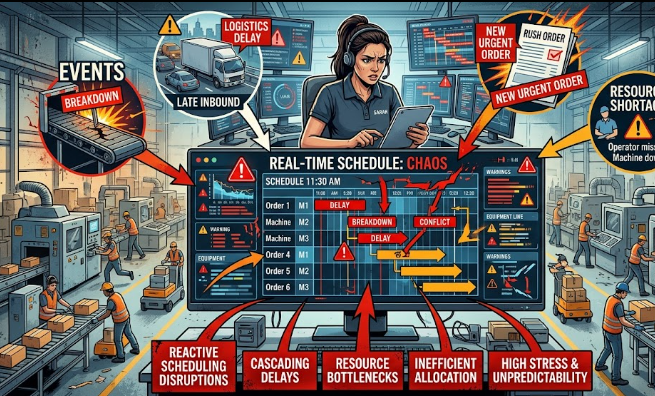
Traditional production scheduling often operates on assumptions rather than live data. Planners create schedules based on historical trends, fixed capacity, and estimated demand. However, real-world variables—machine breakdowns, supply chain disruptions, labor shortages, or sudden demand spikes—quickly make these plans obsolete.
This reactive approach forces teams into constant firefighting. Instead of optimizing production, they spend time adjusting schedules, reallocating resources, and managing delays. The lack of visibility across departments—procurement, inventory, sales, and production—further complicates decision-making.
The Shift: From Static Planning to Intelligent Forecasting
Modern manufacturing demands a shift from static scheduling to intelligent, data-driven planning. Odoo integrates BI and forecasting capabilities directly into its manufacturing module, enabling operations leaders to make decisions based on real-time data rather than assumptions.
With Odoo, forecasting is not a separate activity—it is embedded within the workflow. Sales forecasts, inventory levels, and production capacity are continuously analyzed to generate dynamic production schedules. This ensures that planning is always aligned with current business conditions.
Real-Time Visibility: The Foundation of Smart Scheduling
One of the most significant advantages of Odoo’s BI capabilities is real-time visibility. Operations leaders can access live dashboards that provide insights into key metrics such as production output, machine utilization, order status, and inventory levels.
This visibility eliminates guesswork. For example, if a critical component is running low, the system can immediately flag the issue and adjust production schedules accordingly. Similarly, if demand for a product increases, planners can quickly scale production without disrupting other operations.
Forecasting Demand: Aligning Production with Market Needs
Accurate demand forecasting is essential for efficient production scheduling. Overestimating demand leads to excess inventory and increased holding costs, while underestimating demand results in stockouts and lost sales.
Odoo uses historical sales data, seasonal trends, and real-time inputs to generate reliable forecasts. These forecasts are then directly linked to production planning, ensuring that manufacturing output aligns with actual market demand.
For operations leaders, this means fewer surprises and more control. Instead of reacting to demand fluctuations, they can anticipate changes and adjust production proactively.
Automation in Scheduling: Reducing Manual Intervention
Manual scheduling is not only time-consuming but also prone to errors. In complex manufacturing environments, even a small mistake can disrupt the entire production cycle.
Odoo automates key aspects of production scheduling, including:
- Work order generation based on demand forecasts
- Resource allocation based on availability and capacity
- Dependency management between production stages
This automation reduces the burden on planners and ensures consistency in execution. More importantly, it allows teams to focus on strategic decisions rather than routine tasks.
Case Study: Improving Throughput in a Multi-Plant Manufacturing Setup
Consider a large manufacturing company operating multiple plants across different regions. Each plant produces interdependent components, making coordination critical. Previously, the company relied on separate systems for sales, inventory, and production planning.
The challenges were evident:
- Frequent production delays due to lack of coordination
- Excess inventory in some plants and shortages in others
- Limited visibility into overall operations
After implementing Odoo with BI and forecasting capabilities, the company experienced a significant transformation:
- Production schedules became dynamic and responsive to real-time data
- Inventory levels were optimized across all plants
- On-time delivery rates improved substantially
- Overall throughput increased without additional resources
This case highlights how integrated systems can eliminate inefficiencies and unlock hidden capacity within existing operations.
Data-Driven Decision Making: Empowering Operations Leaders
One of the key benefits of Odoo’s BI tools is the ability to turn data into actionable insights. Operations leaders can analyze trends, identify bottlenecks, and evaluate performance across different dimensions.
For example:
- Identifying underutilized machines and reallocating workloads
- Analyzing production delays to improve process efficiency
- Monitoring supplier performance to reduce lead times
These insights enable leaders to make informed decisions that drive continuous improvement.
Scalability: Supporting Growth Without Complexity
As manufacturing operations grow, complexity increases. Managing multiple product lines, plants, and supply chains requires a system that can scale without adding unnecessary complexity.
Odoo’s modular architecture allows businesses to expand their capabilities as needed. Whether it’s adding advanced analytics, integrating new production units, or managing global operations, the platform adapts to evolving requirements.
This scalability ensures that the system remains relevant as the business grows, eliminating the need for frequent system upgrades or replacements.
The Strategic Advantage: From Operations to Optimization
The real value of Odoo BI and forecasting lies in its ability to transform production scheduling from an operational task into a strategic function. Aligning production with demand, optimizing resource utilization, and providing real-time insights, it enables businesses to operate at peak efficiency.
For operations leaders, this shift is critical. Instead of managing day-to-day challenges, they can focus on long-term goals such as cost reduction, process optimization, and capacity expansion.
Conclusion: Building a Smarter Production Future
In large-scale manufacturing, the difference between success and struggle often comes down to how effectively production is planned and executed. Traditional methods, with their reliance on static data and manual processes, are no longer sufficient in a dynamic business environment.
Odoo BI and forecasting offer a smarter approach—one that combines real-time data, automation, and predictive insights to create efficient, responsive production schedules.
For operations leaders, the message is clear: the future of manufacturing is not just about producing more—it’s about producing smarter.




Post Comment