
Table of Contents
When Systems Don’t Talk, Businesses Slow Down
Most businesses don’t struggle because of a lack of effort—they struggle because their systems don’t work together. Sales teams track leads in one tool, finance manages invoices in another, and inventory sits in a completely separate system. On paper, everything looks fine. In reality, it creates delays, confusion, and missed opportunities.
As companies grow, this fragmentation becomes harder to manage. Teams spend more time coordinating than executing. Data becomes inconsistent. Decisions take longer. This is exactly where an integrated platform like Zoho changes the game.
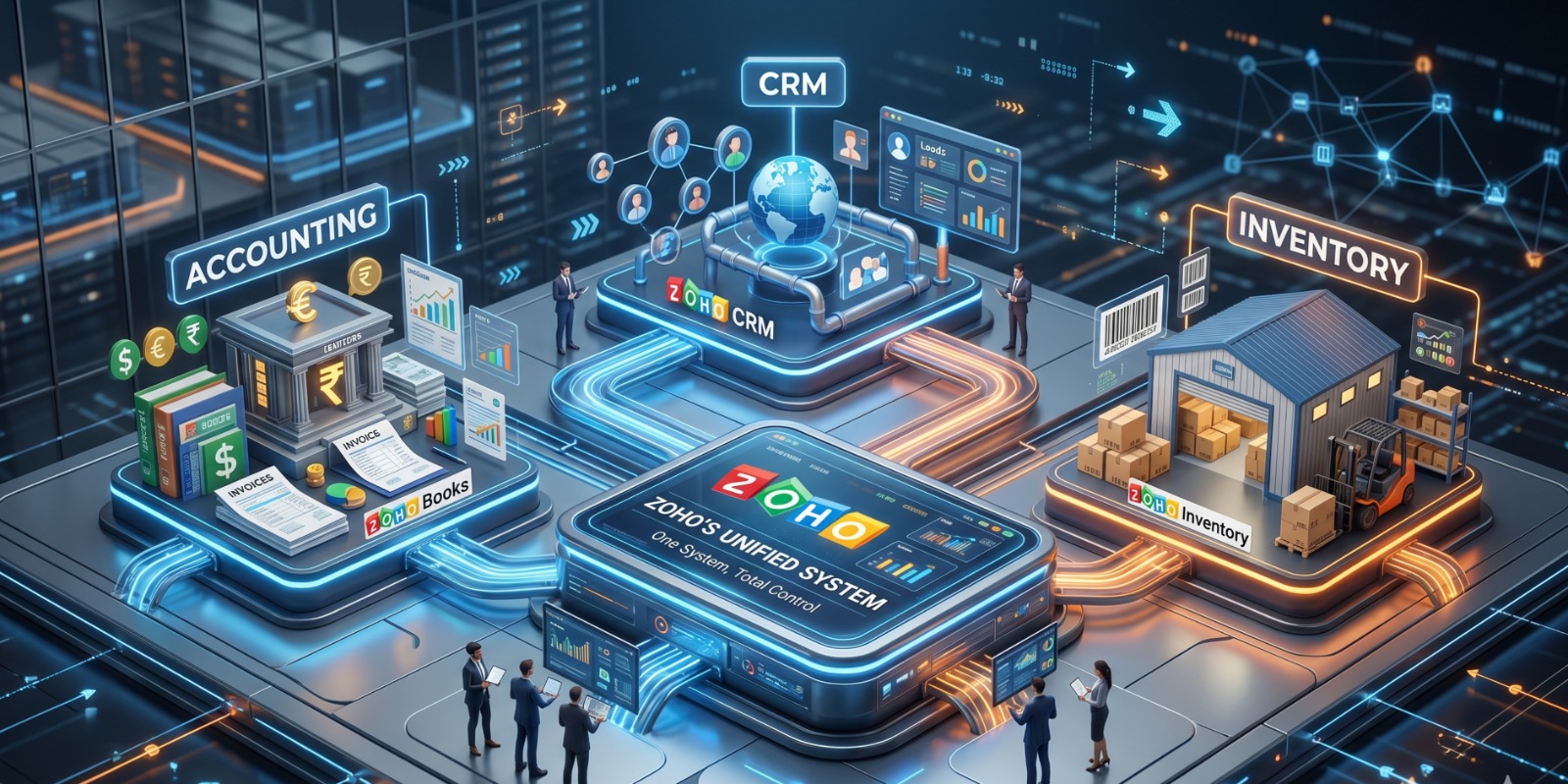
Instead of managing multiple disconnected tools, Zoho offers a unified ecosystem where accounting, CRM, and inventory work as one. The result is not just efficiency—it’s clarity, speed, and better control over the business.
The Real Problem: Disconnected Operations
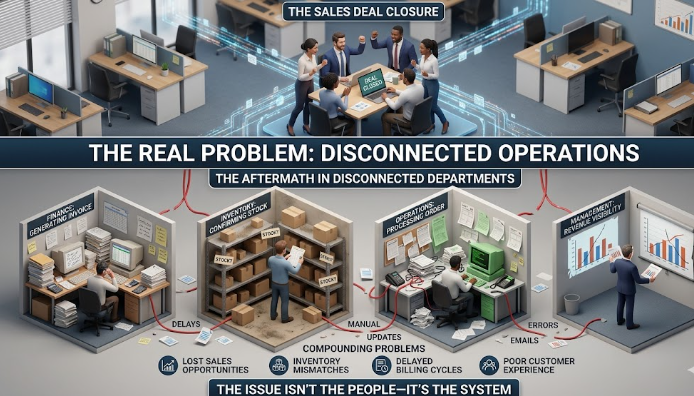
Let’s consider a simple scenario.
A sales team closes a deal. Now what happens?
- The finance team needs to generate an invoice
- Inventory must confirm stock availability
- Operations need to process the order
- Management wants visibility into revenue
In a disconnected system, each step requires manual updates, emails, or spreadsheet entries. This leads to delays, errors, and often miscommunication.
Over time, these small inefficiencies compound into bigger problems:
- Lost sales opportunities
- Inventory mismatches
- Delayed billing cycles
- Poor customer experience
The issue isn’t the people—it’s the system.
Zoho’s Ecosystem: Connecting the Dots
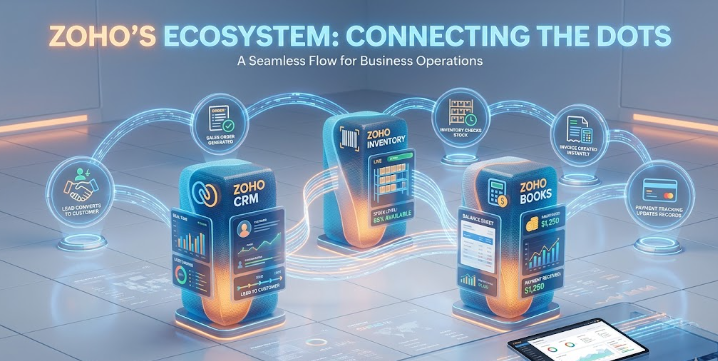
Zoho approaches this problem differently. Instead of offering standalone tools, it builds a connected ecosystem where each function flows into the next.
At the core of this integration are three critical components:
- Zoho CRM
- Zoho Books
- Zoho Inventory
When these tools are connected, business operations become seamless.
For example:
- A lead converts into a customer in CRM
- A sales order is generated automatically
- Inventory checks stock availability in real time
- An invoice is created instantly in accounting
- Payment tracking updates financial records
Everything happens in one flow, without duplication or manual effort.
Accounting That Reflects Real Operations
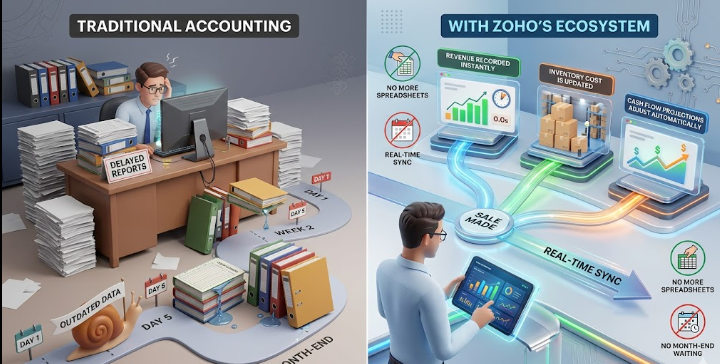
In traditional setups, accounting is often delayed. Data is entered after transactions occur, which means reports are always slightly outdated.
With Zoho’s ecosystem, accounting reflects real-time business activity.
When a sale is made:
- Revenue is recorded instantly
- Inventory cost is updated
- Cash flow projections adjust automatically
This gives finance teams accurate, up-to-date information without waiting for month-end processes.
It also reduces dependency on spreadsheets and manual reconciliation.
CRM That Drives Revenue, Not Just Records Data
Many businesses use CRM systems only to store customer data. But CRM should do more than that—it should drive revenue.
With Zoho CRM integrated into the ecosystem:
- Sales teams can track every interaction
- Follow-ups can be automated
- Deal stages are clearly visible
- Forecasting becomes more reliable
More importantly, CRM data flows directly into inventory and accounting. This means sales decisions are backed by real availability and financial impact.
Inventory That Works in Real Time
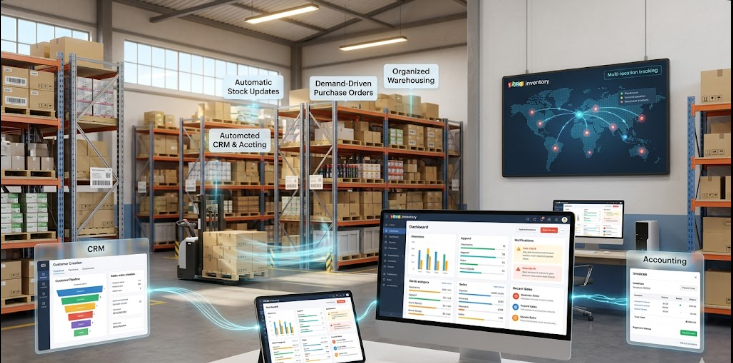
Inventory management is often one of the most challenging areas for growing businesses. Stockouts, overstocking, and mismatched data can directly affect profitability.
With Zoho Inventory:
- Stock levels update automatically with every sale
- Purchase orders can be triggered based on demand
- Warehouse operations become more organized
- Multi-location tracking becomes possible
When inventory is connected with CRM and accounting, businesses gain complete visibility—from demand generation to delivery and payment.
Case Study: Trading Business Improves Coordination
A mid-sized trading company operating across multiple cities was facing constant issues with coordination.
Challenges included:
- Sales team promising products that were out of stock
- Finance team struggling with delayed invoices
- Inventory discrepancies across warehouses
- Lack of a unified performance view
After implementing Zoho’s integrated ecosystem:
Within Three Months:
- Sales and inventory alignment improved significantly
- Invoice generation became instant
- Stock visibility became real-time across locations
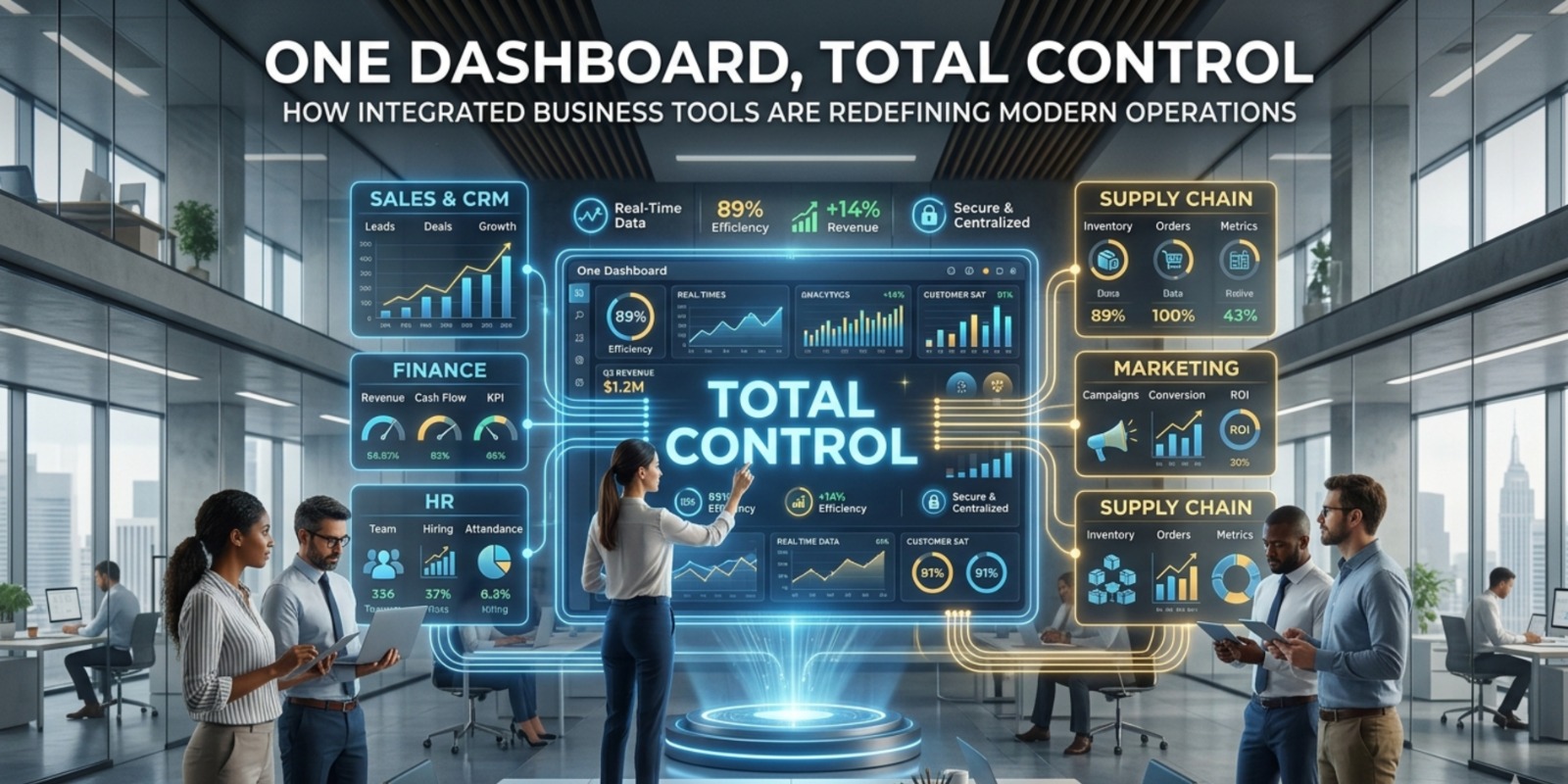
- Management gained a centralized dashboard
The company saw faster order processing, fewer errors, and improved customer satisfaction.
What changed was not just software—it was the way teams worked together.
Better Decisions Through Unified Data
One of the biggest advantages of an integrated ecosystem is better decision-making.
When data is scattered, leaders rely on assumptions. When data is unified, they rely on facts.
With Zoho:
- Revenue trends are visible instantly
- Inventory turnover can be tracked easily
- Customer behavior insights become actionable
- Financial health is always clear
This allows businesses to respond faster to market changes and make confident decisions.
Scalability Without Complexity
As businesses grow, systems must evolve. Many companies face a painful transition when moving from small tools to large enterprise systems.
Zoho avoids this problem by offering a modular approach.
Businesses can:
- Start with CRM or accounting
- Add inventory when needed
- Expand into HR, projects, or analytics later
This flexibility allows companies to scale without disrupting operations.
The Human Impact: Less Stress, More Productivity
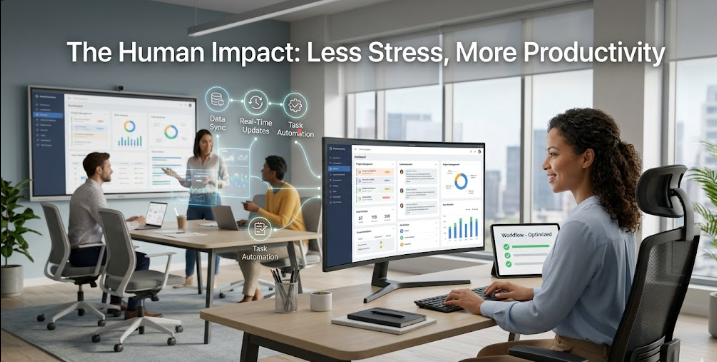
Technology should simplify work, not complicate it.
When systems are integrated:
- Teams spend less time switching between tools
- Manual errors reduce
- Communication improves
- Workflows become smoother
Employees can focus on meaningful tasks instead of administrative work.
This leads to higher productivity and better job satisfaction.
Signs Your Business Needs Integration
You may need an integrated system if:
- Sales and inventory data don’t match
- Invoices are delayed or manually created
- Reports take too long to prepare
- Teams rely heavily on spreadsheets
- Customer experience is inconsistent
- Growth is creating operational confusion
These are clear indicators that disconnected systems are limiting your business.
Conclusion: Simplicity Drives Growth
Managing a business should not feel like managing multiple systems.
The real advantage of Zoho’s ecosystem lies in its simplicity. By connecting accounting, CRM, and inventory into one platform, it removes friction and creates a smoother flow of operations.
Businesses no longer need to chase data, fix errors, or coordinate across disconnected tools. Everything works together, giving teams the clarity and control they need.
In today’s fast-moving environment, the companies that succeed are not just the ones that work hard—they are the ones that work smart.
And that starts with systems that are built to grow with you.



Post Comment