


Table of Contents
Growth Is Easy Until Operations Become Complicated
Every business dreams about growth. More customers, more employees, more branches, and more revenue are signs of success. But growth also introduces a hidden challenge that many startups and enterprises underestimate—operational complexity.
What starts as a small team using spreadsheets and disconnected tools quickly becomes difficult to manage. Sales teams lose visibility, finance struggles with reports, approvals become slow, and leadership spends more time chasing updates than making strategic decisions.
This is why businesses across industries are moving toward simpler and more connected cloud ecosystems like Zoho. The shift is not just about software modernization. It is about building a business that can grow without operational chaos.
Today, both startups and large enterprises are discovering the same truth: simplicity scales better than complexity.
The Problem with Traditional Business Systems
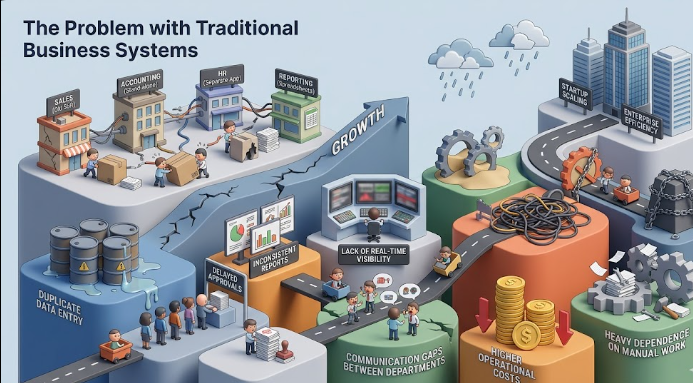
Many companies still rely on outdated software or disconnected applications for daily operations. One tool manages sales, another handles accounting, HR works separately, and reporting often depends on spreadsheets.
At first, this may seem manageable. But as businesses expand, these disconnected systems create friction.
Common challenges include:
- Duplicate data entry
- Delayed approvals
- Inconsistent reports
- Lack of real-time visibility
- Communication gaps between departments
- Higher operational costs
- Heavy dependence on manual work
Instead of helping growth, these systems begin slowing the organization down.
For startups, this creates confusion during scaling. For enterprises, it reduces efficiency and visibility across departments.
Why Cloud Simplicity Is Becoming Essential
Modern businesses no longer want complicated systems that require large infrastructure, expensive maintenance, or months of deployment.
They want solutions that are:
- Fast to implement
- Easy to use
- Accessible from anywhere
- Scalable over time
- Flexible enough to adapt with business needs
This is where cloud-based platforms like Zoho are changing the business landscape.
Cloud simplicity means teams can work from one connected environment instead of juggling multiple disconnected systems. It reduces operational friction while improving speed and collaboration.
More importantly, it allows leadership to focus on business growth instead of system management.
Why Startups Prefer Zoho
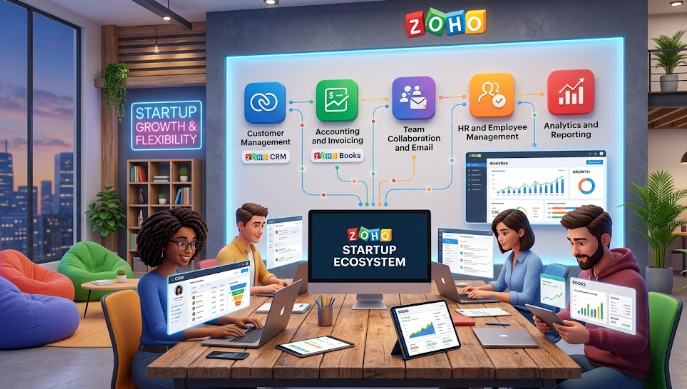
Startups operate in high-pressure environments where speed and efficiency matter the most. They need systems that support growth without consuming large budgets.
This is one reason why many startups choose Zoho early in their journey.
Instead of purchasing multiple expensive tools, startups can use an integrated ecosystem that covers:
- Customer management with Zoho CRM
- Accounting and invoicing with Zoho Books
- Team collaboration and email
- HR and employee management
- Analytics and reporting
This creates structure from the beginning, helping startups grow with better organization and visibility.
The biggest advantage is flexibility. Startups can begin with only the tools they need and expand gradually as operations become more complex.
Why Enterprises Are Also Moving Toward Simpler Platforms
While startups value affordability and speed, enterprises focus more on visibility, governance, scalability, and operational control.
Large organizations often struggle with legacy systems that:
- Require expensive upgrades
- Create department silos
- Lack integration flexibility
- Slow down decision-making
Enterprises are increasingly realizing that complexity does not always equal capability.
Platforms like Zoho provide enterprise-level functionality while maintaining usability and flexibility. Teams can automate workflows, centralize reporting, and improve collaboration without overcomplicating operations.
This balance between simplicity and scalability is what makes cloud-based ecosystems attractive to larger organizations.
Real Business Impact: A Growing Retail Company Case Study
A retail company operating across multiple locations in the UAE faced operational challenges during expansion.
The business was using:
- Separate accounting software
- Spreadsheet-based inventory tracking
- Manual approval processes
- Independent reporting systems across branches
As the company expanded, management struggled with:
- Delayed sales reports
- Stock mismatches
- Poor communication between branches
- Lack of centralized visibility
After implementing a connected Zoho ecosystem, the business experienced major improvements.
Within the First Few Months:
- Branch reporting became centralized
- Leadership gained real-time dashboards
- Inventory visibility improved significantly
- Approval workflows became faster
- Teams reduced manual reporting effort
The company did not simply digitize operations. It created a scalable structure for future growth.
The Human Side of Better Systems
Technology decisions are often discussed only from a cost or productivity perspective. But one of the biggest advantages of simpler systems is employee experience.
Complicated workflows frustrate teams. Constant manual tasks create burnout. Slow approvals reduce productivity.
When businesses implement connected cloud systems:
- Employees spend less time on repetitive work
- Managers access information faster
- Collaboration improves naturally
- Teams work with more confidence
A simpler operational environment often leads to happier and more productive teams.
Why Cloud Flexibility Matters in UAE and Africa

Businesses across the UAE and Africa are growing rapidly, but they also face unique operational challenges.
These include:
- Multi-location operations
- Mobile workforces
- Cost sensitivity
- Rapid digital transformation
- Cross-border expansion
Cloud-based platforms fit these environments well because they provide:
- Remote accessibility
- Lower infrastructure dependency
- Faster deployment
- Better scalability
- Easier collaboration across regions
This is one reason why cloud adoption is accelerating across these markets.
Signs Your Business Has Outgrown Its Current Systems
Many businesses delay upgrading until problems become severe.
You may need a more connected system if:
- Teams rely heavily on spreadsheets
- Reports take too long to prepare
- Departments use disconnected tools
- Managers lack operational visibility
- Employees complain about manual work
- Growth feels operationally messy
These are not small issues. They are indicators that the business needs stronger operational foundations.
Simplicity Is Becoming a Competitive Advantage
The future of business operations is not about having the most complicated software. It is about having systems that teams actually use effectively.
Simple, connected systems help businesses:
- Move faster
- Make better decisions
- Improve customer experience
- Scale more confidently
- Reduce operational stress
Companies that simplify operations often outperform those trapped in fragmented workflows.
Conclusion: Growth Needs Systems That Scale With You
Growth is exciting, but unmanaged growth creates confusion.
Businesses today need systems that can evolve with them—systems that simplify operations instead of complicating them further.
That is why startups and enterprises alike are choosing Zoho.
Not because it is trendy.
Not because it is complex.
But because it helps businesses organize growth, improve visibility, and build stronger operational foundations.
In the modern business environment, cloud simplicity is no longer just a convenience.
It is a strategic advantage.




Post Comment