

Table of Contents
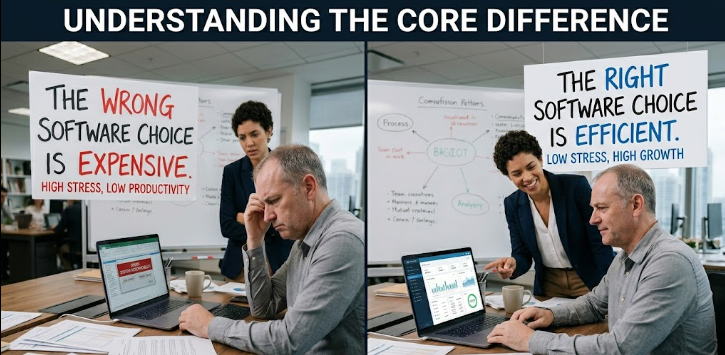
The Wrong Software Choice Is Expensive

Choosing business software is no longer a simple IT decision. It affects how teams sell, manage customers, process accounts, run operations, track inventory, and scale growth. When companies choose the wrong platform, the cost is not just financial. It appears in slow workflows, frustrated employees, duplicate data, and missed opportunities.
Two names often come into the conversation: Zoho and Odoo.
Both are respected platforms. Both offer broad business functionality. Both can help companies modernize operations. Yet they are built with different strengths, and the smartest decision is not asking which one is better. The real question is: Which one fits your business model, growth stage, and operational complexity?
The right software should feel like a growth engine, not a daily struggle.
Understanding the Core Difference
At a high level, Zoho is often chosen for its ease of use, connected cloud apps, and strong front-office capabilities such as CRM, finance, collaboration, and workflow tools.
Odoo is widely known for its ERP depth, modular flexibility, and stronger alignment for businesses needing integrated operations such as inventory, manufacturing, warehousing, procurement, and advanced process control.
In simple terms:
- Zoho often feels like a smart business operating system.
- Odoo often feels like a customizable operations engine.
That distinction matters when evaluating long-term fit.
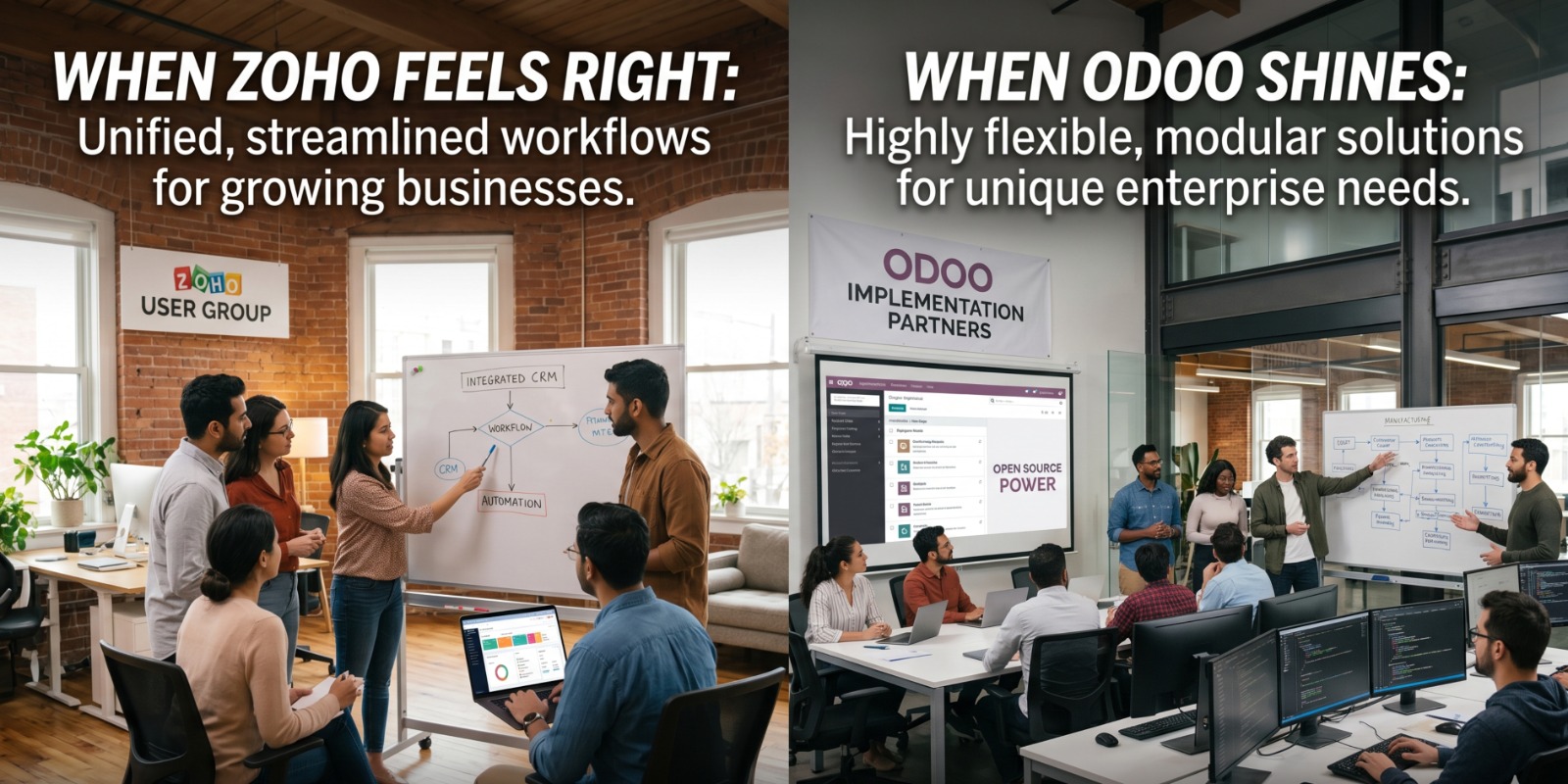
When Zoho Feels Right
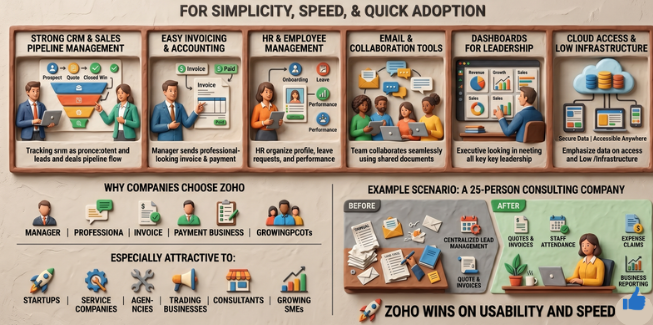
Many businesses want simplicity, speed, and quick adoption. They need systems that teams can start using without months of disruption.
This is where Zoho often feels right.
Companies commonly choose Zoho when they need:
- Strong CRM and sales pipeline management
- Easy invoicing and accounting
- HR and employee management
- Email and collaboration tools
- Dashboards for leadership
- Cloud access with low infrastructure burden
Zoho is especially attractive to startups, service companies, agencies, consultants, trading businesses, and growing SMEs that need structure without enterprise complexity.
Example Scenario
A 25-person consulting company manages leads manually, invoices through spreadsheets, and approvals over email.
By moving to Zoho, they can centralize:
- Lead management
- Quotes and invoices
- Staff attendance
- Expense claims
- Business reporting
The shift is fast, practical, and easy for non-technical teams.
That is where Zoho often wins: usability and speed.
When Odoo Shines
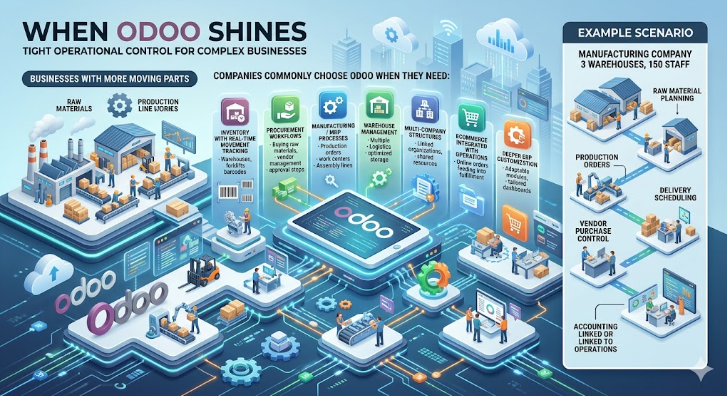
Some businesses operate with more moving parts.
They manage stock across warehouses. They buy raw materials. They run production lines. They handle purchase planning, quality checks, dispatch, returns, and fulfillment.
These businesses need tighter operational control.
This is where Odoo often shines.
Companies commonly choose Odoo when they need:
- Inventory with real-time movement tracking
- Procurement workflows
- Manufacturing / MRP processes
- Warehouse management
- Multi-company structures
- eCommerce integrated with operations
- Deeper ERP customization
Example Scenario
A manufacturing company with 3 warehouses and 150 staff needs:
- Raw material planning
- Production orders
- Delivery scheduling
- Vendor purchase control
- Accounting linked to operations
Odoo is often a stronger fit because the business depends heavily on operational coordination.
That is where Odoo stands out: process depth and operational visibility.
Comparing Real Business Priorities
| Priority | Zoho Often Stronger | Odoo Often Stronger |
|---|---|---|
| CRM & Sales Automation | ✔ | ✔ |
| Ease of Adoption | ✔ | |
| Service Business Operations | ✔ | |
| Finance + Office Productivity | ✔ | |
| Inventory Complexity | ✔ | |
| Manufacturing / MRP | ✔ | |
| ERP Customization | ✔ | |
| Fast Cloud Deployment | ✔ | ✔ |
| Operational Process Control | ✔ |
Neither platform is universally better. Fit depends on priorities.
Case Study 1: Growing Startup Chooses Zoho
A SaaS startup grew from 8 to 40 employees in one year.
Their pain points:
- No lead tracking discipline
- Delayed invoicing
- Weak reporting
- Hiring admin chaos
They adopted Zoho tools for CRM, Books, People, and Analytics.
Result:
- Sales pipeline visibility improved
- Invoice cycle accelerated
- HR requests became structured
- Founders gained weekly dashboards
For them, Zoho matched the need for speed and simplicity.
Case Study 2: Distributor Chooses Odoo
A wholesale distributor selling across UAE and Africa had rapid order growth but struggled with:
- Inventory mismatch
- Manual procurement planning
- Delayed dispatch
- Separate finance and stock systems
They implemented Odoo for inventory, purchase, accounting, and sales.
Result:
- Better stock accuracy
- Faster purchase planning
- Improved dispatch control
- Unified operations reporting
For them, Odoo solved operational fragmentation.
Mistakes Businesses Make During Selection
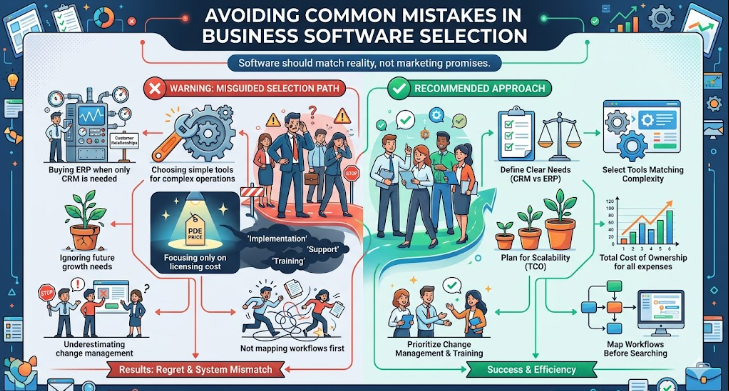
Many companies choose software based on price alone or because a competitor uses it.
That often leads to regret.
Common mistakes include:
- Buying ERP when only CRM is needed
- Choosing simple tools for complex operations
- Ignoring future growth needs
- Focusing only on licensing cost
- Underestimating change management
- Not mapping workflows first
Software should match reality, not marketing promises.
Questions to Ask Before Choosing
Before selecting Zoho or Odoo, leadership should ask:
- Are we operationally complex or commercially disorganized?
- Do we need stronger sales systems or deeper backend control?
- Is inventory central to revenue?
- Will users adopt a more advanced system easily?
- Do we need quick wins or long-term operational redesign?
- How much customization is realistic?
The clearer these answers are, the easier the decision becomes.
A Strategic View: It’s About Timing Too
Sometimes Zoho is the right choice now, and Odoo becomes the right choice later.
Sometimes Odoo is necessary immediately because operations are already complex.
Software selection is not only about company size—it is about business maturity and process demands.
A 15-person manufacturer may need Odoo sooner than a 100-person consulting firm.
That nuance is where smart decisions happen.
Final Thoughts: Choose the System That Matches How You Grow
The best platform is the one that supports how your business actually works.
If your company needs cleaner sales, finance, HR, and faster adoption, Zoho may feel right.
If your company needs stronger inventory control, production coordination, procurement discipline, and ERP flexibility, Odoo may shine.
The smartest businesses do not chase software trends.
They choose systems that remove friction, strengthen execution, and grow with confidence.
Because finding your perfect fit is not about software.
It is about building a better business.






Post Comment